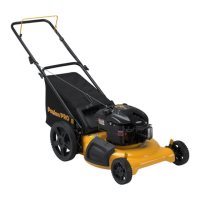
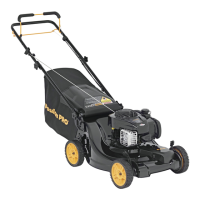
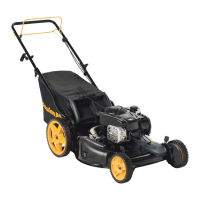
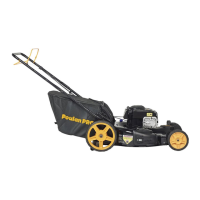
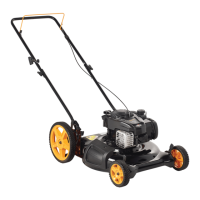
This document is an operator's manual for a Poulan PRO PR625AWD lawn mower, a pedestrian-controlled lawn mower designed for cutting grass.
Function Description
The Poulan PRO PR625AWD is a lawn mower primarily designed for cutting lawns. It features an internal combustion engine that powers the cutting blade and, in self-propelled models, the drive system. The engine brake handle is a key safety feature, designed to stop the engine and disengage the drive when released, minimizing the risk of blade contact injury. The machine can operate in different modes: mulching, rear bagging, and rear-side discharging, offering versatility for grass clipping management.
In mulching mode, the mower recuts grass clippings multiple times, reducing them in size so they disperse into the lawn, providing natural nutrients. For rear bagging, clippings are collected in a grass catcher, which can be easily attached and removed. Rear-side discharging allows the machine to expel cut material to the left side while mowing.
The cutting height is adjustable, offering nine different positions (1-9) to suit various lawn requirements, with a medium position recommended for most lawns. The drive system, when equipped, allows for self-propelling, controlled by a drive bail that adjusts speed based on how far it is pulled towards the handle.
Usage Features
Before operation, users must ensure the cutting equipment is correctly fitted and adjusted, and the engine is filled with fuel and oil. The manual emphasizes reading and understanding all instructions to prevent serious injury or death.
Starting and Stopping:
To start, the engine brake handle must be held against the handlebar. For manual start, the starter handle is gripped and pulled quickly, ensuring the starter rope does not snap back. To stop, the engine brake handle is simply released. For self-propelled models, forward motion stops when either the brake handle or the drive bail is released. To continue mowing without self-propelling, only the drive bail should be released while holding the brake handle down.
Operating Environment:
The mower should be used in daylight or good artificial light. It is crucial to clear the mowing area of objects like rocks, toys, wire, bones, and sticks that could be picked up and thrown by the blade. Users must stay behind the handle when the engine is running and ensure the area is clear of other people before mowing. The machine should be stopped if anyone enters the area.
Slope Operation:
Slopes require extra caution. The manual advises mowing across the face of slopes, never up and down, and avoiding excessively steep slopes (greater than 15 degrees). Obstacles like holes, ruts, bumps, and hidden objects should be removed or watched out for, as uneven terrain can cause slips and falls. Wet grass should not be mowed due to slipperiness.
Fuel Handling:
Extreme care is required when handling gasoline, as it is highly flammable. Refueling should only occur after the engine has cooled down, never indoors, and away from open flames or sparks. Only fresh, clean, regular unleaded gasoline with a minimum of 87 octane should be used, and it should not be mixed with oil. Fuel stabilizer is an acceptable alternative for long-term storage to prevent fuel system damage.
Storage and Transport:
For transport, the equipment should be secured to prevent damage. For storage, the machine and fuel should be kept in a dry, frost-proof, and lockable area, out of reach of children. The fuel tank should be emptied for long-term storage, and the machine should be cleaned and lubricated. The handle assembly can be folded to minimize space for transport and storage.
Maintenance Features
Regular maintenance is crucial for the machine's lifespan and safe operation. The manual provides a maintenance schedule outlining daily, every 10 hours, every 25 hours, and every 100 hours/before storage tasks.
General Maintenance:
Before any checks or maintenance, the engine must be switched off, and the spark plug wire disconnected to prevent unintentional starting. Users should regularly check that nuts and screws are tight and replace any damaged, worn, or broken parts with genuine accessories.
Cleaning:
The lawn mower should be brushed free of leaves and grass. The top of the engine, around the starter, should be kept clean to ensure proper airflow and extend engine life. The underside of the mower housing should be scraped to remove grass and trash buildup. A water washout port (if equipped) allows for quick cleaning of the underside by connecting a garden hose, but the drive system should not be engaged during this process. The engine should not be flushed with water directly, and the electrical system, muffler, air filter, and carburetor should be covered if using a garden hose to clean the exterior.
Lubrication:
The unit should be kept well lubricated. High-quality detergent oil rated API SG-SL should be used. The engine oil level must be checked before each use and after every five hours of continuous use. The oil should be changed after every 25 hours of operation or at least once a year, and more often under dusty conditions. Plastic wheel bearings should not be oiled or greased; instead, a dry powdered graphite lubricant should be used sparingly if lubrication is necessary.
Engine Components:
The spark plug should be replaced at the beginning of each mowing season or after every 100 hours of operation. The air filter cartridge should be replaced every 100 hours or every season, or more often in dusty conditions. The muffler should be regularly checked for completeness and secure attachment, and replaced if corroded or damaged.
Blade Maintenance:
The blade should be checked for cracks or damage and replaced if necessary. It must be well-ground and correctly balanced. Sharpening and balancing should ideally be conducted by an authorized service workshop. When replacing the blade, only manufacturer-approved replacement blades should be used. A wood block should be used to prevent the blade from turning when removing or tightening the blade bolt.
Drive Belt:
For models with a drive belt, the fuel tank should be emptied, and the spark plug disconnected before accessing movable parts. The lawn mower should be turned on its side with the air filter and carburetor facing upward to remove the drive cover and replace the belt. Only genuine parts should be used for replacement.
Grass Catcher:
The grass catcher's pores can become filled with dirt and dust, reducing its collection efficiency. It should be regularly hosed off with water and allowed to dry. The grass catcher should also be frequently checked for wear or deterioration and replaced as needed.
Troubleshooting:
A troubleshooting schedule is provided to help identify and resolve common issues such as the machine not starting, less power, uneven mowing, excessive vibrations, hard-to-pull starter rope, grass catcher not filling, difficult-to-push machine, and slow drive. For issues requiring more extensive work, an authorized service workshop should be contacted.


 To Next Page
 General