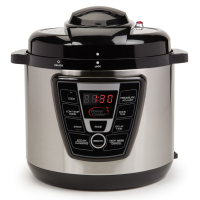
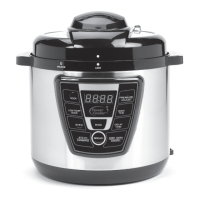
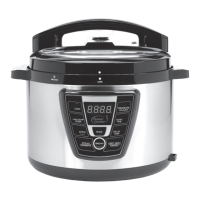
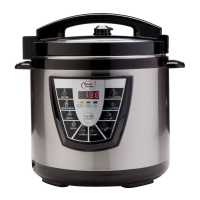
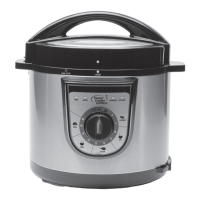
The device is a digital pressure cooker, available in 6-quart (PC-WAL2) and 8-quart (PC-WAL3) models. It is designed for household use and offers various cooking modes and safety features.
Function Description:
The Power Cooker is a versatile kitchen appliance that utilizes digital pressure cooking to prepare a wide range of foods. It offers several cooking modes, including:
- Cook: A general pressure cooking mode with a default time of 15 minutes and a pressure of 70 kPa, adjustable from 1 to 30 minutes.
- Low Temp Cook: Designed for longer cooking durations, with a default of 6 hours, adjustable from 1 to 12 hours.
- Stew: For stewing, with a default time of 30 minutes and a pressure of 70 kPa, adjustable from 1 to 50 minutes.
- Steam Canning: For steaming and canning, with a default time of 10 minutes and a pressure of 80 kPa, adjustable from 1 to 120 minutes.
- Rice: Specifically for cooking rice, with a default time of 10 minutes and a pressure of 70 kPa, adjustable from 1 to 30 minutes.
- Brown: Allows searing or browning food in the inner pot before pressure cooking, with a default time of 20 minutes, adjustable from 1 to 20 minutes.
- Pressure Adjust: Offers customizable pressure settings from 20 kPa to 80 kPa in 10 kPa intervals, each with a default cook time that can be further adjusted.
- Delay Time: Allows users to set a delayed start for cooking, from 30 minutes to 24 hours in 30-minute increments.
- Keep Warm Mode: Automatically activates at the completion of a cooking cycle to keep food warm indefinitely. However, foods kept in this mode for over 4 hours may lose flavor and texture. This mode can also be manually cancelled.
The digital display provides a wide range of choices and indicates the cooking status. When plugged in, it shows "0000". When a cooking process is selected, the default time blinks, and then rotating double zeros appear, signifying that pressure is building. Once pressure is built, the zeros stop rotating, and the countdown begins. Upon completion, the unit beeps, the display goes blank, and it enters "KEEP WARM MODE".
Important Technical Specifications:
- Model Numbers: PC-WAL2 (6-quart) and PC-WAL3 (8-quart).
- Supply Power: AC 120V 60HZ.
- Rated Power: 1000W (6-quart) and 1300W (8-quart).
- Capacity of Inner Pot: 6QT and 8QT, respectively.
- Working Pressure: 0-70 kPa.
- Safety Working Pressure: 80-90 kPa.
- Pressure Measurement: kPa (kilopascals) is used, with approximately 7kPa equivalent to 1PSI.
- Temperature Range: Digital Pressure Cooking utilizes temperatures up to 248° F (120° C).
Usage Features:
- Digital Display (1): Shows cooking time and status.
- Control Panel (B): Houses all the function buttons.
- Inner Pot (D): The removable cooking container with a "MAX FILL LINE" that should not be exceeded, especially for expanding foods like rice or beans.
- Lid (E) with Lid Handle (F): Equipped with a safety lock mechanism.
- Pressure Release Valve (I) and Rapid Release Button (K): Used to release pressure quickly and completely. The Rapid Release Button should be slid forward in short bursts initially, then held in the full forward position until all pressure escapes.
- Floating Valve (J): A safety indicator that drops when pressure is released.
- Red Pressure Indicator (Q): On the lid, indicates when the unit is pressurized. Do not touch or press this indicator directly.
- Magnetic Sensor for Lid (S): Ensures the lid is properly closed for pressurization. If not closed correctly, a beeping noise and "LID" message will appear on the display.
- Cook Time Button (9): Allows adjustment of default cooking times.
- Delay Time Button (10): For setting delayed cooking starts.
- Keep Warm/Cancel Button (11): Stops cooking cycles or cancels the "KEEP WARM" operation. Also resets the unit to "KEEP WARM MODE" when in neutral (0000 on LED) mode.
- Steamer Tray (M): For steaming vegetables and other foods.
- Condensation Collector (N): Aligns with grooves on the back of the cooker to capture moisture.
- Measuring Cup (O) and Ladle (P): Included accessories.
Built-in Safety Features:
- Lid Safety Lock: Prevents opening when pressurized.
- Pressure/Temperature Sensor Controls: Automatically activate/deactivate power to maintain even heat and pressure.
- Back-Up Safety Release Valve: Releases built-up pressure if the primary sensor malfunctions.
- Clog Resistant Feature: Prevents food from blocking the steam release port.
- Spring-Loaded Safety Pressure Release: A device beneath the heating element that automatically lowers the inner pot, causing it to separate from the rubber gasket to release steam and pressure if other safety features fail.
- Temperature Cut-Off Device: Cuts off power supply if internal temperature rises beyond safe limits and does not automatically reset.
- Red Pressure Indicator on Lid: Visually indicates pressurization.
- Magnetic Sensor for Lid: Ensures proper lid closure for pressurization.
Maintenance Features:
- Cleaning: The inner pot, lid, and rubber gasket should be washed with warm, soapy water after each use. The base should be wiped with a soft, damp cloth or sponge.
- Rubber Gasket (G): Located under the lid, it should be removed using the pull tab for cleaning and re-attached securely. It needs to be checked periodically for cleanliness, flexibility, and tears, and replaced annually or sooner if damaged or if the cooker has been unused for a long time, causing the gasket to harden. Only the correct type and size of gasket should be used for replacement.
- Pressure Release Valve: Should be removed, cleaned with mild detergent under warm running water, and checked for free movement of the interior spring-loaded part. The opening should also be cleaned with a pin to remove any blockages.
- Float Valve: Should be checked for correct assembly and free movement.
- Condensation Collector: Should be emptied and cleaned after each use.
- No User Serviceable Parts: The appliance requires little maintenance, and users should not attempt to repair it themselves. Contact customer service for authorized servicing.
- Food Residue: It is crucial to clean all pressure release devices and sealing rings thoroughly after each use to prevent food fragments from blocking them and affecting safety.

 Need help?
 General

 To Next Page