8 9
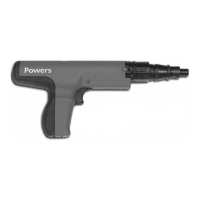
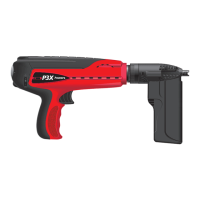
Model P3X Model P3X
POWDER LOAD SELECTION
Use of the proper power level is critical to the success of a powder actuated fastening. Prior to selecting the
proper power level, conduct a centre punch test as described in the section on base material suitability (pg 5).
To select the proper power level to be used with a specific fastener, always do a test firing using the lowest
power level recommended for the tool being used. If the lowest power level does not fully drive the fastener,
try a powder load with the next highest power level. Continue this process until the proper fastener
penetration is obtained.
POWERS loads are specifically designed for use in the P3X tool. Do not use any other type of load. Failure to
follow this instruction may cause accidental load discharge, damage to the tool and cause serious injury or
death to the operator and/or bystanders.
The P3X uses .25 caliber (6.3 / 10) disk powder loads.
SAFETY PRECAUTIONS
Safety is your primary responsibility when operating any powder actuated tool. You must read and understand
the contents of this manual. You must be familiar with all functional and safety requirements of the tool. It
is your responsibility to obtain proper training in accordance with AS / NZS 1873.1:1994. Existing state or
local regulations should also be followed.
PRIOR TO OPERATING THE TOOL
1. Warning signs should always be posted within the area in which the powder actuated tool is being used.
These signs should be at least 500mm(W) x 300mm(H) in size with bold face type that is not less than
30mm in height. The sign should state CAUTION - EXPLOSIVE POWERED TOOL IN USE.
2. The operator or bystander must always use eye protection properly in accordance with AS / NZS
1873.1:2003 to protect their eyes from flying particles. Operators and bystanders must also always use
hearing protection properly in accordance with AS / NZS 1873.1:2003 when using a powder actuated
tool. Other personal safety protection as required should also be used.
3. Never modify or fabricate parts for use in your POWERS tool. Use only POWERS fasteners, loads and tool
parts.
4. Hands or other body parts must never be placed in front of the muzzle / barrel. Accidental discharge can
cause the piston and/or fastener to pass through the operator’s hand.
5. Never compress the tool against any part of the body. Serious injury or death may result in the event of
an accidental discharge.
6. Always point the tool in a safe direction at all times.
7. Tools should be cleaned and maintained as directed in this manual.
8. Use the tool for its intended purpose only.
PREPARATION FOR LOADING THE TOOL
1. Tools must be checked prior to operating to make sure they are not fully or partially loaded with a
powder load or fastener.
2. To ensure safe operation, perform the daily function test described in this manual (pg 14). Be sure the
tool is not loaded prior to performing this test.
3. Do not operate this tool unless all its parts are in place and operating appropriately. Never attempt to use
a malfunctioning tool.
4. Never guess about the suitability of a base material. If you are uncertain about the suitability of a base
material, perform a centre punch test (pg 5).
5. Do not operate the tool until you learn and understand the colour code / numbering system used to
identify the power level of power tools (pg 8).
OPERATING THE TOOL
1. Only use fasteners and powder loads designed for this tool as supplied by POWERS.
2. Do not use powder actuated tools in a flammable or explosive atmosphere.
3. Do not fire a tool without a fastener. The piston will impact the work surface, possibly causing serious
injury to the operator and/or bystanders along with damage to the tool.
4. Do not load the tool until you are ready to make a fastening. Check the powder load level before
inserting it into the tool chamber.
5. Fastener must be loaded prior to loading the powder load to avoid injury to the operator and/or
bystanders in the event of an accidental discharge.
6. Do not close tool against work surface. The tool should be manually closed, with hand away from
muzzle / barrel to prevent accidental discharge.
7. Hold the tool perpendicular to the work surface at all times. Use a spall guard wherever possible. This will
limit the possibility of fastener richochet which could cause serious injury to the operator and/or bystanders.
8. Always perform a test-fastening with the lightest load level designed for use with the tool. If the lightest
load fails to set the fastener, try the next higher load until the proper level is attained. Failure to follow
this procedure may cause the fastener to be overpowered. If this occurs, the fastener may fully penetrate
the base material causing serious injury or death. Overpowering the fastener can also damage the tool
creating a safety hazard for both operator and bystanders.
9. Do not fasten into cast iron, tile, glass or other types of brittle materials. These materials can shatter and
create sharp fragments which may cause injury.
10. Do not fire tool within 75mm (3 inches) of the edge of a concrete base material or 13mm (1/2inch)
of the edge of a steel base material.
11. Do not attempt to install a fastener closer than 75mm (3 inches) to another previously inserted fastener
in concrete or 38mm (1 1/2 inch) in steel.
12. Do not fasten into a concrete base material less than 3 times as thick as the fastener penetration or into
a steel base material thinner than 3mm.
13. Never attempt to install a fastener in a cracked or spalled area in concrete. Place fastener at least 75mm
(3 inches) away from a spalled area to prevent the possibility of the fastener bending and striking the
operator or bystander.
14. Do not attempt to install fasteners in areas that have been welded or cut with a torch as these
procedures may have caused hardening of the steel.
15. Do not fasten through a pre-drilled hole unless proper guidance is provided.
16. If you decide not to make a fastening after the tool has been loaded, you must always remove the
powder load first followed by the fastener.
17. Never attempt to override the safety features of this tool.
CHOOSING THE POWDER LOAD
Part No. Description Strength Power Load Colour Qty Qty
50536 PDLYEL 10MM Medium 4 Yellow 100 1000
50558 PDLRED 10MM Strong 5 Red 100 1000
P3X Inst Manual Update 14-8-13.indd 8-9 8/14/2013 9:44:22 AM


 To Next Page
 Loading...