The ZAP 4 Button Transmitter is a remote control device designed for various applications, likely related to garage door openers or similar access control systems. It operates on a specific radio frequency and uses a particular modulation and protocol for communication.
Function Description:
The primary function of this device is to transmit commands wirelessly using its four distinct buttons. Each button, labeled "Command Button 1," "Command Button 2," "Command Button 3," and "Command Button 4," can be programmed to perform a specific action, such as opening or closing a gate, activating a light, or controlling other compatible devices. The transmitter sends a signal to a receiver (controller board), which then executes the corresponding command. The process of "recording" the transmitter involves pairing it with the controller board, which typically requires consulting the controller board's manual for specific instructions.
Important Technical Specifications:
- Frequency: The transmitter operates at a frequency of 433.92 MHz. This is a common frequency band used for short-range wireless devices, including remote controls and home automation systems.
- Modulation: The device uses OOK (On-Off Keying) modulation. OOK is a simple form of amplitude shift keying that represents digital data as the presence or absence of a carrier wave. It is known for its simplicity and low power consumption, making it suitable for battery-powered remote controls.
- Protocol: The transmitter supports either a Fixed Code or Rolling Code protocol.
- Fixed Code: In a fixed code system, the same code is transmitted every time a button is pressed. While simpler, it can be less secure as the code can potentially be captured and replayed.
- Rolling Code: A rolling code system transmits a different, unique code each time a button is pressed. This significantly enhances security by making it much harder for unauthorized individuals to capture and reuse the code. The specific protocol used (fixed or rolling) would depend on the configuration of the paired controller board.
Usage Features:
The transmitter features a straightforward four-button interface, making it easy to operate. The buttons are clearly identifiable, allowing users to quickly select the desired command. The compact and ergonomic design, as suggested by the battery replacement diagrams, indicates it is designed for handheld use. To initiate use, the transmitter must first be "recorded" or paired with the intended controller board. This setup process is crucial for the device to function correctly with the specific system it is intended to control.
Maintenance Features:
The primary maintenance task for this device is battery replacement. The manual provides clear visual instructions for this process:
- Opening the Casing: The device appears to have a two-part casing. To open it, a small tool (like a screwdriver) is inserted into a designated slot (indicated by "A" and "B" in the diagrams) to pry open the back cover. This reveals the internal components, including the battery compartment.
- Battery Type: While the specific battery type is not explicitly stated in the text, the diagrams show a circular, coin-cell type battery (e.g., CR2032 or similar) located within a dedicated holder.
- Replacement Procedure: Once the casing is open, the old battery can be removed, and a new one inserted. The diagrams illustrate the process of carefully prying out the old battery and placing the new one into its slot, ensuring correct polarity.
- Disposal: The manual emphasizes the importance of discarding the old battery in an "appropriate place" after replacement, highlighting environmental responsibility.
The device complies with Part 15 of the FCC Rules, which outlines regulations for unintentional radiators. This compliance means:
- The device may not cause harmful interference to other electronic devices.
- The device must accept any interference received, including interference that may cause undesired operation.
Users are also warned that any changes or modifications not expressly approved by the party responsible for compliance could void the user's authority to operate the equipment. This underscores the importance of using the device as intended and avoiding unauthorized alterations.
In summary, the ZAP 4 Button Transmitter is a user-friendly, wireless remote control designed for secure and reliable operation of compatible systems, featuring standard radio frequency communication, multiple command buttons, and a simple battery replacement procedure.

 Need help?
 General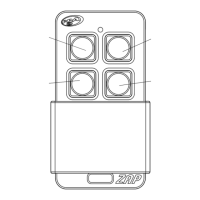

 To Next Page