2
DO NOT OPERATE UNTIL YOU
HAVE READ INSTRUCTIONS
psi
kg/cm
2
.5
1
1.5
10
15
20
5
0
C
A
U
T
I
O
N
Getting Acquainted
Your canner is a special, large capacity pressure vessel designed for home
canning a wide variety of fruits, vegetables, meats, poultry, fish, and seafood.
The canner uses pressure to achieve the high temperatures required for safely
processing foods while canning.
The United States Department of Agriculture (USDA) recommends the
pressure canner as the only safe method for canning low-acid foods:
vegetables, meats, poultry, fish, and seafood.
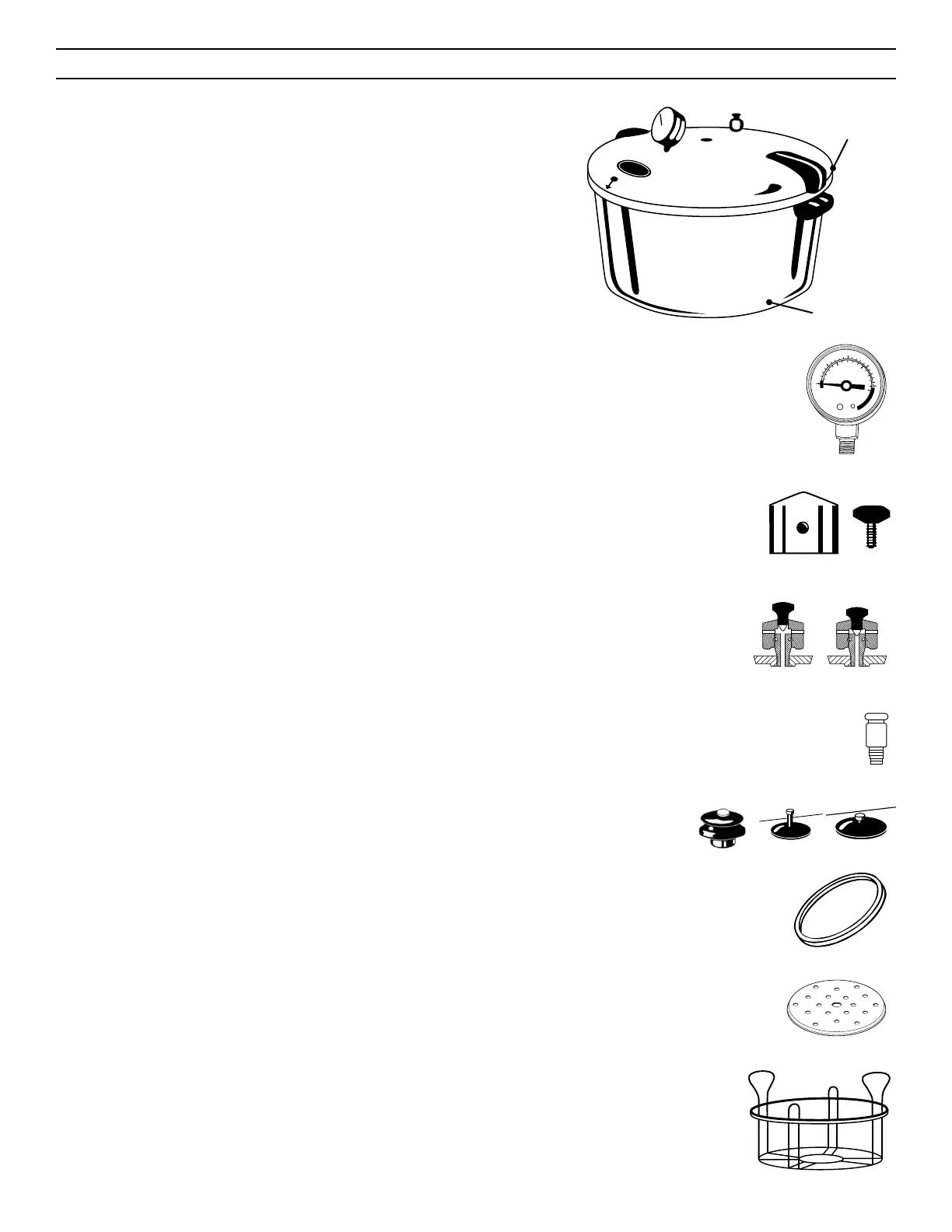
Become familiar with the various parts of the canner as shown in Fig. A.
Do not use your pressure canner before reading the instructions on
pages 4 and 5.
Introduction to Parts
Note: The parts shown are not to scale.
Pressure Dial Gauge
The pressure dial gauge registers pressure in pounds per square inch, or PSI. The pointer moves around the dial
indicating the pressure within the unit. Pressure can be controlled and maintained by adjusting the heat setting on
your stove.
If you are still using the original tilt gauge, please replace it with a new gauge. Please call the Presto Consumer
Service Department (see page 6) to see which gauge is appropriate for your canner model.
Pressure Control Weight and Petcock Screw
The pressure control weight (A) and petcock screw (B) help control the pressure inside the canner. If
the pressure inside the canner builds to a level in excess of the 20 psi, the weight will lift from the vent
pipe and allow the excess pressure to be released.
The petcock screw is rotated counterclockwise to open the holes on the side of the control weight so air
can be vented from the canner at the beginning of the canning process. When all the air has been vented
through the vent pipe, the petcock screw is then rotated clockwise to close the holes so pressure can begin
to build inside the canner (Fig. B).
Vent Pipe
The pressure control weight fits on the vent pipe. Air is released through the vent pipe during the venting period at the
beginning of the canning process.
Automatic Air Vent
When the petcock is open, the automatic air vent assists in venting air from the canner. When the
petcock is closed, the metal plunger of the air vent rises and seals the canner (A) so pressure
can build. If the metal plunger of the automatic air vent is down (B), there is no pressure in the
canner.
The automatic air vent will also pop out and release stream in case the vent pipe becomes blocked
and pressure cannot be released normally through the vent pipe. Replace the automatic air vent every time you
replace the sealing ring. This should be at least every 3 years, or sooner if they become hard or inflexible. Use
only genuine Presto
®
replacement parts.
Sealing Ring
The sealing ring fits into the canner cover and forms a pressure-tight seal between the cover and the body
during canning. Replace the sealing ring at least every 3 years. Use only genuine Presto
®
replacement parts.
Canning Rack or Canning Basket
The canning rack or basket is placed in the bottom of the pressure canner to hold the jars off the bottom
of the canner while canning. Always use the rack or basket when canning; the jars may break if set
directly on the bottom of the canner.
Please note the canning basket is no longer available. If you are in need of a replacement, please call
the Consumer Service Department to see which canning rack is appropriate for your canner model.
BA
A B
Fig. A
Fig. B
&
(in canner
and not shown)
(in cover and
not shown)





 To Next Page