2
Important Cord Information
This appliance has a polarized plug (one blade is wider than the other). To reduce the risk of electric shock, this plug is intended to
fit into a polarized outlet only one way. If the plug does not fit fully into the outlet, reverse the plug. If it still does not fit, contact a
qualified electrician. Do not attempt to modify the plug in any way.
A short, detachable power supply cord is provided to reduce the risk of becoming entangled in or tripping over a longer cord. An
extension cord may be used if care is properly exercised in its use. If used, the marked electrical rating of the extension cord should be
at least as great as the electrical rating of the appliance.
The extension cord should be arranged so that it will not drape over the countertop or tabletop where it can be pulled on by children or
tripped over unintentionally. Connect the power supply cord to a 120VAC electrical outlet only.
Before the First Use
Remove all packing material, including the black plastic piece nestled over the shipping foam to
protect the plug guard. Set the handles, drip tray, and Control Master
heat control aside. Wash
the griddle according to the “Care and Cleaning” instructions on page 3.
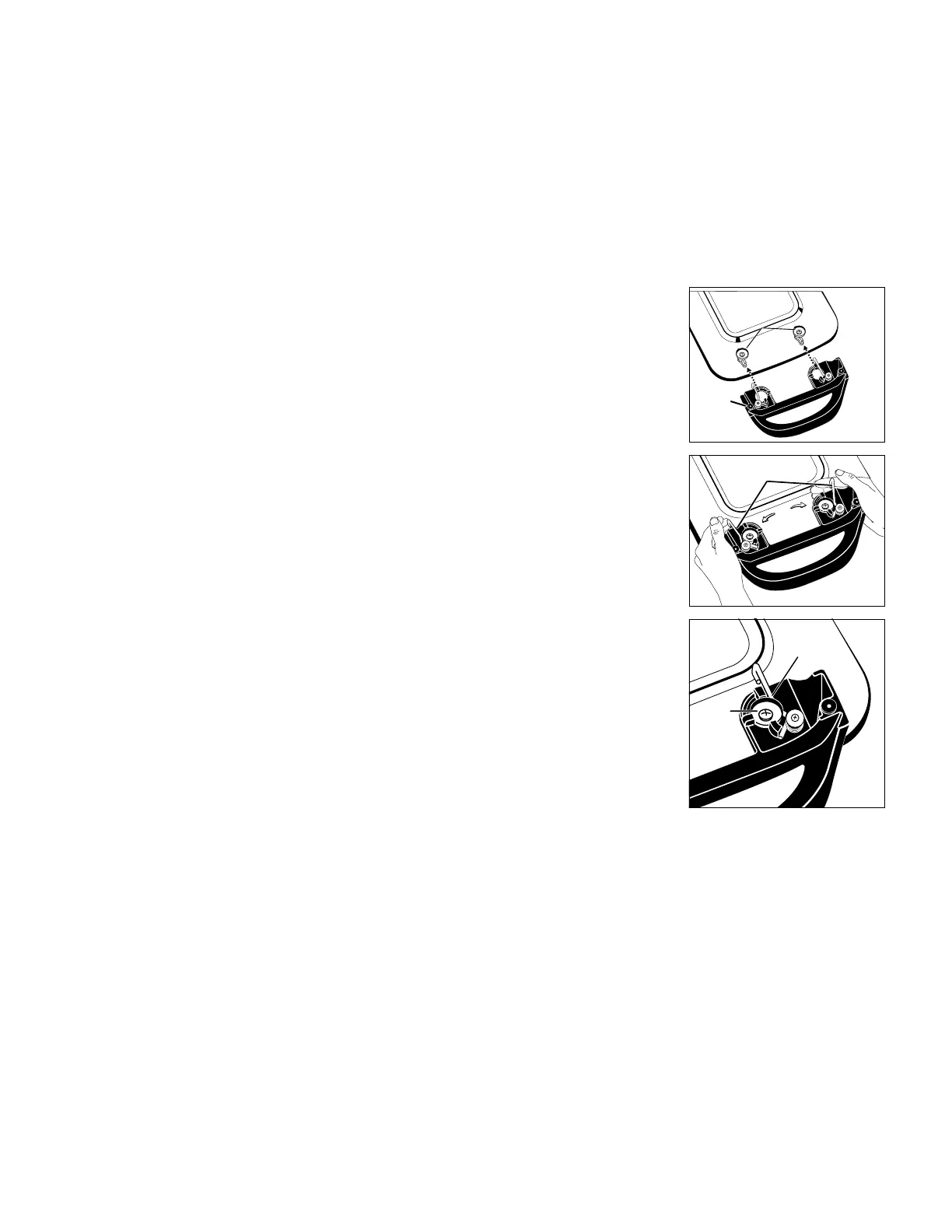
Before using this griddle, the handles must be attached as instructed below:
1. With the cooking surface down, place the griddle on a flat surface, such as a countertop or
tabletop (Fig. A).
2. With the rubber feet up, position one of the handles over the griddle so that the two handle
holes are directly over the latch clip catches. The latch clip levers will rest on the catches.
3. Pull the latch clips (Fig. B) back beyond the catches and push the handle down until it is
firmly seated against the griddle. Release the latch clips to lock the handle into place.
To be sure the handle is securely attached, check that both latch clips are under the edge of
the latch clip catches (Fig. C).
4. Repeat steps 2 and 3 with the other handle.
How to Use
NOTICE: This griddle is not intended to be used as a warming tray, hot plate, or for heating any
cookware.
Using this appliance for purposes different from those specified in the instruction manual may
cause damage to the appliance and will void the warranty.
1. Place the assembled griddle on a dry, level, heat-resistant surface away from walls, cabinets,
and other objects.
NOTICE: To prevent possible heat damage to your countertop, place a heat-resistant
protector, such as aluminum foil, under the griddle. To keep the appliance from moving on
the countertop, do not place any portion of the foil under the rubber feet on the griddle frame.
2. Slide the drip tray onto its tracks. Insert the Control Master
heat control probe into the
griddle so the two electrical pins on the griddle are fully inserted into the heat control. Connect the cord to a 120VAC electrical
outlet only.
3. Turn the heat control to the desired temperature; see page 3 for the temperature-timetable. Preheat the griddle. The indicator light
turns off when the selected temperature is reached after approximately 5 to 10 minutes.
Note: It is normal to hear a pop or clicking sound while the griddle heats up and cools down. This is due to the expansion and
contraction of the metal.
4. Prepare the food for cooking. Because the griddle features a ceramic nonstick finish, food may be prepared with little or no oil.
NOTICE: Avoid using no-stick cooking sprays as they may cause the cooking surface to become tacky.
5. Place the food on the griddle and cook according to the temperature-timetable. Adjust the heat according to personal preference
and the particular food being cooked. The indicator light will turn on and off as the griddle maintains the selected temperature.
Use nylon, plastic, wooden, or rubber utensils for best results. Do not use metal utensils or cut food on ceramic nonstick surface
as doing either may scratch the surface.
6. Turn the heat control to OFF when cooking is complete. Unplug the heat control from the wall outlet, and then from the griddle.
Allow the griddle to cool completely before removing the drip tray and before cleaning.
Fig. A
Fig. C
Fig. B
Latch clip
catches
Latch clip
Latch
clip
catch
Latch clip levers
Handle
holes
Griddle
Rubber
foot
Handle


 To Next Page
 Loading...