10
TABLE FOR THE STEAMING OF INGREDIENTS
1 cup equals 175 ml. water
Some more 'steam - tips':
- When steaming vegetables the amount of water need not be adjusted to the amount of vegetables.
- Keep the lid on the pan during steaming. If you lift the lid, heat and steam will escape, as a result of
which cooking will take longer. If the lid must nevertheless be lifted for a brief instant, some extra
water can be poured into the inner pan to adjust the cooking time again.
- The suggested steaming times are approximate. By increasing or reducing the amount of water one can
adjust the preparation times.
Making soups and casseroles
For this the inner pan is used with the lid. Simply put the required ingredients in the pan and switch to the
'cook' position. Soups and casseroles must 'simmer' for some time. For this the 'warm' position of the
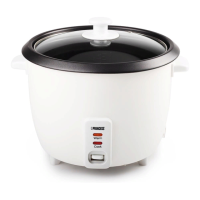
Princess Rice Cooker Food steamer is highly suitable.
Poaching eggs
If you want to poach eggs with the Princess Rice Cooker Food Steamer we advise that you use medium-
sized eggs. Before you begin poaching the eggs, you should always grease the poaching dish.
Add no more than 0.8 litres of water to the pan and crack open the eggs before putting them into the
poaching dish. Now put the lid onto the appliance and switch it on. The water will take around 8 minutes
to boil.
Once the water reaches the boil, the eggs will take another 2 to 3 minutes to poach.
Cooking pasta
The Princess Rice Cooker Food Steamer is also ideal for cooking small quantities of pasta. When cooking
pasta, you should bear in mind the following:
1 cup of pasta (approx. 100g) to every 2 cups of water.
Please note: you cannot cook more than 200g of pasta at any one time.
Bring the water to the boil before adding the pasta. To ensure the pasta is properly cooked, you should
wait until the water has evaporated and the appliance emits a signal to indicate that the pasta is ready. If
you prefer your pasta 'al dente' or slightly less cooked, you should reduce the cooking time
rather than waiting for the 'ready' signal.
CLEANING
FIRST UNPLUG THE CORD FROM THE SOCKET
The outer pan can be cleaned with a damp cloth. Make sure that the pan is thoroughly dry
before re-connecting the cord to the socket. If necessary, dry the electrical connection on
the side of the appliance further with, for instance, kitchen paper.
The other components can be cleaned in warm soapy water. Do not use abrasive cleaning
agents or a scouring pad for this.
Vegetables Quantity of water Steaming time
Meat, fish & poultry
1
/
2
cups per 100 grammes Depending on the quantity
Asparages
1
/
2
cup 10 minutes
Broccoli
1
/
4
cup 5 minutes
Cabbage 1 cup 15 minutes
Carrots 1 cup 15 minutes
Cauliflower 1 cup 15 minutes
Corn 1 cup 10 minutes
Aubergine 1
1
/
4
cup 20 minutes
Broad beans 1 cup 15 minutes
Green peas
1
/
2
cup 10 minutes
Spinach
1
/
2
cup 10 minutes


 To Next Page
 Loading...