Page 24
Make sure that your hands can reach and squeeze the brake levers comfortably. If your hands are too small to operate the levers
comfortably, consult your dealer before riding the bike. The lever reach may be adjustable; or you may need a different brake lever
design.
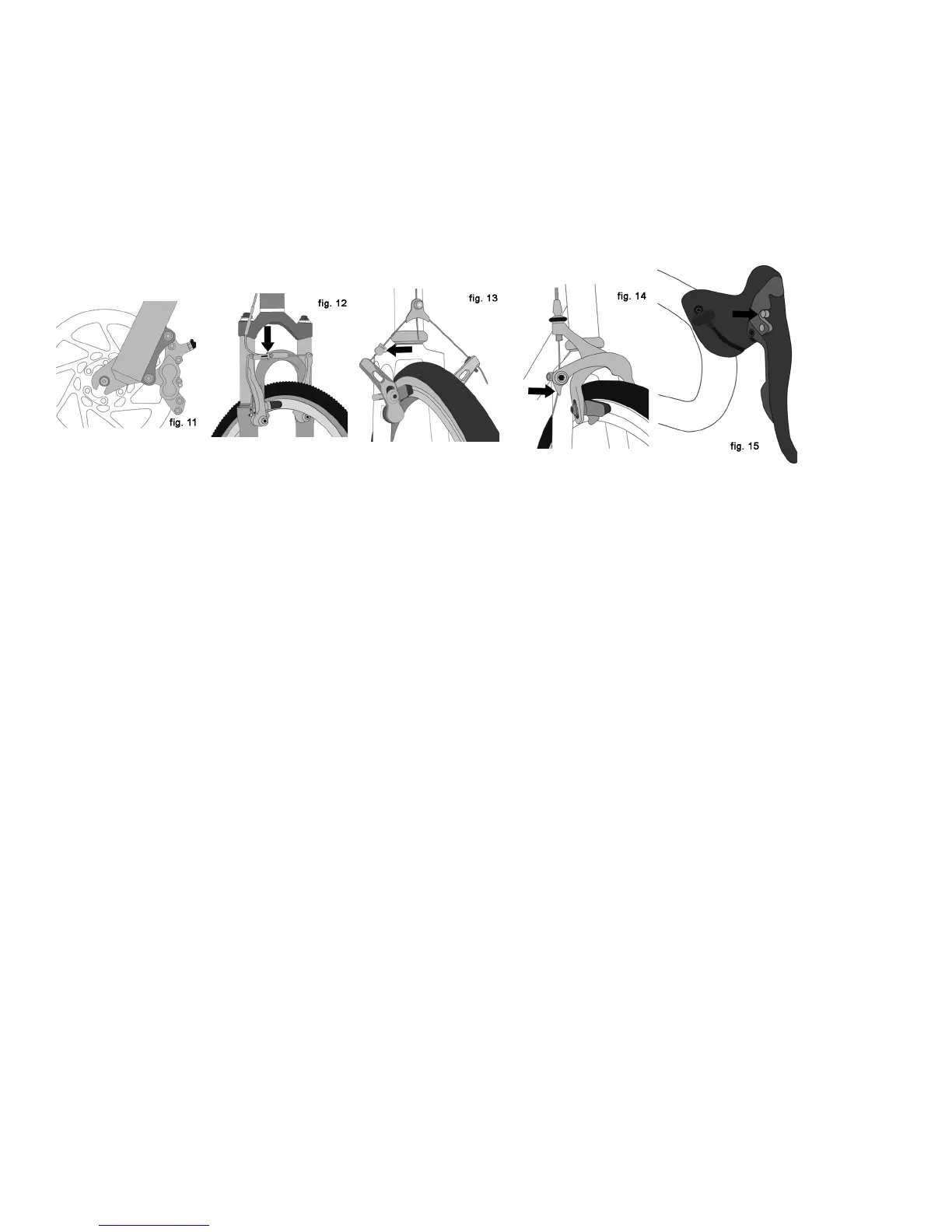
Most rim brakes have some form of quick-release mechanism to allow the brake pads to clear the tire when a wheel is removed or
reinstalled. When the brake quick release is in the open position, the brakes are inoperative. Ask your dealer to make sure that you
understand the way the brake quick release works on your bike (see figs. 12, 13. 14 & 15) and check each time to make sure both
brakes work correctly before you get on the bike.
2. How brakes work
The braking action of a bicycle is a function of the friction between the braking surfaces. To make sure that you have maximum
friction available, keep your wheel rims and brake pads or the disk rotor and caliper clean and free of dirt, lubricants, waxes or polishes.
Brakes are designed to control your speed, not just to stop the bike. Maximum braking force for each wheel occurs at the point just
before the wheel “locks up” (stops rotating) and starts to skid. Once the tire skids, you actually lose most of your stopping force and all
directional control. You need to practice slowing and stopping smoothly without locking up a wheel. The technique is called progressive
brake modulation. Instead of jerking the brake lever to the position where you think you’ll generate appropriate braking force, squeeze
the lever, progressively increasing the braking force. If you feel the wheel begin to lock up, release pressure just a little to keep the
wheel rotating just short of lockup. It’s important to develop a feel for the amount of brake lever pressure required for each wheel at
different speeds and on different surfaces. To better understand this, experiment a little by walking your bike and applying different
amounts of pressure to each brake lever, until the wheel locks.
When you apply one or both brakes, the bike begins to slow, but your body wants to continue at the speed at which it was going. This
causes a transfer of weight to the front wheel (or, under heavy braking, around the front wheel hub, which could send you flying over
the handlebars).



 To Next Page