13
Use charger for charging a LEAD-ACID (lead acid, sealed lead acid, gel cell and AGM) battery
only. It is not intended to supply power to a low voltage electrical system other than in a start-
er-motor application. Do not use battery charger for charging dry-cell batteries that are commonly used with
home
appliances. These batteries may burst, causing personal injury and damage to property.
Utiliser le chargeur pour charger une batterie au plomb uniquement. Ce chargeur n’est pas concu pour alimenter un réseau
électrique très basse tension ni pour charger des piles sèches. Le fait d’utiliser le charger des piles sèchespourait entrainer
l’éclatement des piles et causer des blessures ou des dommages.
DO NOT attempt to attach a charger to a battery pack if the output of the charger does
not match the battery pack voltage. Example: Model i-3625 is a 36 volt output charger
and is only usable on 36 volt battery systems. NEVER connect to just one battery (ie. 6V) in the pack. Dam-
age can occur.
Be extra cautious to reduce risk of dropping a metal tool onto battery. It might cause a
spark or short-circuit a battery or other electrical part, possibly resulting in an explo-
sion. If damaged, contact PCS (615.471.5300).
NEVER charge a frozen battery.
Ne jamais charger une batterie gelée.
Assure that the area around your charger and batteries is properly ventilated. Connect your extension cord, with
no AC Power present, to the battery charger and proceed to plug your extension cord into a 120VAC GFCI pro-
tected (Ground Fault Circuit Interrupt) outlet.
Risk of electrical shock! Do not touch uninsulated parts of the battery charger output
connector, battery connector, or battery terminals.
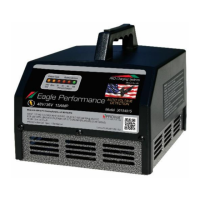
Once you plug in your PCS battery charging system, the charge cycle will begin automatically. State of charge will
be displayed by illumination of the Light Emitting Diodes (LEDS) on the battery status indicator located on the
front of the unit.
DO NOT connect or disconnect the DC output electrical cord to or from the battery
receptacle when the charger is on. Arcing and / or burning of the plug and receptacle
could result and could cause the batteries to explode. If the charger must be stopped, rst
disconnect the AC power supply cord from its outlet, then disconnect the charger DC output plug from
the battery receptacle.
We recommend that you leave your system plugged in. This will reduce sulfation on the lead plates of the batter-
ies and allow your PCS charging system to keep your batteries fully maintained and ready to perform at their
best.
To reduce the risk of re, use only on circuits provided with 15Amperes Branch Circuit
Protection in accordance with the National Electrical Code, ANSI/NFPA 70.
Study all battery manufacturers’ specic precautions such as removing or not removing
cell caps while charging and recommended rates of charge.
Prendre connaissance des measures de précaution spéciés par le fabricant de la batterie, p. ex., vérier s’il faut en-
lever les bouchons des cellules lors du chargement de la batterie, et les taux de chargement recommandés.


 To Next Page
 Loading...