This document is the user manual for the HC Series Storage Refrigeration units, manufactured by Prodis. The manual covers various models including HC202R, HC202RSS, HC202F, HC202FSS, HC401R, HC401RSS, HC401F, HC401FSS, HC601R, HC601RSS, HC601F, and HC601FSS.
Function Description:
The HC Series Storage Refrigeration units are commercial refrigerators and freezers designed for indoor use. Their primary function is to provide controlled temperature storage for various products. The units are equipped with digital controllers for precise temperature management and feature adjustable shelves to accommodate different product sizes. Some models offer automatic defrost systems, while others require manual defrosting.
Important Technical Specifications:
The HC Series includes both refrigerators and freezers, with varying temperature ranges and specifications:
- HC202R / HC202RSS: Refrigerators with a cabinet temperature range of 2°C to 10°C. Climate Class 4. Finish options are White (HC202R) and Stainless Steel (HC202RSS). They come with 2 shelves and an Off Cycle defrost system. Controller: XR02CX. Dimensions (w,d,h): 600 x 620 x 850 mm. Energy Efficiency: C. Voltage: 230V/50Hz.
- HC202F / HC202FSS: Freezers with a cabinet temperature range of -18°C to -22°C. Climate Class 4. Finish options are White (HC202F) and Stainless Steel (HC202FSS). They come with 2 shelves and a Manual defrost system. Controller: XR02CX. Dimensions (w,d,h): 600 x 620 x 850 mm. Energy Efficiency: N/A. Voltage: 230V/50Hz.
- HC401R / HC401RSS: Refrigerators with a cabinet temperature range of 2°C to 8°C. Climate Class 4. Finish options are White (HC401R) and Stainless Steel (HC401RSS). They come with 4 shelves and an Off Cycle defrost system. Controller: XR02CX. Dimensions (w,d,h): 600 x 646 x 1875 mm. Energy Efficiency: D. Voltage: 230V/50Hz.
- HC401F / HC401FSS: Freezers with a cabinet temperature range of -10°C to -25°C. Climate Class 4. Finish options are White (HC401F) and Stainless Steel (HC401FSS). They come with 6 shelves and a Manual defrost system. Controller: XR02CX. Dimensions (w,d,h): 600 x 646 x 1875 mm. Energy Efficiency: N/A. Voltage: 230V/50Hz.
- HC601R / HC601RSS: Refrigerators with a cabinet temperature range of 0°C to 8°C. Climate Class 4. Finish options are White (HC601R) and Stainless Steel (HC601RSS). They come with 4 shelves and an Off Cycle defrost system. Controller: XR02CX. Dimensions (w,d,h): 780 x 720 x 1895 mm. Energy Efficiency: D. Voltage: 230V/50Hz.
- HC601F / HC601FSS: Freezers with a cabinet temperature range of -10°C to -25°C. Climate Class 4. Finish options are White (HC601F) and Stainless Steel (HC601FSS). They come with 6 shelves and a Manual defrost system. Controller: XR02CX. Dimensions (w,d,h): 780 x 720 x 1895 mm. Energy Efficiency: N/A. Voltage: 230V/50Hz.
All models operate on 230V/50Hz power supply. The normal operating ambient temperature range for these refrigerators is between 10°C and 32°C. The cabinets are suitable for use in conditions up to 55% relative humidity.
Usage Features:
- Installation: Requires at least two people or a lifting device for positioning and unpacking. Must be installed on a solid, level floor in a well-ventilated area, away from heat sources and direct sunlight. A minimum clearance of 200mm on all sides is required for proper air circulation. Electrical connections must conform to national regulations and be performed by a qualified engineer or electrician, plugging into an independent power source or socket with specified voltage and frequency. Extension leads are not recommended.
- Operation: Features a digital controller with factory-preset parameters for optimal cooling. Users can adjust the set point temperature by pressing and holding the SET button, using the up/down arrows, and pressing SET again to store the new value. However, altering controller parameters should only be done by a qualified refrigeration engineer.
- Shelves: Fitted with adjustable shelves that can be moved to suit different size products.
- Defrosting: Refrigerators are equipped with an automatic off-cycle defrost system, generally not requiring manual defrosting under normal circumstances. Freezers require periodic manual defrosting, which involves unloading the cabinet, turning off power, and allowing frost and ice to melt naturally. Sharp implements should not be used to remove frost.
- Loading: After installation, the cabinet should run for 2 hours before loading products. Products should be loaded in batches to avoid a significant temperature increase. Adequate space for airflow must be maintained inside the cabinet, avoiding products touching interior walls or overhanging shelves.
- Efficient Use: To maintain efficiency, doors should be opened and closed quickly, the cabinet should be loaded to allow sufficient airflow, and kept as full as possible with cold produce. Regular defrosting (for freezers) helps maintain efficiency.
- Safety Warnings: Do not allow children to play with the cabinet. Do not operate the unit with unauthorized changes or if misused/abused. Do not cover front vents. Do not store flammable gases or liquids near the refrigerator. Do not use high-pressure water cleaning devices. Always transport the cooler in an upright position, never tilting more than a 45° angle. Wait at least 5 minutes after turning off before restarting to avoid compressor damage. Disconnect from mains electricity before any cleaning or maintenance.
Maintenance Features:
- Cleaning:
- Exterior: Clean with a micro-fibre cloth or sponge. Avoid abrasive or metallic products.
- Interior: Wash with a solution of lukewarm water and a small amount of dish-washing liquid. Rinse and dry immediately.
- Condenser: The condenser should be cleaned every six months by a qualified engineer. This involves disconnecting power, removing the rear bottom panel and grill, and using a soft brush and vacuum cleaner to remove dirt and dust from the condenser fins. Failure to clean the condenser can lead to component failure and invalidate the warranty.
- Long Term Storage/Moving:
- Disconnect from mains electricity.
- Remove all products.
- Clean and thoroughly dry the interior.
- Leave the door open at least 50mm to allow air circulation and prevent mold/mildew.
- Tape the door shut with low tack tape or lock it if fitted.
- Transport in an upright position, never tilting more than a 45° angle.
- Follow all installation instructions when reinstalling after storage or transport.
All maintenance and service work must be undertaken by a qualified refrigeration engineer or an authorized service partner.

 Need help?
 General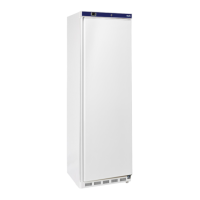

 To Next Page