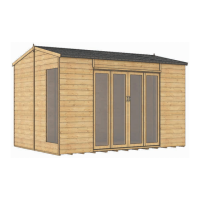
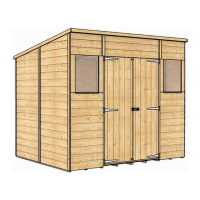
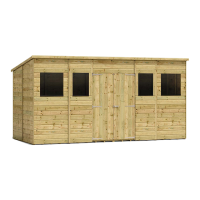
This document provides comprehensive building instructions for the "Evolution My Den" 8x6 metal roof shed, manufactured by Project Timber in Britain. It details the assembly process from the base module to the final touches, including internal trims and optional silicone sealant application.
Function Description
The "Evolution My Den" is a garden shed designed for storage or as a small outdoor workspace. Its primary function is to provide a secure and weather-resistant enclosure. The design features a metal roof, which offers durability and protection against the elements. The shed includes a single door panel and options for side window openings, allowing for natural light and ventilation. The modular design facilitates assembly by individuals, with clear instructions for each stage.
Important Technical Specifications
- Cover Size: 8x6 feet.
- Roof Type: Metal Roof.
- Window Opening Options: Available with side window opening on the RIGHT (as shown on the cover) or LEFT (detailed on page 3).
- Door Position Options: The single door panel can be positioned on the LEFT or RIGHT of the front facade.
- Floor Assembly: Comprises two main floor sections: 585mm x 2348mm (1 unit) and 2348mm x 1217mm (1 unit).
- Base Module (ID: PT25393): Dimensions 1893mm x 2440mm (2 units required).
- Gable Bearers (ID: PT25397): Dimensions 38mm x 1817mm (2 units required).
- Plinth (IDs: 15906, 18685): Used to form the perimeter of the floor assembly.
- Floor Panels (IDs: PT18173, PT18181): 11mm thick, forming the shed floor.
- Back Panels (IDs: PT25541, PT25542): 1220mm width (1 LEFT, 1 RIGHT).
- Gable Panels:
- Left Gable Panel (LOW) (ID: PT25531)
- Left Gable Panel (HIGH) (ID: PT25534)
- Right Gable Panel (LOW) (ID: PT25532)
- Right Gable Panel (HIGH) with Window Opening (ID: PT25522)
- Door Panel (ID: PT20330/19503): Single door panel, UPVC.
- Window Glazing Units (ID: PT18490): 610mm width (2 units).
- Plain Panels:
- Top Plain Panel (ID: PT20323): W1220mm (1 unit).
- Bottom Plain Panel (ID: 25548): W1220mm (1 unit).
- Roof Sections:
- Metal Roof Section L2285mm x W515mm (ID: 21159): 1 unit.
- Metal Roof Section L2285mm x W1000mm (ID: PT21150): 2 units.
- Flashing Components:
- Drip Edge Flashing (ID: 21173): L2530mm x 1.
- Water Deflector Flashing (ID: 21169): L2530mm x 1.
- Barge Board Flashing (ID: 21178): 2 units.
- Monopitch Ridge Flashing (ID: 21166).
- Corner Trims (ID: PT21074):
- Front: 60mm x 16mm x 2135mm.
- Back: 60mm x 16mm x 2050mm.
- Cloaking Strips (ID: PT21074):
- Gable Cloaking Strip: 60mm x 16mm x 2050mm (1 unit).
- Rear Cloaking Strip: 60mm x 16mm x 2012mm (1 unit).
- Roof Stand-Off Frames (ID: PT21074):
- Rear Frame: 44mm x 27mm x 2475mm (1 unit).
- Gable Frames: 44mm x 27mm x 2050mm (2 units).
- Door Stop (ID: PT21074): 28mm x 28mm x 250mm.
- Internal Cover Trims (ID: 21080):
- Top Window Architrave.
- Side Window Architrave.
- D Mould strips: 40mm x 11mm x 1766mm (x2).
- Side Window Batton: 23mm x 28mm x 1766mm.
- Back Wall Top Batton: 23mm x 28mm x 1176mm (2 units).
- Guttering Kit (ID: 20131): Optional, includes gutter brackets.
- Screws: Various sizes (70mm, 100mm, 50mm, 80mm, 115mm metal roof screws, 25mm metal roof screws, 25mm black screws for guttering). Pilot drill holes are recommended before fixing.
Usage Features
- Modular Assembly: The shed is designed for self-assembly, with components clearly identified and step-by-step instructions provided.
- Customizable Door/Window Placement: Users can choose the position of the side window opening (left or right) and the door (left or right) to best suit their needs and site conditions. This flexibility is crucial for adapting the shed to different garden layouts or functional requirements.
- Durable Construction: The use of a metal roof and UPVC door panel ensures longevity and resistance to weather.
- Natural Light: The inclusion of window panels allows for natural light inside the shed, making it more suitable for tasks that require visibility.
- Guttering Option: An optional guttering kit can be installed to manage rainwater runoff, protecting the shed's foundation and surrounding area.
- Internal Finishing: The manual includes instructions for internal cover trims, providing a neat and finished interior appearance.
- Safety Precautions: The instructions emphasize safety, such as using a step ladder and having two people for roof section installation. Pilot drilling is consistently recommended to prevent wood splitting and ensure secure fixings.
Maintenance Features
- Silicone Sealant (Optional): The manual suggests applying silicone sealant around window frames and where window frames meet timber framing. This is a key maintenance step to enhance weatherproofing and prevent water ingress. While not provided with the building, it's an important recommendation for long-term durability.
- Guttering (Optional): If installed, the guttering system requires periodic cleaning to prevent blockages and ensure efficient water drainage.
- Regular Checks: Although not explicitly detailed as "maintenance," the assembly process implies the need for regular checks of screw tightness and panel alignment over time to ensure the structural integrity of the shed.
- Wood Treatment: While not mentioned in the provided pages, timber sheds typically require periodic wood treatment (e.g., staining, painting, or preservative application) to protect against rot, insect infestation, and UV damage. This would be a standard maintenance practice for a timber-based structure.
- UPVC Door Maintenance: UPVC doors are generally low maintenance, requiring only occasional cleaning with mild soap and water to keep them looking good. Moving parts like hinges and locks may benefit from periodic lubrication.
The "Evolution My Den" is designed as a practical and adaptable outdoor structure, with clear instructions to guide the user through its construction and recommendations for enhancing its lifespan.

 Need help?
 General

 To Next Page