This document is the Operator's Manual for the PRONAR NV161 series of manure spreaders, specifically covering models NV161/1, NV161/2, NV161/3, NV161/4, and NV161/5. It provides essential information for the safe and proper operation and maintenance of these agricultural machines.
Function Description
The PRONAR NV161 series manure spreader is designed for the uniform spreading of various materials, including all kinds of manure, peat, and compost. It is a single-axle machine primarily intended for agricultural use. The spreader features a V-shaped monocoque load box and a PTO-driven vertical spreader unit with two wormshafts, which disintegrate the material and spread it backward. Some models can be optionally equipped with a load box slide gate for safe transport of disintegrated materials on public roads and to ensure a safe start of the disintegrating wormshafts. Tailgates can also be added to prevent load spill during transport and to control spreading width during fieldwork.
Important Technical Specifications
The manual provides detailed technical specifications for each model, including dimensions, weight, power requirements, and capacities.
Manure Spreader Dimensions:
- Total length: Ranging from 7,250 mm (NV161/1, NV161/2) to 8,580 mm (NV161/5).
- Total width: Ranging from 2,540 mm (NV161/1, NV161/2) to 3,090 mm (NV161/4).
- Total height: Ranging from 2,270 mm (NV161/4) to 2,800 mm (NV161/5).
- Wheel track: Ranging from 2,050 mm (NV161/1, NV161/2) to 2,340 mm (NV161/4).
Internal Load Box Dimensions:
- Length: 4,500 mm (NV161/1, NV161/2, NV161/3), 5,000 mm (NV161/4), 5,680 mm (NV161/5).
- Width (top / bottom): 2,000/1,500 mm for all models.
- Height: 1,160 mm (NV161/1), 1,360 mm (NV161/2), 1,500 mm (NV161/3, NV161/4, NV161/5).
Technical Specifications:
- Maximum gross weight: Ranging from 10,500 kg (NV161/1) to 19,900 kg (NV161/5).
- Carrying capacity: Ranging from 6,750 kg (NV161/1) to 14,690 kg (NV161/5).
- Tare weight: Ranging from 3,750 kg (NV161/1) to 5,210 kg (NV161/5).
- PTO speed: 540 RPM (NV161/1, NV161/2), 1,000 RPM (NV161/3, NV161/4, NV161/5).
- Tractor power demand (minimum): Ranging from 70 hp / 51.5 kW (NV161/1) to 120 hp / 88.2 kW (NV161/5).
- Cargo capacity: Ranging from 9.1 m³ (NV161/1) to 14.9 m³ (NV161/5).
- Load surface: Ranging from 6.7 m² (NV161/1, NV161/2, NV161/3) to 8.5 m² (NV161/5).
- Maximum spread width: 8-12 m for all models.
- Maximum design speed (version standard): 30 km/h for all models.
- Maximum speed (version EU): 25 km/h for all models.
Other Information:
- Loading height: Ranging from 2,250 mm (NV161/1) to 2,700 mm (NV161/5).
- Electrical system voltage: 12 V for all models.
- Drawbar eye load: Ranging from 2,000 kg (NV161/1) to 4,000 kg (NV161/5).
- Tyre dimensions: Various, e.g., 18.4 – 34 (NV161/1) to 650/75R32 (NV161/5).
- Type of spreader unit: Vertical 2-beater for all models.
The machine can be equipped with single conduit pneumatic, double conduit pneumatic, or hydraulic braking systems. The hydraulic system is filled with L-HL32 Lotos hydraulic oil.
Usage Features
The manual emphasizes safe and correct usage, including preparation before first use, hitching/unhitching procedures, loading, and spreading.
Preparation and First Use:
- Users must thoroughly read the Operator's Manual and the PTO shaft manual.
- Before connecting, ensure the tractor meets all requirements (hitch, braking, hydraulic, electrical systems) and that hydraulic oils are mixable.
- A test start without load is recommended, checking all systems, including lights, indicators, brakes, and chain conveyor operation.
- The PTO shaft must be correctly installed with shields and secured, and its rotation speed must match the specifications in Table 3.1 to prevent damage.
Hitching and Unhitching:
- Always immobilize the manure spreader and tractor with the parking brake.
- Ensure no one is between the tractor and spreader during hitching.
- The parking stand must be fully raised during operation or travel.
- Hydraulic and pneumatic conduits must be connected correctly, identified by color-coded plugs (black for floor conveyor, green for tailgate, red for slide gate, yellow/red for pneumatic).
- Wheel chocks must be used when disconnecting or parking on a slope.
Loading:
- Load on a level, stable surface with the spreader connected to the tractor and both machines immobilized.
- Use appropriate loaders; avoid compacting manure.
- Distribute the load evenly, starting from the rear.
- Do not exceed the permissible load weight or the height of the spreader unit mechanism.
- Guideline weights for various organic fertilizers are provided (e.g., old manure 700-800 kg/m³, compost 950-1100 kg/m³).
Spreading and Adjusting Fertilizer Dose:
- The amount of material spread depends on load height, working width, chain conveyor speed, and travel speed.
- Chain conveyor speed is adjusted via a flow regulator knob (0-10 scale).
- Higher travel speed and lower conveyor speed result in a smaller spreading dose, and vice-versa.
- Tailgates can be adjusted to limit spreading width, especially along field boundaries.
- PTO drive should be disengaged when making turns to protect the shaft and ensure uniform spreading.
- In case of clogging, the feeding mechanism can be reversed for a short time. If persistent, disengage PTO, turn off the tractor, disconnect the PTO shaft, and manually clear the obstruction.
Transport:
- Comply with road traffic regulations and transport regulations.
- The slow-moving vehicle warning sign must be placed at the rear.
- Do not carry people or animals.
- Ensure the parking brake is released and the braking force regulator is in the correct position (for pneumatic systems).
- Be aware that vertical drawbar load can unload the tractor's front axle, affecting steering.
Maintenance Features
The manual outlines a comprehensive maintenance schedule, emphasizing regular inspections and specific procedures for various components.
General Maintenance:
- Regular inspections are crucial to maintain technical condition.
- Unauthorized repairs or modifications will invalidate the warranty.
- Symbols and pictograms are used throughout the manual to highlight important information, warnings, and maintenance tasks.
Brakes and Axles:
- Specialist workshops should handle major repairs, changes, or regeneration of axle and brake elements.
- User responsibilities include initial inspection of axle brakes (after first use and first travel with load), checking brake shoe linings for wear (every 3 months, or if brakes overheat/cylinder stroke is longer), and inspecting/adjusting wheel axle bearings for slackness (after 500 km, then 1500-2000 km, and before intensive use).
- Minimum brake shoe lining thickness is 5 mm.
- Wheel nuts should be tightened to 450 Nm (M22x1.5) using a torque spanner, checked after the first 10 working hours and then every 50 working hours.
- Tyre pressure should be checked at least monthly, or more frequently with intensive use, when the spreader is unloaded and tyres are cold.
- Parking brake cable tension should be checked every 12 months or as needed.
Pneumatic System:
- Checking air tightness and visual inspection of the system should be done annually, and after every 1,000 km or any repairs.
- Air filters should be cleaned every 3 months of use.
- Water should be drained from the air tank every seven days of use.
- The drain valve should be cleaned every 12 months (before winter).
- Pneumatic conduit connections and sockets should be cleaned and maintained regularly.
- Pneumatic conduits should be replaced if permanently deformed, cut, or frayed.
Hydraulic System:
- The hydraulic system must be leak-tight; leaks should be addressed immediately.
- Hydraulic oil type (L-HL32 Lotos) should be consistent with the tractor's system.
- Hydraulic conduits should be replaced every 4 years.
- Detailed tightness and technical condition inspection should be performed annually.
Manure Spreader Gears:
- Oil level in adapter drive gear and floor conveyor drive gear should be checked before each start.
- Oil in both gears should be changed after the first 50 working hours, then every 600 working hours.
- Specific grease types and quantities are provided for different gear mechanisms.
Lubrication:
- A detailed lubrication schedule is provided for various points (hub bearings, drawbar eye, axle expander shaft sleeves, parking brake mechanism, drive shaft bearings, articulated joints, etc.).
- Lubrication periods range from 10 working hours to 24 months, depending on the component.
- Recommended lubricants include general-purpose grease (lithium, calcium), permanent grease with MOS2 or graphite, ordinary machine oil, silicon grease in aerosol, and grease for chains.
Cleaning and Storage:
- Manure spreader should be cleaned daily after use.
- When using a pressure washer, maintain a distance of at least 50 cm from surfaces and avoid directing the jet at sensitive components (valves, cylinders, electrical connections, decals). Water temperature should not exceed 55°C.
- For end-of-season storage, thoroughly clean and dry the spreader, check and grease all components, oil conveyor chains, check tyre pressure, and repair any corroded surfaces. Store in a closed or roofed building.
- For longer outdoor storage, protect against adverse weather conditions and move the machine periodically to prevent tyre deformation.
Electrical System and Warning Elements:
- Technical inspection of the electrical system and reflectors should be done each time the manure spreader is connected.
- Damaged lamp lenses, burned-out bulbs, or lost/damaged reflective lights must be replaced immediately.
- The supply voltage of the electrical system is 12V.
- Tightening torques for nut and bolt connections are provided, with specific values for different thread metrics and strength classes. Hydraulic conduits should be tightened to 50-70 Nm.
The manual also includes a troubleshooting section with common faults, their causes, and remedies, such as conveyor knocking, blocked spreader unit, braking problems, and noise in axle hubs.

 Need help?
 General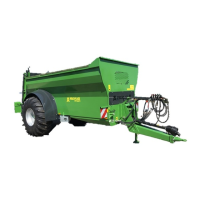

 To Next Page