Oscillometric market patented their technology
and tried to exert some control on the market
by aggressively pursuing patent litigation. The
result of this was not that they were able to
keep any other manufacturers out of the
market, but rather that all manufacturers have
been legally forced to use slightly different
methods. Key differences in these methods
include:
1. Different cut-off frequencies for the AC
channel high pass and low pass filters.
2. Different metrics for measuring pulse size.
3. Different methods for averaging pulse size.
4. Different methods for finding the peak of the
pulse size envelope.
5. Different methods for determining average
cuff pressure on a given pressure step.
6.Different methods and coefficients for
extracting systolic and diastolic pressure from
the pulse size envelope.
7. Different methods of controlling cuff
pressure such as step down, step up, bleed
down, and bleed up.
Since the oscillometric signal is complex and
different for different patients these design
differences can lead to identical results on
some patients and quite different results on
others.
In addition to the design differences several
other factors lead to differences in readings
between manufacturers:
1. Every manufacturer has adjusted their
system based on the data they measured on
their test patient group. Of course, they used
different test patient groups. In theory the
groups are large enough that they should be
statistically identical, but in practice they can
still give different results.
2. Every manufacturer has adjusted their
system based on data which was measured by
the nurses they used to generate the manual
values for comparison. Of course, they used
different nurses. In theory the nurses are all
using the standard method, but in practice the
process is still subjective and different nurses
get slightly different results.
The end result of these differences is that the
various devices do yield similar but slightly
different results on the average, and on any
specific patient the results can be quite
different.
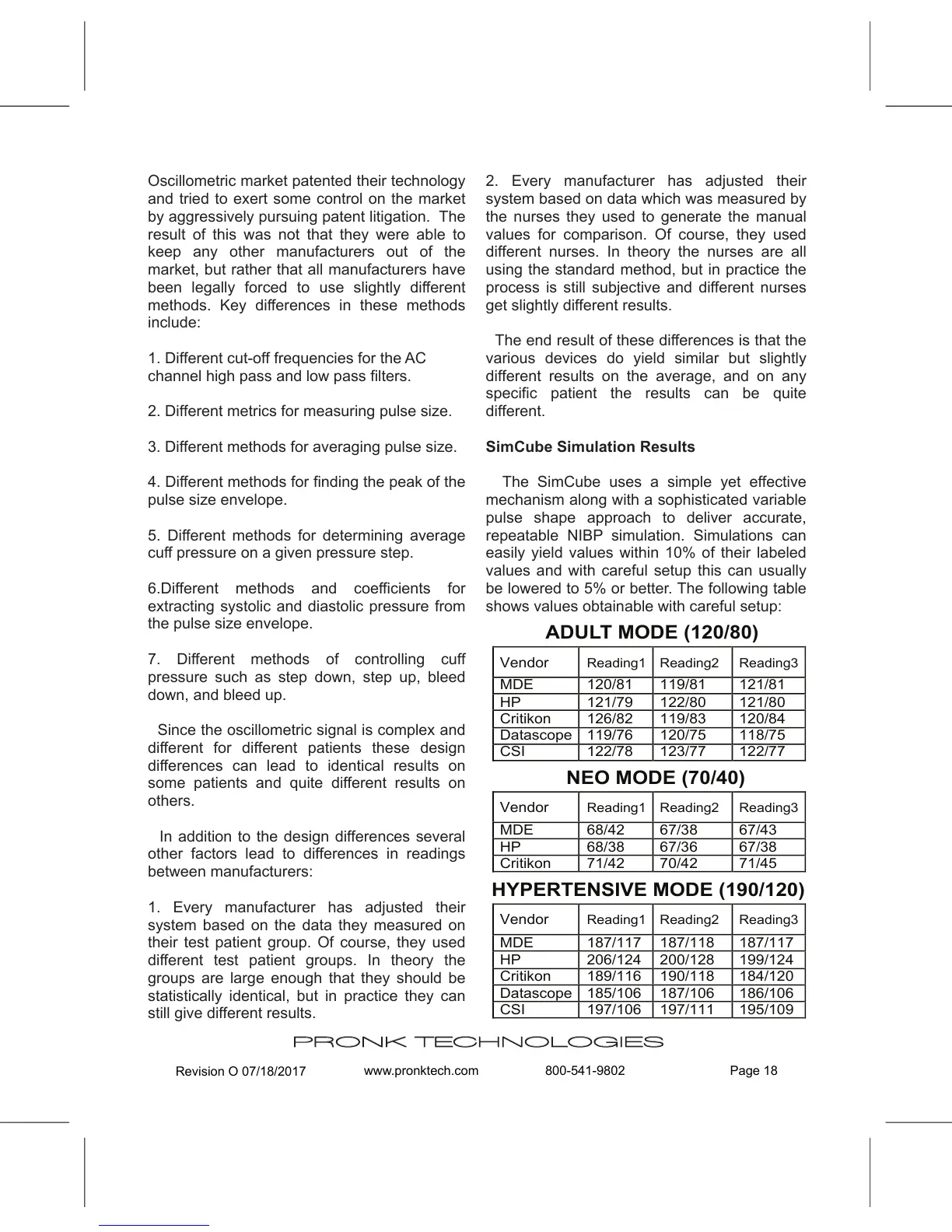
SimCube Simulation Results
The SimCube uses a simple yet effective
mechanism along with a sophisticated variable
pulse shape approach to deliver accurate,
repeatable NIBP simulation. Simulations can
easily yield values within 10% of their labeled
values and with careful setup this can usually
be lowered to 5% or better. The following table
shows values obtainable with careful setup:
ADULT MODE (120/80)
Vendor Reading1
Reading2 Reading3
MDE
120/81
119/81
121/81
HP
121/79
122/80
121/80
Critikon
126/82
119/83
120/84
Datascope
119/76
120/75
118/75
CSI
122/78
123/77
122/77
NEO MODE (70/40)
Vendor Reading1
Reading2 Reading3
MDE
68/42
67/38
67/43
HP
68/38
67/36
67/38
Critikon
71/42
70/42
71/45
HYPERTENSIVE MODE (190/120)
Vendor
Reading1
Reading2
Reading3
MDE
187/117
187/118
187/117
HP
206/124
200/128
199/124
Critikon
189/116
190/118
184/120
Datascope
185/106
187/106
186/106
CSI
197/106
197/111
195/109
Revision O 07/18/2017
www.pronktech.com 800-541-9802 Page 18
PRONK TECHNOLOGIES


 To Next Page
 Loading...