2
LIMITATIONS: Consider the following
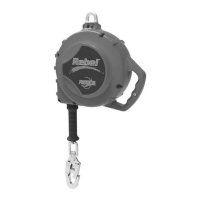
limitations when using the Reble SRL:
IT IS NOT PERMISSIBLE to 1.
make additions or alterations
to this equipment.
Follow manufacturer’s instructions 2.
for the correct use of the SRL
and associated accessories.
NEVER attach clips, etc., as a 3.
positioning device to the lifeline
which will prevent the lifeline
from retracting automatically. This
practice is dangerous as it leaves
excessive slack in the lifeline which,
in the event of a fall, will increase
the fall distance and the shock load
on the body to unacceptable levels.
Avoid allowing the lifeline to pass 4.
between your arms or legs while
moving about or working.
Avoid allowing the lifeline to contact 5.
paints, concrete, bitumen, oils,
etc. which will adversely affect the
SRL if it enters the mechanism.
Always keep the lifeline clean and 6.
free of dry mud, cement, etc. Failure
to do so could result in premature
locking and rewinding failure.
When detaching from the SRL 7.
do not quick-release the lifeline
allowing uncontrolled rewind
back into the device. This can
be dangerous and there is a
probability that the lifeline will
rewind unevenly. Uneven rewind of
lifeline can prevent full retraction.
Do not leave lifeline extended 8.
for long periods of time.
DO NOT repair equipment in 9.
the fi eld. Only Capital Safety is
equipped to repair Protecta devices.
DO NOT combine SRLs with other 10.
components such as lanyards
to extend their length.
DO NOT OPEN the SRL as the 11.
spring is under tension.
CHEMICAL HAZARDS: Solutions 12.
containing acid or caustic
chemicals, particularly at elevated
temperatures, may damage Protecta
SRLs. When working with such
chemicals, frequent inspection of
the entire SRL must be completed.
If chemical damage is detected the
SRL must be removed from service.
Exercise caution when using 13.
this equipment around moving
machinery or electrical hazards.
RESCUE: When using this equipment,
the employer must have a rescue plan
and the means at hand to implement
and communicate that plan to users,
authorized persons, and rescuers.
OPERATION AND USE
WARNING: Read and understand all
instructions and warnings on the labels attached
to the device before using. These instructions
and warnings are placed on the device for your
protection. Be sure that you understand and follow
these directions carefully.
Before using this equipment,
make a visual inspection to ensure
serviceable condition of the device (see
Inspection). Under no circumstances
should the SRL be used if the lifeline
has any defect (i.e., cut fi bers or is
not retracting correctly). To check
for proper lifeline operation:
Pull the entire length of lifeline 1.
out and allow it to retract
slowly through your hand.
Test the locking mechanism several 2.
times by jerking down on the lifeline
and ensuring the system locks.
SRLs with suspected faults should be
immediately withdrawn from service.
IMPORTANT: Always hold on to the lifeline
while it is rewinding into the SRL. Do not leave the
lifeline extended for long durations.
WARNING: The Rebel SRL should always
be used with a Capital Safety approved Full Body
Harness. Never use a waist or chest belt of any
type for fall arrest hazards.
After connecting the Fall Arrest Device to
a safe anchorage point attach the snap
hook at the end of the lifeline to the
dorsal D-ring of the harness, ensuring
that the snap hook closes fully and locks.
In situations where it is necessary to use
a front D-ring as a point of attachment
such as working on a fi xed ladder a
harness with chest D-rings must be
used. Refer to OSHA requirements.
Capital Safety highly recommends
the exclusive use of DBI-SALA or
Protecta full body harnesses with all
its individual fall prevention systems.
Make every effort to keep the
lifeline clean and free from dry
mud, cement, etc. Failure to do
so can result in premature locking
and rewind failure of the device.
Never allow the lifeline to contact sharp
abrasive edges, i.e. girders, roofi ng
panels, etc. which could damage
and ultimately weaken the lifeline.
The SRL permits complete freedom
of movement; however, ensure
that you move normally as sudden
or quick movements will activate
the locking mechanism.
While using, always ensure that there
is constant tension on the lifeline.
Slack in the lifeline could result in an
increase in fall distance. Move normally,
sudden jerky movements will activate
the locking mechanism. In the event
of a fall, the fall arrest device must
not be used until it has been visually
checked by a competent person.
INSPECTION
Before Each Use: • OSHA 1910.66,
OSHA 1926.502 and ANSI
Z359.1 requires an inspection
of equipment before each use
(see Inspection Steps).
Annually: • ANSI Z359.1 requires
a formal inspection of the SRL
be completed by a competent
person other than the user at least
annually. More frequent inspections
by a competent person may be
required based on the nature and
severity of workplace conditions
affecting the equipment and the
modes of use and exposure time
of the equipment (see Inspection
Steps). Record the results of
each formal inspection in the
Inspection and Maintenance log
at the end of this manual.
After a Fall Arrest: • Rebel SRLs are
not repairable and must be removed
from service after a fall arrest.
WARNING: If the self retracting lifeline has
been subjected to fall arrest or impact forces, it
must be removed from service.
IMPORTANT: Extreme working conditions
(harsh environment, prolonged use, etc.) may
require increasing the frequency of inspections.
INSPECTION STEPS:
Inspect for loose screws and 1.
bent or damaged parts.
Inspect housing for distortion, 2.
cracks or other damage. Ensure
the swivel eye is not damaged
or distorted in any way. Ensure
the swivel eye turns freely.
The lifeline must fully extend 3.
and retract without hesitation or
creating a slack line condition.
Ensure the device locks up when 4.
lifeline is jerked sharply. Lock-up
must be positive, with no slipping.
The labels must be present and 5.
fully legible (see Labels).
Look for signs of corrosion 6.
on the entire unit.
Inspect the web lifeline for 7.
concentrated wear, frayed strands,
broken yarn, burns, cuts, and
abrasions. The lifeline must be
free of knots throughout its length.
Inspect for excessive soiling, paint
build-up, and rust staining. Inspect
for chemical or heat damage
indicated by brown, discolored, or
brittle areas. Inspect for ultraviolet
damage indicated by discoloration
and the presence of splinters and
slivers on the lifeline surface.
Inspect connecting hooks or 8.
carabiners for signs of damage,
corrosion, and working condition.


 To Next Page
 Loading...