13 Fundamentals on wo rking with the machine
27 of 54
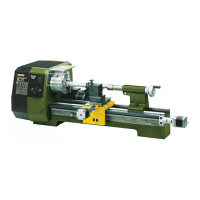
13.3. Fundamentals on turning and the PD 400 CNC lathe
13.3.1. Straight turning
Straight turning is the type of turning whereby the cutter moves on a path parallel to the
work piece axis, the "longitudinal feed".
The cutting depth, also called "infeed" is the amount by which the cutter dips deeper into
the material for every turning cycle.
"Feed" is the distance per revolution of the work piece which the tool travels on its path.
The cutting cross-section is therefore the product of feed and cutting depth. Straight
turning is the most common machining type.
13.3.2. Grooving and parting
Grooving is the manufacture of fine grooves through radial infeeding of the cutting tool
without longitudinal feed.
If the tool is infeed so much that the work piece is thus "cut through" (meaning up to the
rotary axis or the centre of the work piece), then this is called "parted".
In principle:
The height of the cutting edge of the parting tool must be adjusted precisely to the height
of the centre of the work piece! Also, the tool must be clamped as short as possible:
Too much free length always means deformation and susceptibility to vibrations! This
naturally applies to straight turning as well.
Use a low speed and lubricate the tool if possible with a bit of machine oil.


 To Next Page
 Loading...