Common Sources of CO
Common sources of potentially dangerous levels
of
CO are:
• Poorly maintained furnaces, gas heaters,
or
fireplaces.
• Dirty
or
plugged chimneys, or flue exhausts.
• Poorly maintained gas, oil,
or
kerosene appliances.
• Internal combustion engines (e.g
.,
automobiles, lawnmowers, blowers).
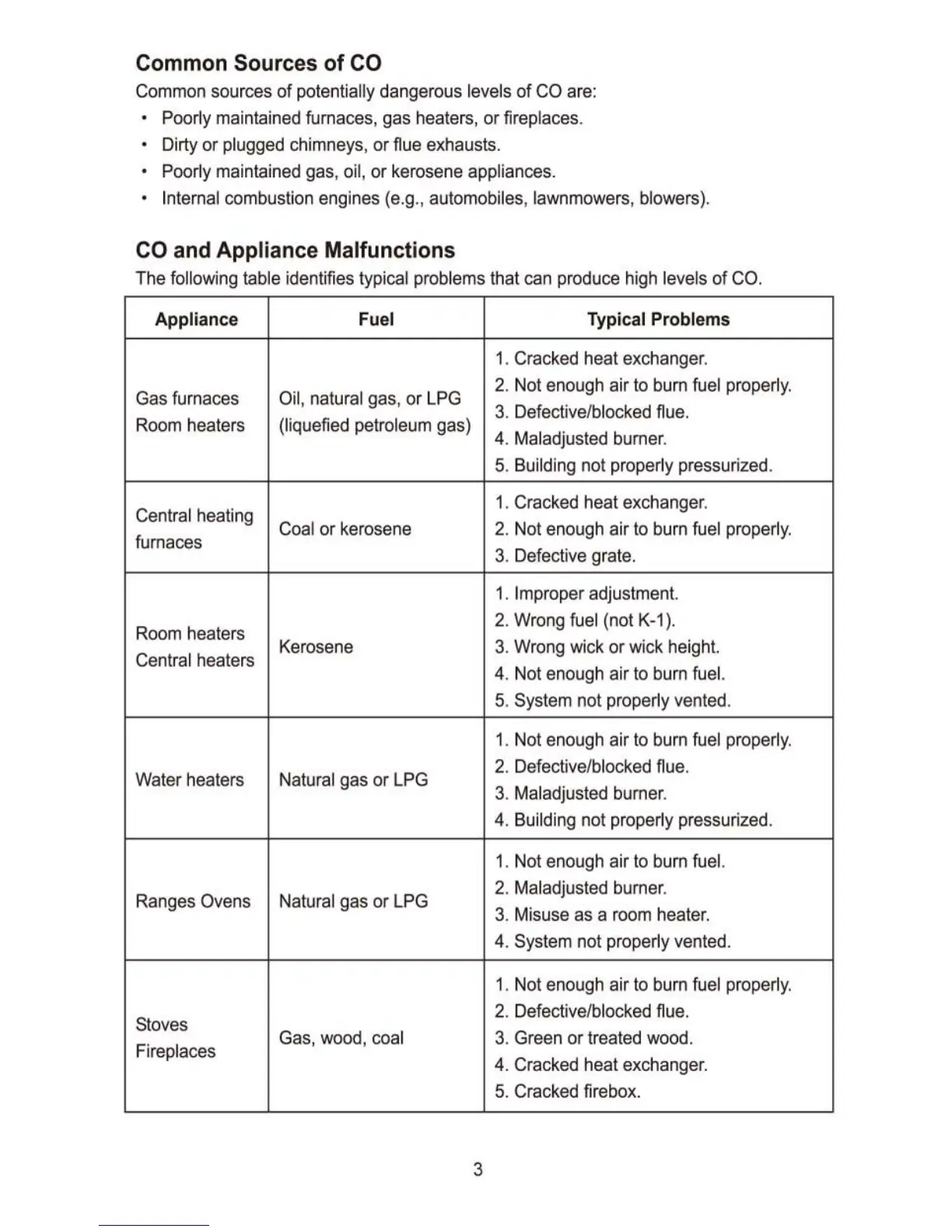
CO and Appliance Malfunctions
The following table identifies typical problems that can produce high levels of CO.
Appliance
Fuel
Typical
Problems
1.
Cracked heat exchanger.
Gas furnaces Oil, natural gas,
or
LPG
2.
Not enough air to burn fuel properly.
3. Defective/blocked flue.
Room heaters
(l
iquefied petroleum gas)
4. Maladjusted burner.
5.
Building not properly pressurized.
Central heating
1.
Cracked heat exchanger.
furnaces
Coal
or
kerosene
2.
Not enough air to burn fuel properly.
3.
Defective grate.
1.
Improper adjustment.
Room heaters
2.
Wrong fuel (not K-1).
Kerosene
3.
Wrong wick
or
wick height.
Central heaters
4. Not enough air to burn
fuel.
5. System not properly vented.
1.
Not enough air to burn fuel properly.
Water heaters
Natural gas
or
LPG
2. Defective/blocked
flue.
3.
Maladjusted burner.
4.
Building not properly pressurized.
1. Not enough air to burn
fuel.
Ranges Ovens Natural gas
or
LPG
2. Maladjusted burner.
3.
Misuse as a room heater.
4. System not
properly vented.
1. Not enough air to burn
fuel properly.
Stoves
2. Defective/blocked
flue.
Fireplaces
Gas, wood, coal
3.
Green
or
treated wood.
4. Cracked heat exchanger.
5.
Cracked firebox.
3


 To Previous Page
 Loading...