The Radley Multi-Purpose Sharpener, model 1281-112, is a versatile tool designed for sharpening various items, including hatchets, knives, scissors, and drill bits. It is intended for household use and comes with a 3-year limited warranty against defects in material and workmanship.
Function Description:
The sharpener is designed to provide a convenient and efficient way to maintain the sharpness of common household tools. It features multiple sharpening slots and guides to accommodate different types of items. For sharpening hatchets and similar tools, the blade is inserted into the sharpening slot and pulled through. Knives and kitchen utensils are sharpened by inserting the blade into the guide and pulling the item through. Scissors are sharpened by placing the blade in the oblique cut side and pulling through. Drill bits are sharpened using a dedicated drill bit holder and positioning claws, allowing for precise angle adjustment and rotation to ensure even sharpening. The tool includes a dust box to collect debris generated during sharpening, which should be emptied after each use.
Important Technical Specifications:
- Rating: 120 V, 60 Hz AC
- Amperes: 1 A
- Grinding Speed: 5,500 RPM (no load)
- Sharpens Bit Sizes: 1/8-1/2" (3-13mm)
- Tool Weight: 4.6 lbs. (2.1kg)
Usage Features:
The Radley Multi-Purpose Sharpener is designed for ease of use with clear instructions for each sharpening task.
- Sharpening Hatchets and Knives: For hatchets and similar tools, the blade is inserted into the sharpening slot and pulled toward you. For knives and kitchen utensils, the blade is placed in the guide and pulled toward you.
- Sharpening Scissors: Scissors are sharpened by placing the blade in the oblique cut side and pulling toward you.
- Sharpening Drill Bits: This process involves several steps for precision. First, the drill bit holder is inserted into the guide, and the drill bit holder is turned counterclockwise to adjust the depth dial. The positioning claws are opened by pushing down on the plunger. The drill bit is then inserted into the drill bit holder, ensuring the drill bit tip is in contact with the internal positioning pad. The plunger is pulled up to close the positioning claws, holding the bit securely. The drill bit holder is then rotated to allow the bit to be inserted inside. The drill bit is rotated inside the holder, and the claws meet the surface of the drill bit when it is rotated. Finally, the drill bit holder is turned clockwise to lock the drill bit into place. The sharpener is designed for drill bits 10mm (3/8") or larger, with the top sharpener intended for drill bits 10mm (3/8") or smaller. The drill bit sharpener on the side is for bits smaller than 10mm (3/8"). The safety cover needs to be pushed off to one side. For bits smaller than 3/8" (10mm), the safety cover is pushed to the side, and the drill bit is inserted securely into the drill bit holder. The "rib" on the holder matches with the rib on the guide. The drill bit holder is oscillated in the sharpener, then removed and turned 180 degrees, reinserted, and oscillated to ensure symmetry while sharpening the bit. For bits larger than 3/8" (10mm), the drill bit is inserted into the drill bit holder, ensuring the cutting face of the drill bit aligns with the positioning rib on the drill bit holder. The drill bit is held securely, and the safety cover is pushed aside. The "rib" on the holder matches with the rib on the guide. The drill bit holder is oscillated in the sharpener, then removed and turned 180 degrees, reinserted, and oscillated to ensure symmetry while sharpening the bit.
- Extension Cords: Guidelines are provided for using extension cords, specifying minimum gauge (AWG) based on amperage rating and total length to prevent voltage drop and ensure safe operation. For example, for a 1A tool, a 16 AWG cord is recommended for lengths up to 50 ft (15m), and a 14 AWG cord for lengths up to 100 ft (30m).
Maintenance Features:
Regular maintenance is crucial for the longevity and safe operation of the sharpener.
- Cleaning: The dust collection boxes should be emptied after each use to prevent buildup and maintain performance.
- Grinding Wheels: The grinding wheels are consumable parts and will need to be replaced periodically. The manual states that important grinding wheels must be replaced with identical grinding wheels.
- General Maintenance: The manual emphasizes that when servicing, only identical replacement parts should be used. Any attempt to repair or replace electrical parts on this tool may create a safety hazard unless repairs are performed by a qualified technician. Do not use solvents when cleaning plastic parts. Most plastics are susceptible to damage from various types of commercial solvents and may be damaged by their use. Use a clean cloth to remove dirt, dust, oil, grease, etc.
- Warning on Lubricants: Do not use solvents, gasoline, petroleum-based products, penetrating oils, etc., to come in contact with plastic parts as they contain chemicals that can damage, weaken, or destroy plastic.
- Plug Maintenance: Remove the plug from the socket before carrying out any adjustment, service, or maintenance.
Safety Guidelines:
The manual stresses the importance of safety during operation.
- Eye Protection: Always wear CSA-approved eye protection that conforms with CSA requirements or ANSI Safety Standard Z87.1. Flying debris can cause permanent eye damage. Prescription eyeglasses are not a replacement for proper eye protection.
- Ear Protection: Wear hearing protection, particularly during extended periods of operation of the tool, or if the operation is noisy.
- Face Protection: Wear face protection.
- Dust Mask: Wear a dust mask that is designed to be used when operating a power tool in a dusty environment. Dust created by power sanding, sawing, grinding, drilling, and other construction activities may contain chemicals that are known to cause cancer, birth defects, or other genetic abnormalities.
- Electrical Safety: Avoid body contact with earthed or grounded surfaces. Do not expose power tools to rain or wet conditions. Do not abuse the cord. Never use the cord for carrying, pulling, or unplugging the power tool. Keep cord away from heat, oil, sharp edges, or moving parts. This tool is wired at the factory for 120 V AC operation. It must be connected to a 120 V AC, 15 A circuit that is protected by a time-delayed fuse or circuit breaker. To avoid shock or fire, replace power cord immediately if it is worn, cut, or damaged in any way.
- Work Area Safety: Keep the work area clean and well lit. Cluttered or dark areas invite accidents.
- Personal Safety: Stay alert, watch what you are doing, and use common sense when operating a power tool. Do not use a power tool while you are tired or under the influence of drugs, alcohol, or medication. Dress properly; do not wear loose clothing or jewelry. Keep your hair, clothing, and gloves away from moving parts.
- Tool Specific Warnings: Do not plug in the tool until you have read and understood the instruction manual. Learn the tool's applications and limitations, as well as the specific potential hazards related to this tool. Always wear eye protection. Do not allow foreign objects into vent eyes and cause permanent eye damage. Always wear safety goggles (not glasses) that comply with ANSI safety standard Z87.1. Average glasses have only impact resistant lenses. They are NOT safety glasses.
- Grinding Wheels: Abrasive grinding wheels should be stored and handled with care. Examine the grinding wheel before use; do not use chipped, cracked, or otherwise deficient products. Use only grinding wheels reinforced with organic bond (80m/s). Make sure that the abrasive product is correctly mounted and clamped before use. Avoid use in the presence of flammable materials or substances. Sparks created by the tool may ignite them. Make sure air vents are unobstructed and cleaned of dust. Grinding wheels continue to rotate after the motor stops. If the supply cord is damaged, it must be replaced by the manufacturer, its service agent, or similarly qualified persons. When servicing, use only identical replacement parts. To reduce the risk of electric shock, this equipment has a polarized plug (one blade is wider than the other). This plug will fit in a polarized outlet only one way. If the plug does not fit fully in the outlet, reverse the plug. If it still does not fit, contact a qualified electrician to install the proper outlet. Do not change the plug in any way. Do not operate this tool in a damp location. Do not apply water to tool.

 Need help?
 General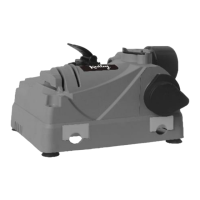

 To Next Page
