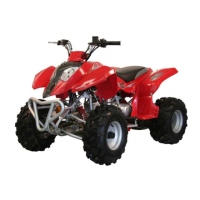
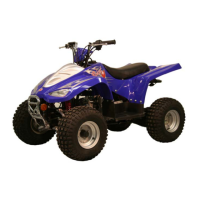
The provided manual describes the Redcat KMX-50 ATV, a children's quad designed for off-road use.
Function Description:
The Redcat KMX-50 is a motorized all-terrain vehicle (ATV) specifically designed for children. Its primary function is to provide a safe and enjoyable riding experience for young riders, from beginners to more experienced youth. The ATV is equipped with features that prioritize safety, ease of use, and adaptability to a child's developing skill level. It is intended for recreational off-road use only and is not legal or safe for use on public streets, roads, or highways.
Important Technical Specifications:
- Engine: Four-stroke engine, known for reliability, ease of starting, and simple maintenance.
- Displacement: 50cc (Note: The manual mentions that in some countries, ATVs with 50cc or smaller engines cannot be driven by those aged 6 and under).
- Transmission: Unique transmission with automatic and semi-automatic gear options. It can start in any gear (second or third gear is recommended for beginners). The gearbox can be locked into first or second gear to function as an automatic vehicle for less experienced riders. For older/experienced children, the gear lever can be left on, providing four semi-automatic gears.
- Brakes: Single brake system designed for simplicity, stopping the quad with one lever/pedal.
- Fuel Type: Unleaded gasoline (same as used in cars).
- Engine Oil: Recommended SAE20w/50 x 900ml for summer/hot climates (15w-40 or 20w-50 conventional motor oil) and 10w-30 or 10w-40 conventional motor oil for cold/cool climates. Synthetic oil or synthetic blends are not recommended for the centrifugal clutch due to slipperiness, which could cause premature clutch lining failure.
- Tires: Bouncy tires for off-road performance.
- Suspension: Rear suspension.
- Size & Weight: Uniquely small and lightweight, making it easy for children to handle and convenient for transport.
- Valve Clearance: Intake valve clearance check for 0.004 inches, exhaust valve clearance check for 0.006 inches.
Usage Features:
- Self-Starter: Allows a child to start the ATV independently.
- Headlight: Included for visibility and safety.
- Safety Keys: Similar to adult vehicles, keys can be removed and stored for added safety.
- Speed Governor (Throttle Limiter): Located on the handlebar, this adjustable screw restricts the maximum speed of the ATV. It can be set to allow very slow travel for beginners and gradually increased as the child gains experience.
- Rear Engine Cutout Switch: A safety feature allowing a supervising adult to walk behind the quad and, with a quick tug on an attached cord, cut out the engine and stop the vehicle.
- Single Brake System: Simplifies braking for young riders, reducing confusion.
- Gear Shifter (Optional Removal): For children with little or no ATV riding experience, the gear shift lever can be removed to prevent accidental shifting, allowing the ATV to function like an automatic. It can be re-installed later.
- Foot Brake: Located on the right side of the ATV.
- Choke Lever: Located on the left side, under the front plastic fender, used for starting the ATV when cold.
- Fuel Valve: Has three positions: OFF, RUN, and RESERVE. Should always be turned to OFF when the ATV is not in use.
- Riding Environment: Must be used on level, open ground, free of obstacles, people, and animals. Designed for off-road use only.
- Supervision: Children must NEVER be unsupervised while riding. Riders under 16 should ride only with adult supervision and after training.
- Protective Gear: Riders must always wear an approved helmet, eye protection, gloves, a long-sleeved jacket, long pants, and boots. Loose clothing should be avoided.
Maintenance Features:
- Regular Oil Checks: Engine oil levels should be checked at least once per month, and oil added if needed.
- Oil Changes: Engine oil should be drained and changed every 3 months. It is recommended to drain and add new oil prior to the first use.
- Battery Fluid Check: Battery fluid levels should be checked at least once per month and kept within the upper and lower marked levels. Only distilled water should be used for refilling.
- Brake Adjustment: Brakes should be checked and adjusted before each use. The adjusting nut can be turned clockwise to increase stopping power or counter-clockwise to reduce pressure if the brake is dragging. An inspection plug allows checking brake shoe lining.
- Clutch Adjustment: The centrifugal clutch has an external adjustment screw. To adjust, loosen the jamb nut, turn the stud counter-clockwise until resistance is felt, then turn it 1/8 turn clockwise. Tighten the locknut to 11 ft.lb. torque. Clockwise rotation increases free play (more slippage), counter-clockwise decreases free play (less slippage).
- Chain Adjustment: After initial break-in (and periodically thereafter), the chain slack needs to be adjusted by rotating the axle housing. Loosen two bolts, then tighten adjusting nuts evenly until there is only half an inch of slack. The chain should be inspected and lubricated before each ride. If slack cannot be removed, the chain should be replaced.
- Valve Clearance Check: Recommended after the first 10-20 hours of riding. Involves removing valve covers, checking for rocker arm looseness, and using a feeler gauge (0.004" for intake, 0.006" for exhaust) to ensure a snug fit. Adjusting nuts and lock nuts are used to set the desired gap.
- Carburetor Adjustment:
- Fuel Screw: For leaning out the mixture at higher altitudes, turn the fuel screw all the way in (clockwise) then back out two turns (counter-clockwise).
- Idle Screw: Adjusts idle RPM to around 1400-1500 RPM, balanced with the fuel screw.
- Main Fuel Needle (Advanced Adjustment): Located inside the slide assembly, the retaining clip on the needle can be moved to different slots. Moving the clip up (away from the tip) leans out the mixture; moving it down (closer to the tip) richens it.
- Spark Plug Inspection: The color of the spark plug tip (beer bottle brown is ideal) indicates if the mixture is running lean (white/light gray) or rich (black/carbon/wet). Running lean can cause severe engine damage. A new plug is needed for each test.
- Throttle Cable Adjustment: Ensures full throttle pull and sets 2-4mm of free play in the thumb throttle lever. A turnbuckle assembly under the front panel is used for this adjustment.
- Storage (60+ days): Requires draining all fuel from the tank, lines, and carburetor. Pouring a teaspoon of SAE 10w30 motor oil into the spark plug hole and turning the engine over slowly by hand (without plug wire) to coat cylinder walls. Lubricate control cables. Block up the frame to keep wheels off the ground. Cover the exhaust pipe. Coat exposed metal surfaces with a light oil film. Remove, fully charge, and store the battery in a dry place, recharging monthly.

 Need help?
 General

 To Next Page