EasyManua.ls Logo

Renault Master Van 2004 - Page 133

Renault Master Van 2004
190 pages
Print Icon
To Next Page IconTo Next Page
To Previous Page IconTo Previous Page
Loading...
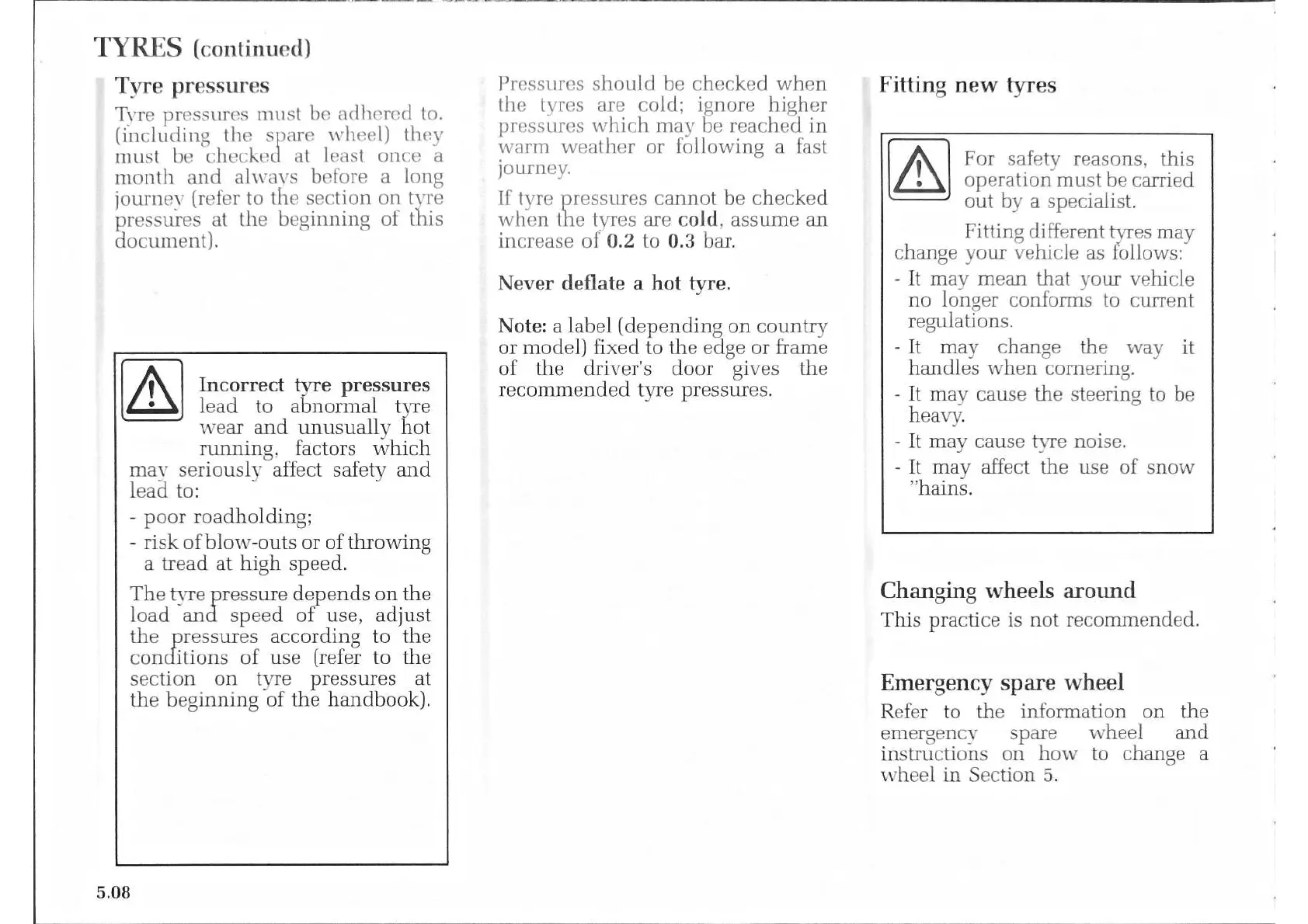
TYRES
(continued)
Tyre
pressures
Tyre
pressures
must
be
adhered
to.
(including
the
spare
wheel)
they
must
be
chec
kad
at
least
once
a
month
and
always
before
a
long
journey
(refer
to
the
section
on
tyre
pressures
at
the
beginning
of
this
document).
Incorrect
tyre
pressures
lead
to
abnormal
tyre
wear
and
unusually
hot
running,
factors
which
may
seriously
affect
safety
and
lead
to:
-
poor
roadholding;
-
risk
of
blow-outs
or of
throwing
a
tread
at
high
speed.
The
tyre
pressure
depends
on
the
eat
and
speed
of
use,
adjust
ressures
according
to
the
ie
fone
of
use
(refer
to
the
section
on
tyre
pressures
at
the
beginning
of
the
handbook).
5.08
Pressures
should
be
checked
when
the
tyres
are
cold;
ignore
higher
pressures
which
may
be
reached
in
warm
weather
or
following
a
fast
journey.
If
tyre
pom
cannot
be
checked
when
the
tyres
are
cold,
assume
an
increase
of
0.2
to
0.3
bar.
Never
deflate
a
hot
tyre.
Note:
a
label
(depending
on
country
or
model)
fixed
to
the
edge
or
frame
of
the
driver's
door
gives
the
recommended
tyre
pressures.
Fitting
new
tyres
For
safety
reasons,
this
operation
must
be
carried
out by
a
specialist.
Fitting
different
tyres
may
change
your
vehicle
as
follows:
-
It
may
mean
that
your
vehicle
no
longer
conforms
to
current
regulations.
-It
may
change
the
way
it
handles
when
cornering.
-
It
may
cause
the
steering
to
be
heavy.
-
It
may
cause
tyre
noise.
-
It
may
affect the
use
of
snow
“hains,
Changing
wheels
around
This
practice
is
not
recommended.
Emergency
spare
wheel
Refer
to
the
information
on
the
emergency
spare
wheel
and
instructions
on
how
to
change
a
wheel
in
Section
5.

Related product manuals