EasyManua.ls Logo

Renault Master Van 2004 - Child Safety and Seat Installation

Renault Master Van 2004
190 pages
Print Icon
To Next Page IconTo Next Page
To Previous Page IconTo Previous Page
Loading...
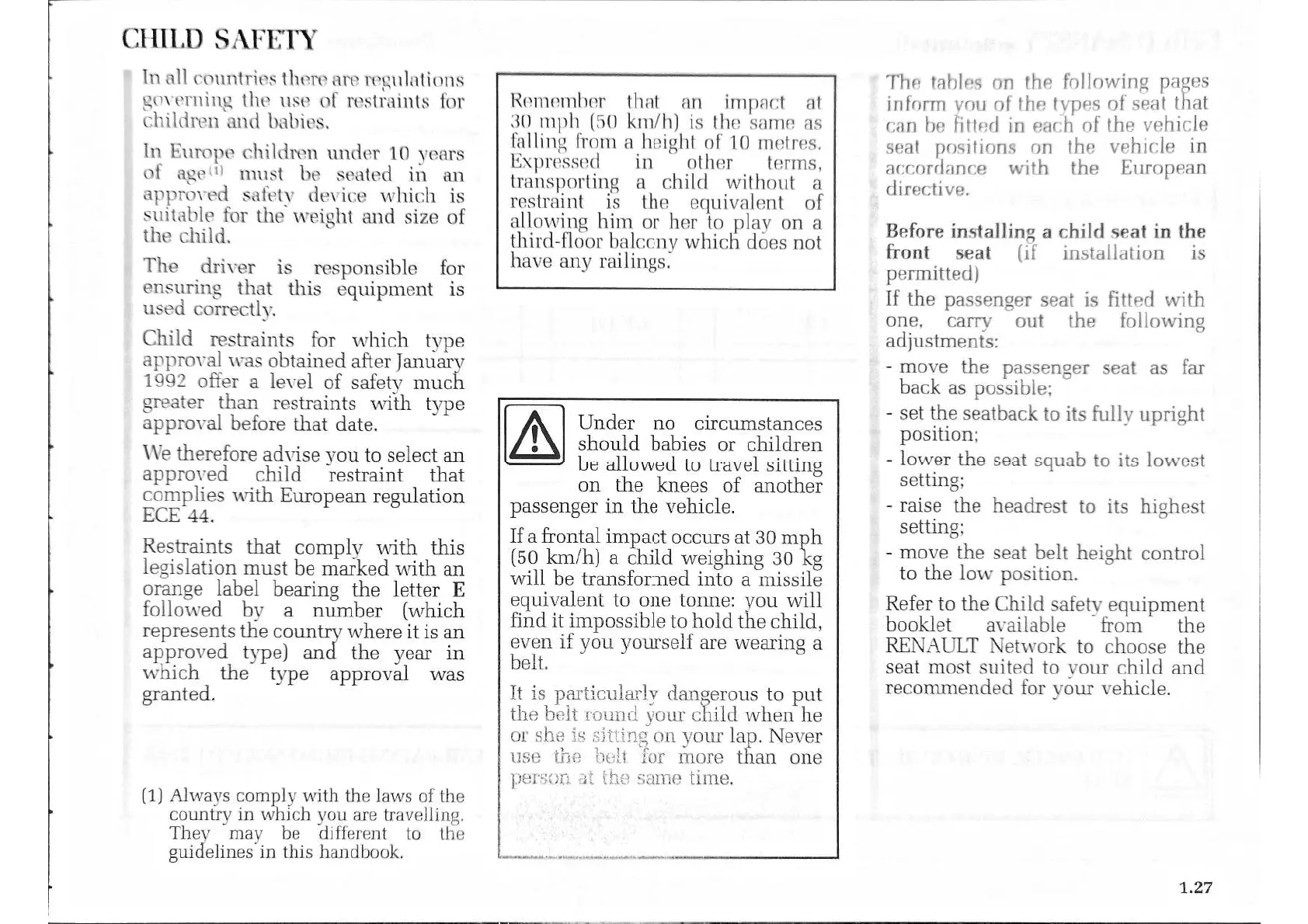
CHILD
SAFETY
Tn
all
countries
there
are
regulations
governing
the
use
of
restraints
for
children
and
babies.
In
Europe
children
under
10
years
of
age’
must
be
seated
in
an
approved
satety
device
which
is
suitable
for
the
weight
and
size
of
the
child,
The
driver
is
responsible
for
ensuring
that
this
equipment
is
used
correctly.
Child
restraints
for
which
type
approval
was
obtained
after
January
1992
offer
a
level
of
safety
much
greater
than
restraints
with
type
approval
before
that
date.
We
therefore
advise
you
to
select
an
approved
child
restraint
_
that
complies
with
European
regulation
ECE
44.
Restraints
that
comply
with
this
legislation
must
be
marked
with
an
orange
label
bearing
the
letter
E
followed
by
a
number
(which
represents
the
country
where
it
is
an
approved
type)
and
the
year
in
which
the
type
approval
was
granted.
(1)
Always comply
with
the
laws
of
the
country
in
which
you
are
travelling.
They
may
be
different
to
the
guidelines
in
this
handbook.
Remember
that
an
impact
at
30
mph
(50
km/h)
is
the
same
as
falling
from
a
height
of
10
metres.
Expressed
in
other
_
terms,
transporting
a
child
without
a
restraint
is
the
equivalent
of
allowing
him
or
her
to
play
on
a
third-floor
balcony
which
does
not
have
any
railings.
Under
no
circumstances
should
babies
or
children
be
allowed
to
travel
sitting
on
the
knees
of
another
passenger
in
the
vehicle.
Ifa
frontal
impact
occurs
at
30
mph
(50
km/h)
a
child
weighing
30
kg
will
be
transformed
into
a
missile
equivalent
to
one
tonne:
you
will
find
it
impossible
to
hold
the
child,
on
if
you
yourself
are
wearing
a
belt.
It
is
particularly
dangerous
to
put
the
belt
round
your
child
when
he
on
your
lap.
Never
r
more
than
one
me
time.
The
tables
on
the
following
pages
inform
you
of
the
types
of
seat
that
can
be
fitted
in
each
of
the
vehicle
seat
positions
on
the
vehicle
in
accordance
with
the
European
directive.
Before
installing
a
child
seat
in
the
front
seat
(if
installation
is
permitted)
If
the
passenger
seat
is
fitted
with
one,
carry
out
the
following
adjustments:
-
move
the
passenger
seat
as
far
back
as
possible;
-
set
the
seatback
to
its
fully
upright
position;
-
lower
the
seat
squab
to
its
lowest
setting;
-
raise
the
headrest
to
its
highest
setting;
-
move
the
seat belt
height
control
to
the
low
position.
Refer
to
the
Child
safety
equipment
booklet
available
“from
the
RENAULT
Network
to
choose
the
seat
most
suited
to
your
child
and
recommended
for
your
vehicle.
1.27

Related product manuals