EasyManua.ls Logo

Reno A&E BX Series - User Manual

Reno A&E BX Series
2 pages
Print Icon
To Next Page IconTo Next Page
Loading...
Model BX Operating Instructions 09-05-01.doc 4 RENO A&E P/N 551-2900-00
Reno A & E
4655 Aircenter Circle
Reno, NV 89502-5948 USA
Telephone: (775) 826-2020
Fax: (775) 826-9191
Website: www.renoae.com
E-mail: contact@renoae.com
Engineering Excellence!
Loop Installation
The vehicle detection characteristics of the inductive loop detector are greatly influenced by the loop size and
proximity to moving metal objects such as gates. Vehicles such as small motorcycles and high-bed trucks can
be reliably detected if the proper size loop is selected. If the loop is placed too close to a moving metal gate, the
detector may detect the gate. The diagram below is intended as a reference for the dimensions that will
influence the detection characteristics.
General Rules
1. The detection height for a loop is 2/3rds the shortest leg (A or
B) of the loop. Example: Short leg = 6’ then Height = 4’.
2. As leg A is made longer, distance C will need to increase.
3. For reliable detection of small motorcycles, legs A and B
should not exceed 6 feet.
Loop Installation - Saw Cut Type
1 Mark the loop layout on the pavement. Remove sharp inside corners that can damage the loop wire insulation.
2 Set the saw to cut to a depth (typically 2" to 2.5") that insures a minimum of 1" from the top of the wire to pavement surface.
The saw cut width should be larger than the wire diameter to avoid damage to the wire insulation when placed in the saw
slot. Cut the loop and feeder slots. Remove all debris from the saw slot with compressed air. Check that the bottom of the
slot is smooth.
3 It is highly recommended that a continuous length of wire be used to form the loop and feeder to the detector. Loop wire is
typically 14, 16, 18, or 20 AWG with cross-linked polyethylene insulation. Use a wood stick or roller to insert the wire to the
bottom of the saw slot (do not use sharp objects). Wrap the wire in the loop saw slot until the desired number of turns is
reached. Each turn of wire must lay flat on top of the previous turn.
4 The wire must be twisted together a minimum of 6 twists per foot from the end of the saw slot to the detector.
5 The wire must be held firmly in the slot with 1" pieces of backer rod every 1 to 2 feet. This prevents the wire from floating
when the loop sealant is applied.
6 Apply the sealant. The sealant selected should have good adhering properties with similar contraction and expansion
characteristics to that of the pavement material.
OPERATING INSTRUCTIONS FOR
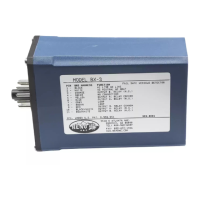
Model BX Series
SINGLE CHANNEL LOOP DETECTORS
I General
Please verify source voltage before applying power. The model designations indicate the
input power required for each detector as follows:
Model BX-3 BX-7 BX-8 BX-23 BX-24
Voltage 120VAC 24VAC 240VAC 12VDC 24VDC
Each detector is factory configured for either Fail-Safe or Fail-Secure operation (see unit side
label).
Fail-Safe Fail-Secure
Relay Power Failure Loop Failure Power Failure Loop Failure
A Call Call No Call No Call
B No Call No Call No Call No Call
II Indicators and Controls
Status PWR Power LED DET Detect LED FAIL LED
Off No power or low power Output off Loop OK
On Normal power to detector Output on Open Loop
Flash N/A
4 Hz - 2 second timing
delay
1 Hz – Shorted Loop
3 Hz - Prior Loop Failure
Note: If the supply voltage drops below 75% of the nominal supply voltage, the
power LED will turn off, providing a visual check of low supply voltage. Model BX
detectors operate with supply voltage as low as 70% of nominal supply voltage.
Sensitivity Level Rotary Switch
The 8-position rotary switch selects one of eight sensitivity levels as shown below. 0 is lowest
and 7 is highest, with normal (factory default) being 3. Use the lowest sensitivity setting that
detects the desired vehicles.
Position 0 1 2 3 4 5 6 7
L/L
1.28% 0.64% 0.32% 0.16% 0.08% 0.04% 0.02% 0.01%
A = 6 ft 9 ft 12 ft 15 ft 18 ft 21 ft
C = 3 ft 4 ft 4.5 ft 5 ft 5.5 ft 6 ft
1
3
1/8" to 1/4" SAW SLOT
THE WIRE IS
CONTINUOUSLY WOUND
IN THE LOOP SAW SLOT
FOR THE REQUIRED
NUMBER OF TURNS (2
turns shown)
turn 2
turn 1
REMOVE SHARP
INSIDE CORNERS
FEEDER SLOT
END OF SAW CUT
4
THE WIRES MUST BE
TWISTED TOGETHER
6 TWISTS PER FOOT
FROM THE END OF
THE SAW CUT TO
THE DETECTOR
Recommended Loop Wire: Reno LW-120 for 1/8" slots
Reno LW-116-S for 1/4" slots
ROAD SURFACE
MIN
1"
SAW SLOT
SEALANT
BACKER ROD
1" piece
spaced about
ever
y
1'
LOOP WIRE
3 TURNS
2
6
5
LOOP PERIMETER NUMBER OF TURNS
10 feet - 13 feet 4
14 feet - 26 feet 3
27 feet - 80 feet 2
81 feet and up 1
A
B
C
A = Loop dimension parallel to the gate
B = Loop dimension perpendicular to the gate
C = Distance of the loop from the gate
SLIDE GATE

Question and Answer IconNeed help?

Do you have a question about the Reno A&E BX Series and is the answer not in the manual?

Overview

The Reno A&E Model BX Series Single Channel Loop Detectors are designed to reliably detect vehicles using inductive loops embedded in pavement. These detectors are suitable for a variety of applications, from traffic control to access management, and are engineered for durability and consistent performance.

Function Description

The primary function of the BX Series detectors is to sense the presence of a vehicle over an inductive loop. When a vehicle enters the loop's detection area, the detector outputs a "Call" signal via its relay, indicating the vehicle's presence. This signal can then be used to trigger gates, traffic lights, or other control systems. The detectors offer both Fail-Safe and Fail-Secure operating modes, which determine the relay's state during power or loop failures. In Fail-Safe mode, a power or loop failure results in a "Call" output on relay A, while relay B remains "No Call." In Fail-Secure mode, both relays A and B remain "No Call" during power or loop failures.

The detectors are highly configurable through front panel DIP switches, allowing users to tailor their operation to specific requirements. Key configurable features include:

  • Frequency Selection: Four distinct operating frequencies (Low, Medium-Low, Medium-High, High) can be selected to prevent crosstalk when multiple loops are in close proximity. High is the default frequency.
  • Presence Hold Time: The detector supports "Normal Presence" (Limited Presence) and "Infinite Presence" (True Presence) modes. In Limited Presence, the output call typically holds for 1-3 hours for normal-sized vehicles, while in True Presence, the call holds indefinitely as long as the vehicle is present or until power is removed/reset. True Presence is recommended for normal-sized vehicles and loops (12 ft² to 120 ft²).
  • Sensitivity Boost: This feature increases loop sensitivity only during the detect period, ensuring reliable detection of vehicles, particularly high-bed vehicles, without altering the sensitivity of a vacant loop.
  • Output Delay: A 2-second delay can be applied to outputs A and B. The output relays will only activate after a vehicle has been continuously present in the loop detection area for 2 seconds. If the vehicle leaves during this interval, detection is aborted, and a new delay cycle begins with the next vehicle.
  • Fault Output: Relay B can be configured to output a "Fault" signal only when a loop fault condition exists. If the fault self-corrects, relay B returns to a "No Fault" state. This setting overrides Entry Pulse/Exit Pulse configurations.
  • Entry Pulse/Exit Pulse: In Pulse Mode, the detector can be programmed to output a 250-millisecond pulse upon vehicle entry or exit over the loop. This setting does not affect output A.
  • Presence/Pulse Mode: Relay B can operate in either Presence or Pulse mode. In Pulse mode, the 250 ms pulse can be set for entry or exit via DIP switch 7. In Presence mode, the hold time is the same as output A.

Important Technical Specifications

  • Input Power: The BX Series offers various models to accommodate different power sources:
    • BX-3: 120VAC
    • BX-7: 24VAC
    • BX-8: 240VAC
    • BX-23: 12VDC
    • BX-24: 24VDC
    • Detectors operate with supply voltage as low as 70% of nominal supply voltage (75% for the power LED to remain on).
  • Loop Wire: Recommended loop wire types are Reno LW-120 for 1/8" slots and Reno LW-116-S for 1/4" slots.
  • Sensitivity Levels: An 8-position rotary switch allows selection of sensitivity from 0 (lowest, 1.28% ΔL/L) to 7 (highest, 0.01% ΔL/L). The factory default is 3 (0.16% ΔL/L).
  • Relay Outputs: The detectors typically feature two relay outputs (A and B) with Normally Open (N.O.) and Normally Closed (N.C.) contacts, depending on the model and configuration. Relay B (pulse relay) always operates in Fail Secure mode when power fails.
  • Loop Dimensions: General rules for loop installation include:
    • Detection height is 2/3rds the shortest leg of the loop.
    • Increasing leg A (parallel to the gate) requires increasing distance C (from the gate).
    • For reliable detection of small motorcycles, legs A and B should not exceed 6 feet.
  • Saw Cut Depth: Typically 2" to 2.5" to ensure a minimum of 1" from the top of the wire to the pavement surface.
  • Twisting: Loop wires must be twisted together a minimum of 6 twists per foot from the end of the saw cut to the detector.

Usage Features

  • LED Indicators:
    • PWR (Power LED): On when normal power is supplied, off for no power or low power.
    • DET (Detect LED): On when output is active, off when output is inactive. Flashes at 4 Hz during a 2-second timing delay.
    • FAIL (Fail LED): On for an open loop, flashes at 1 Hz for a shorted loop, and flashes at 3 Hz for a prior loop failure.
  • Call Memory: If power is removed for 2 seconds or less, the detector "remembers" if a vehicle was present and a Call was in effect, resuming the Call output when power is restored until the vehicle leaves the loop. This prevents gate arms from dropping on vehicles during brief power interruptions.
  • Automatic Fuse Recovery (BX-7 only): If 120VAC power is applied to the 24VAC BX-7 model, the fuse will open and automatically reset after 3 seconds of power removal.
  • Rotary Switch for Sensitivity: An easily accessible rotary switch allows for quick adjustment of sensitivity levels to optimize detection for various vehicle types and environmental conditions.

Maintenance Features

  • Loop Installation Guidelines: Detailed instructions for saw-cut loop installation ensure proper setup, including marking the layout, cutting the slot, removing debris, inserting the wire (using a wood stick or roller), twisting the feeder wires, securing the wire with backer rods, and applying sealant. These steps are crucial for long-term reliability and performance.
  • Troubleshooting with FAIL LED: The FAIL LED provides clear indications of loop faults (open, shorted, or intermittent), aiding in quick diagnosis and resolution of issues.
  • Reset Functionality: Changing any DIP switch position (except 1 or 2) or cycling power will reset the detector, clearing the loop fault memory and re-initializing the frequency selection.
  • Recommended Connections: For trouble-free operation, it is highly recommended that all connections, including crimped connectors, be soldered. A twisted pair of loop wires should be created from the loop to the detector, maintaining approximately six full twists per foot.

The Reno A&E Model BX Series detectors are designed for robust and reliable vehicle detection, offering a comprehensive set of features and configurations to meet diverse application needs while providing clear indicators and maintenance guidelines for optimal performance.

Reno A&E BX Series Specifications

General IconGeneral
BrandReno A&E
ModelBX Series
CategoryGas Detectors
LanguageEnglish