Operator’s Guide Appendix H
002-5572 RJS, Minneapolis, MN
41
Appendix H (Scanning Technique)
The RJS Inspector bar code verifier that is supplied with this document incorporates a model SP1
scanner. The new SP1 provides three major improvements when compared to the previous model:
1. Codes with X dimensions as small as 5 mils (.005 inch, .127 mm) can be analyzed (vs. .0075 inch,
.190 mm).
2. More accurate correlation to the ANSI Decodability calculation is achieved.
3. Bi-directional scanning movement provides better quiet zone analyses.
Scanning Technique
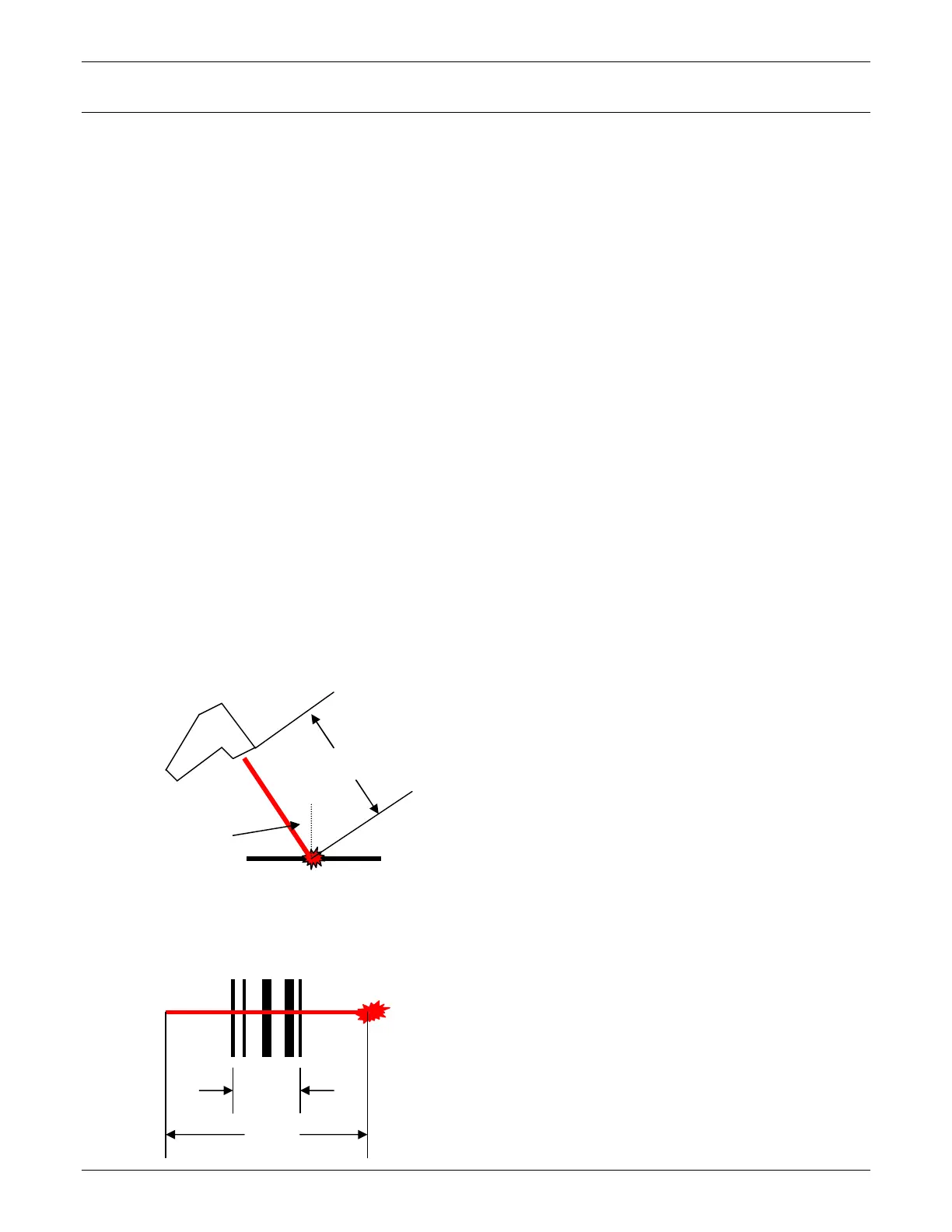
For most accurate analysis calculations, the laser beam should strike the bar code at an angle of approx-
imately 30 degrees from vertical as shown in Figure 1. The scan distance is a function of the width of the
bar code. Adjust the scan distance so it is a minimum of two inches (51 mm) or longer where the
width of the laser beam is twice the width of the bar code and the bar code is centered in the beam
as shown in Figure 2.
A label containing this information is also attached to the top of the scanner for quick reference.
Figure 1 – Scanning angle and distance
Scan distance – See Fig. 2
Scan Angle 30 degrees
From Vertical
Figure 2 – Optimum beam width and placement
Bar code centered in laser beam
*W
*2W



 To Next Page
 Loading...