EasyManua.ls Logo

RMO 660 - User Manual

RMO 660
11 pages
Print Icon
To Next Page IconTo Next Page
Loading...
LA SOUDEUSE ROCKY MOUNTAIN 660
660 MULTI PRUPOSE WELDER
DAS SCHWEIßGERÄT RM 660
La soudeuse Rocky Mountain 660 permet d’effectuer tous les travaux de soudure par points,
brasure (soudure par apport de métal) traitements thermiques et détrempes sur les appareillages
orthodontiques réalisés en acier inoxydable (Tru-chrome, Elgiloy). Son encombrement réduit et sa
polyvalence permettent son intégration dans le cabinet.
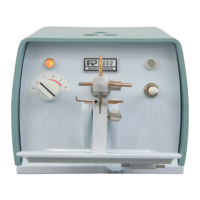
Your RMO 660 is a small, versatile, economical chairside unit created to fulfill the multi-purpose
requirements or Orthodontic and Pedodontic appliance fabrication. It occupies minimum counter
space and its light weight makes it appropriate for chairside and mobil use. Electrodes align
automatically and accessories add versatility to appliance fabrication.
Ihr RMO 660 ist ein kleines, vielseitiges, wirtschaftliches Behandlungsgerät, das entwickelt wurde,
um den Mehrzweckbedarf bei der Apparaturherstellung für die Kieferorthopädie und für die
Kinderzahnkunde zu erfüllen. Man benötigt einen minimalen Arbeitsplatz und das geringe Gewicht
ermöglicht den mobilen Einsatz am Stuhl. Die Elektroden zentrieren sich automatisch und das
Zubehör trägt zur Vielseitigkeit bei der Apparaturherstellung bei.
J64
J00064 Notice Instructions Rev01
Question and Answer IconNeed help?

Do you have a question about the RMO 660 and is the answer not in the manual?

Overview

The Rocky Mountain 660 (RMO 660) is a versatile, economical chairside unit designed for multi-purpose use in orthodontic and pedodontic appliance fabrication. It is a resistance welder, also capable of soldering, heat treating, and annealing. Its compact size and light weight make it suitable for both chairside and mobile use, requiring minimal counter space.

Function Description:

The RMO 660 operates on the principle of resistance welding, where an electrical charge of high amperage and very low voltage is passed through materials to be joined. The material's electrical resistance causes it to heat up to its fusion temperature. When two pieces of stainless steel are pressed together and heated to their fusion temperature, they fuse into one. This method is effective for materials that are poor electrical conductors, such as most types of stainless steel and Elgiloy® wire. However, highly conductive materials like aluminum, copper, and precious metal alloys are not suitable for resistance welding with this device.

The RMO 660 supports three primary functions:

  1. Spot Welding (Soudure par points / Punktschweißung): This is used for joining two pieces of material by applying heat and pressure. The device offers various electrode combinations tailored to different tasks, such as attaching to bands (matrices, plier-formed bands), small anterior and cuspid bands, wires to bands or crowns (for space maintainers, fixed linguals), and wires to wires (for finger springs, arch wire cribs, occlusal rests). Electrodes automatically align for ease of use.

  2. Soldering (Brasure / Elektrolöten): The RMO 660 can solder using either the turret-mounted carbon electrode or auxiliary cables. This technique is particularly recommended for fabricating space maintainers and fixed lingual arches. Bar solder, rather than wire solder, is preferred for this method. Soldering involves positioning and welding the materials, cleaning the carbon tip, setting the heat selector to "S," forming or choosing a solder pellet, applying flux, placing the solder, and then depressing the operate switch until the solder completely fuses. For soldering with auxiliary cables, materials are stabilized (e.g., with acrylic or wax), cables are plugged into the white receptacles, and specific cable tips (carbon tip and metal or vise tip) are used. The carbon tip is cleaned, flux is applied, and the solder is touched with the carbon tip until fusion.

  3. Heat Treatment (Traitement thermique / Stress-Relieving / Hitzhärtbarkeit) and Annealing (Détrempe / Das Glühen):

    • Heat Treatment (Stress-Relieving): This process treats wires directly on the welder or at a distance (e.g., for lingual arches on a model). It involves plugging cables into black and white receptacles, setting up handles with grooved metal tips, locking the handrest in the "down" position, and placing the metal tips on the wire to be stress-relieved. The wire is heated until it turns a straw color, then one tip is removed to break the current flow. This process is repeated along the arch.
    • Annealing (Heat Softening): This function is used to soften resilient stainless steel wires by heating them to approximately 2000°F (bright red). Annealing helps remove temper from wire sections before forming loops for extra-oral appliances, plier-formed lingual arch posts, or hooks for elastics. It involves inserting an annealing plug into the black and white receptacles, setting the heat selector to "S," placing the wire section between the copper elements of the plug, and maintaining contact until the wire turns bright red.

Important Technical Specifications:

  • Electrode Types: The device uses various electrodes for different applications, including:
    • Lower Electrodes: Ball (H101), with solder (H102), round anvil (H103), and pointed (H104).
    • Upper Electrodes: Grooved (H105), for carbon tip (H106), cylindrical (H107), pointed (H108), and carbon tip (H109).
  • Auxiliary Cables (J431): Spare parts for these cables include a brass point and plier (H91) and a metal tip and carbon tip (H92).
  • Heat Selector (Intensité): The heat selector has settings from "S" to "4," corresponding to different material thicknesses and types. "S" is for soldering only, "1" for fine wires, "2" for medium wires and band material, "3" for light/medium attachments and heavy band material, and "4" for buccal/lingual tubes and heavy attachments to molar bands. These values are indicative and may vary based on power supply.

Usage Features:

  • Automatic Electrode Alignment: Electrodes automatically align, simplifying setup for appliance fabrication.
  • Versatile Electrode Combinations: A wide range of electrode combinations are available to suit various spot welding tasks.
  • Handrest/Tray: The handrest/tray can be locked in the "down" position for certain operations, providing stability. It must articulate without play to ensure consistent intensity.
  • Carbon File: A carbon file is used to clean carbon tips, removing dried flux and restoring conductivity.
  • Metal File: A fine flat steel file is used to dress pointed copper electrodes to approximately 1 mm diameter and level their surfaces.
  • Rotary Wire Brush: A stainless steel rotary wire brush is recommended for loosening and removing flux after soldering.

Maintenance Features:

  • Carbon Electrode Maintenance: Carbon tips should be burnished with a carbon file before each soldering operation to remove dried flux and restore conductivity. Worn or shortened carbon tips that no longer heat satisfactorily should be replaced.
  • Copper Electrode Maintenance: Copper electrodes should be cleaned with a metal file to remove oxidation. Pointed electrodes should have their circumference filed to maintain a small contact section and precise intensity.
  • Handrest/Tray Maintenance: The handrest/tray must articulate smoothly without any play on its axis. If play develops, which can reduce welding intensity, it can be eliminated by loosening two "A" screws, alternately tightening the left and right "B" screws until play is gone, and then re-tightening the "A" screws.

RMO 660 Specifications

General IconGeneral
BrandRMO
Model660
CategoryWelding System
LanguageEnglish