drives to work concurrently on different I/O operations, and thus maximize the number of
simultaneous I/O operations that can be performed by the array.
Definition of RAID Levels
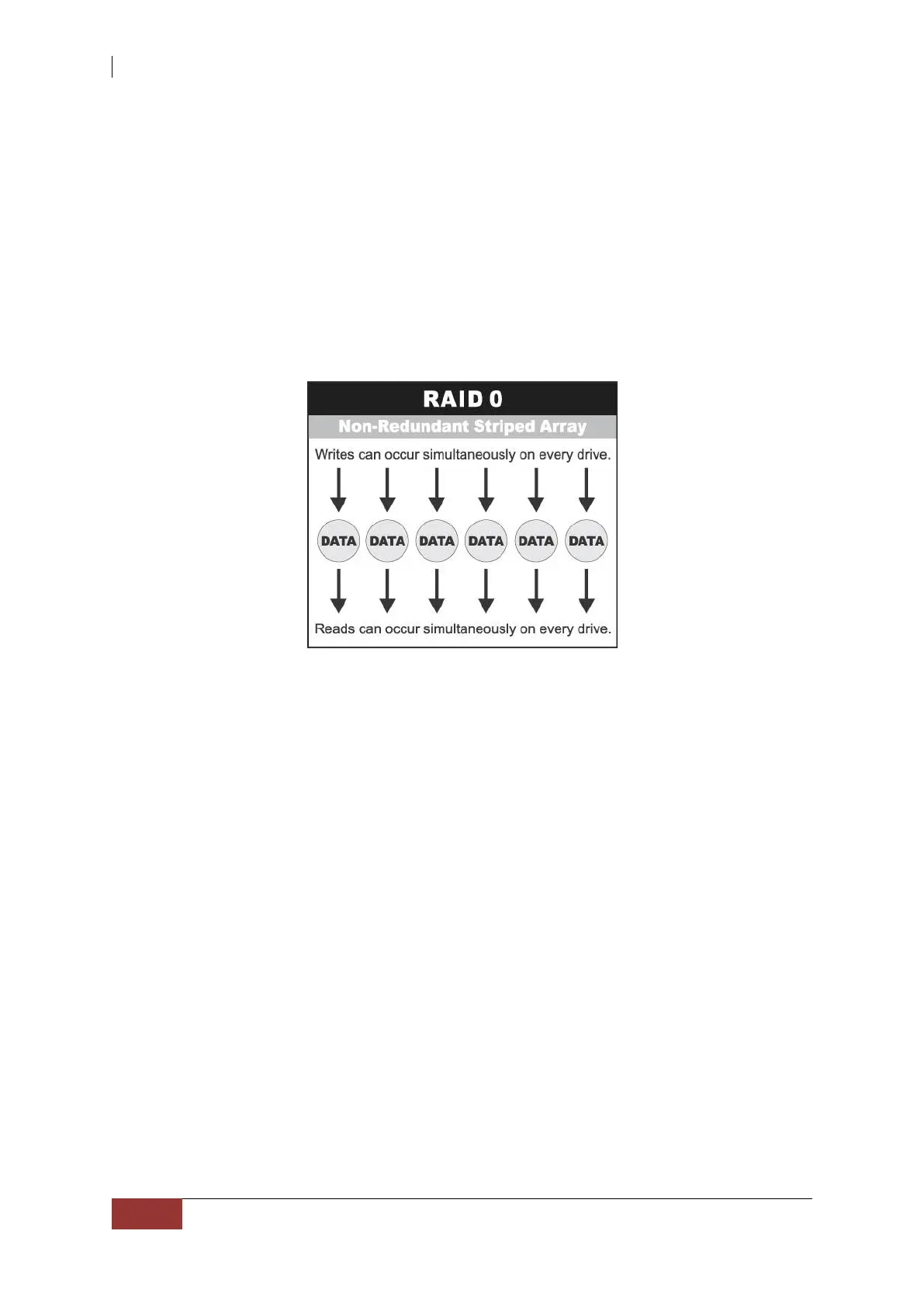
RAID 0 is typically defined as a group of striped disk drives without parity or data
redundancy. RAID 0 arrays can be configured with large stripes for multi-user
environments or small stripes for single-user systems that access long sequential records.
RAID 0 arrays deliver the best data storage efficiency and performance of any array type.
The disadvantage is that if one drive in a RAID 0 array fails, the entire array fails.
RAID 1, also known as disk mirroring, is simply a pair of disk drives that store duplicate
data but appear to the computer as a single drive. Although striping is not used within a
single mirrored drive pair, multiple RAID 1 arrays can be striped together to create a single
large array consisting of pairs of mirrored drives. All writes must go to both drives of a
mirrored pair so that the information on the drives is kept identical. However, each
individual drive can perform simultaneous, independent read operations. Mirroring thus
doubles the read performance of a single non-mirrored drive and while the write
performance is unchanged. RAID 1 delivers the best performance of any redundant array
type. In addition, there is less performance degradation during drive failure than in RAID
5 arrays.



 To Next Page