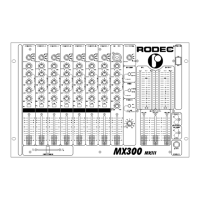
RODEC
MX300 MKIII
6
K) Master output 2 symmetrical
Symmetrical output to connect a power-amplifier. The output level can be manipulated with
the master fader 2 (22) from 0 to maximum (3.3V).
L) Monitor output
Extra output from where the output voltage can be controlled from 0 to maximum (1.55V) with
the monitorfader (23). The musiccompressor, the DJ-micro and the mono/stereo switch have
no influence on this output.
M) Second headphones connector
On this output appears the same signal as on the headphones-output on the frontpanel (6) on
condition that the connection on the frontpanel is not in use. The specifications are the same
as the headphones output on the frontpanel.
N) Primary fuse
Primary fuseholder, please use only the same type of fuse as indicated on the backpanel.
O) Power inlet
Mains power inlet, please connect only to the same mains voltage as indicated on the
backpanel.
Please use signal cables shorter than 1 meter for the inputs and the outputs.
OPERATING INSTRUCTIONS
1) First switch all connected music-sources on (like CD-players, recordplayers, etc.). Switch the
power button (1) to turn the power supply on. The power indicators (2) will light up and a few
seconds later the mixing panel will be in operation, ready state. At this stage you can turn on
the power amplifiers.
2) Connect the headphones to phones output (6) or (M).
3) Choose the right source with input switch (11).
4) Switch the PFL button (9) in position ON to listen to the desired source. Check if the switch (8)
stands in the PFL position, to get the stereo signal on the headphones and the two left VU-
meters. The PFL circuit works as a sum-system, there is a possibility to listen to more sources
at the same time. Al these operations have no influence on the outputsignal! Adjust with the
level control (12) the input signal so that the red indicators of the level meters (3) light up now
and then. Adjust if necessary the tonality of the sound with the equalizer (13).
LOOK OUT :
- The equalizer at each input is used to adjust the different sound between the
sources. To correct the acoustic sound of the room it is probably best to use
an external equalizer.
5) Slide up the fader (15) of the choosen channel.
6) Adjust the volume with the master (22).
7) Correct if necessary the panorama/balance with button (14), for monophonic sound set switch
(5) in mono position.
8) To change the source, repeat point 3) to 5).
9) To add a microphone signal, connect the mike to the MIC input (16) or (G) input. Please
connect only one microphone, input 16 or input G. Turn the level control (17) and the talk-over
(20) to zero, slide up the MIC fader (21) to maximum and adjust with the level button (17) the
volume of the microphone. Adjust with the equalizer (18) the sound of the mike. To use the


 To Next Page
 Loading...