20
Caution:
Do not confuse bone mass with bone density. Bone density can only be
determined by medical examination (e.g. CAT scan, ultrasound). Therefore,
it is not possible to draw conclusions about changes in bones and bone
hardness (e.g. osteoporosis) with this scale.
BMR
The basal metabolic rate (BMR) indicates the amount of energy expended
by the body at complete rest to maintain its basic vital functions (e.g. when
lying 24 hours in bed). This value greatly depends on weight, height and
age. On this diagnostic scale it is indicated in kcal/day and calculated
based on the scientifically recognized Harris-Benedict formula.
This amount of energy corresponds to the basic energy requirement of
your body and must be provided in the form of food. Taking in less energy
over a prolonged period of time can be harmful to your health.
AMR
The active metabolic rate (AMR) is the amount of energy expended by your
body per day when active. The energy consumption of a person rises with
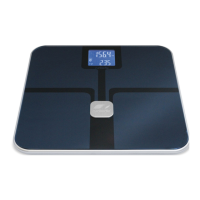
increasing physical activity and is determined by the Runtastic LIBRA
based on the activity level (1-5) you entered.
In order to keep your current weight, the energy expended by the body
needs to be provided again in the form of food and liquids.
If less energy is provided than expended over an extended period of time,
weight loss will be the result. On the other hand, if more energy is
provided than expended per day (AMR) over a prolonged period of time,
this leads to weight gain.
Time as a factor concerning the results
Note that only the long-term trend is significant. Usually, short-term weight
fluctuations within a few days can be explained by fluid loss. The
interpretation of the results depends on overall weight changes and
changes regarding the percentage of body fat, body water content and
muscle mass, as well as on the time frame in which these changes occur.
Rapid changes within a few days must be distinguished from medium-
term changes (within weeks) and long-term changes (months). Basically,
short-term weight fluctuations are almost exclusively due to changes of


 To Next Page