8
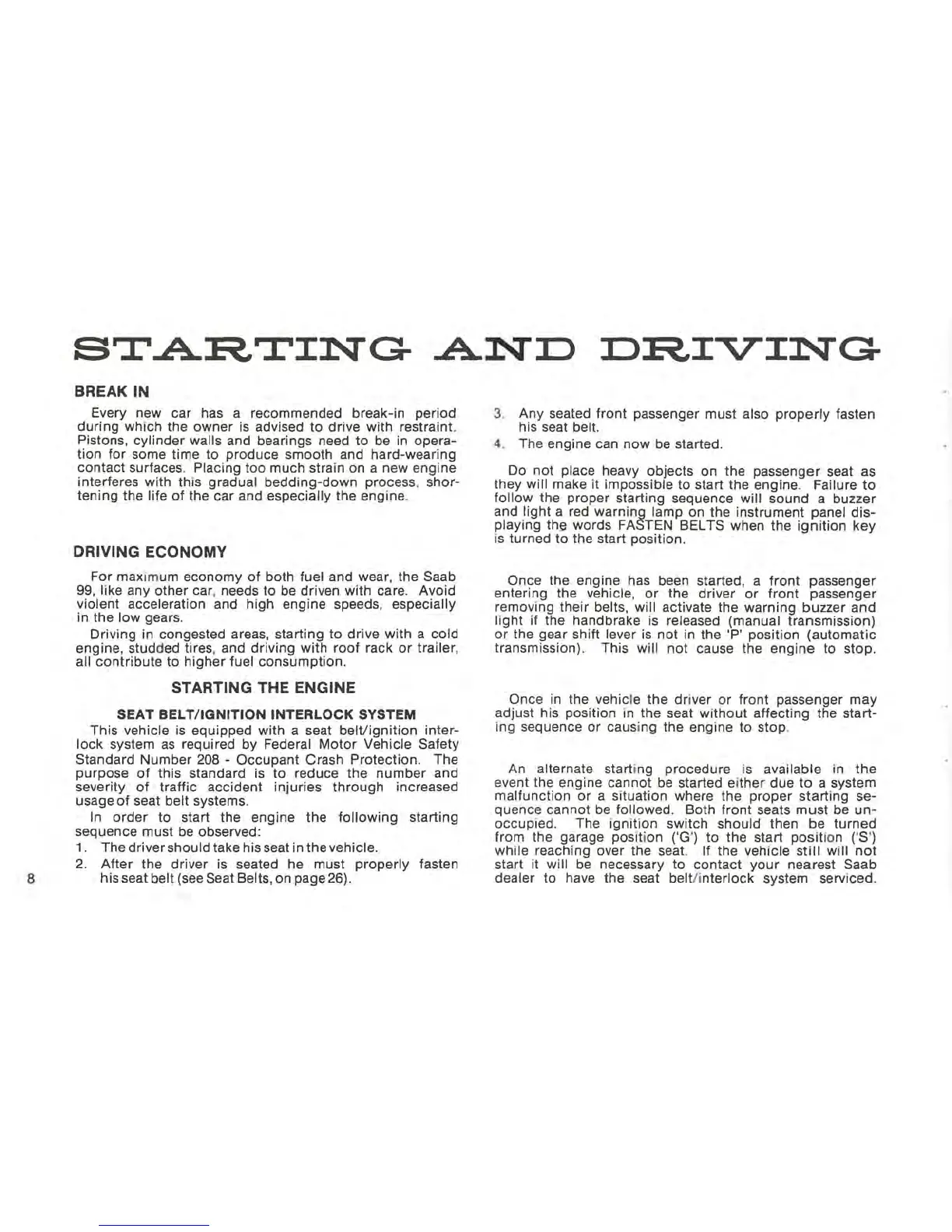
STARTING
AND
DRIVING
BREAK IN
Every new car has a recommended break-in period
during which the
owner
is
advised
to
drive
with
restraint.
Pistons,
cylinder walls and bearings need
to
be
in
opera-
tion
for
some time
to
produce smooth and hard-wearing
contact surfaces.
Placing too much strain on a new engine
interferes with this
gradual
bedding-down
process, shor-
tening the
life
of
the
car
and especially the engine.
DRIVING ECONOMY
For maximum economy
of
both fuel and wear, the Saab
99,
like any other car, needs
to
be driven with care. Avoid
violent acceleration and high engine speeds, especially
in the
low
gears.
Driving in congested areas, starting
to
drive
with
a cold
engine, studded tires, and driving
with
roof
rack
or
trailer,
all
contribute
to
higher
fuel consumption.
STARTING
THE
ENGINE
SEAT BELT/IGNITION INTERLOCK SYSTEM
This vehicle
is
equipped with a seat
belt/ignition
inter-
lock
system
as
required by Federal
Motor
Vehicle Safety
Standard
Number
208 -
Occupant
Crash Protection. The
purpose
of
this standard is to reduce the
number
and
severity
of
traffic accident injuries
through
increased
usage
of
seat belt systems.
In
order
to start the engine the
following
starting
sequence must
be
observed:
1.
The driver should take his seat in the vehicle.
2.
After
the driver is seated he must
properly
fasten
his seat
belt (see Seat Belts, on page 26).
3. Any seated front passenger must
also
properly
fasten
his seat
belt.
4. The engine can
now
be started.
Do
not
place heavy objects on the passenger seat as
they
will make it impossible to start the engine. Failure
to
follow
the proper starting sequence will sound a buzzer
and
light a red warning lamp on the instrument panel
dis-
playing
th~
words FASTEN BELTS when the
ignition
key
is
turned to the start position.
Once the engine has been started, a front passenger
entering the
vehicle,
or
the driver
or
front
passenger
removing their
belts, will activate the warning buzzer
and
light
if the hand brake
is
released (manual transmission)
or
the gear shift lever is
not
in the 'P' position (automatic
transmission). This
will
not
cause the
engine
to stop.
Once in the vehicle the
dr
iver
or
front passenger
may
adjust his position in the seat wi
thout
affecting the start-
ing sequence
or
causing the engine
to
stop
.
An
alternate starting procedure is available in
the
event the engine cannot
be
started ei
ther
due
to
a system
malfunction
or
a situation where the
proper
starting se-
quence cannot be
followed. Both front seats
must
be
un-
occupied. The
ignition
switch should then be
turned
from the garage position ('G') to the start
positi
on ('S')
whi
le
reaching over the seat. If the vehicle
still
will
not
start it will
be
necessary to
contact
your
nearest Saab
dealer to have the seat belt/interlock system serviced.


 To Next Page
 Loading...