40
ALTERNATOR
The
alternator
is driven by a V-belt from a pulley
on
the
crankshaft.
It
is
important
to
keep the
proper
tension.
To tighten the
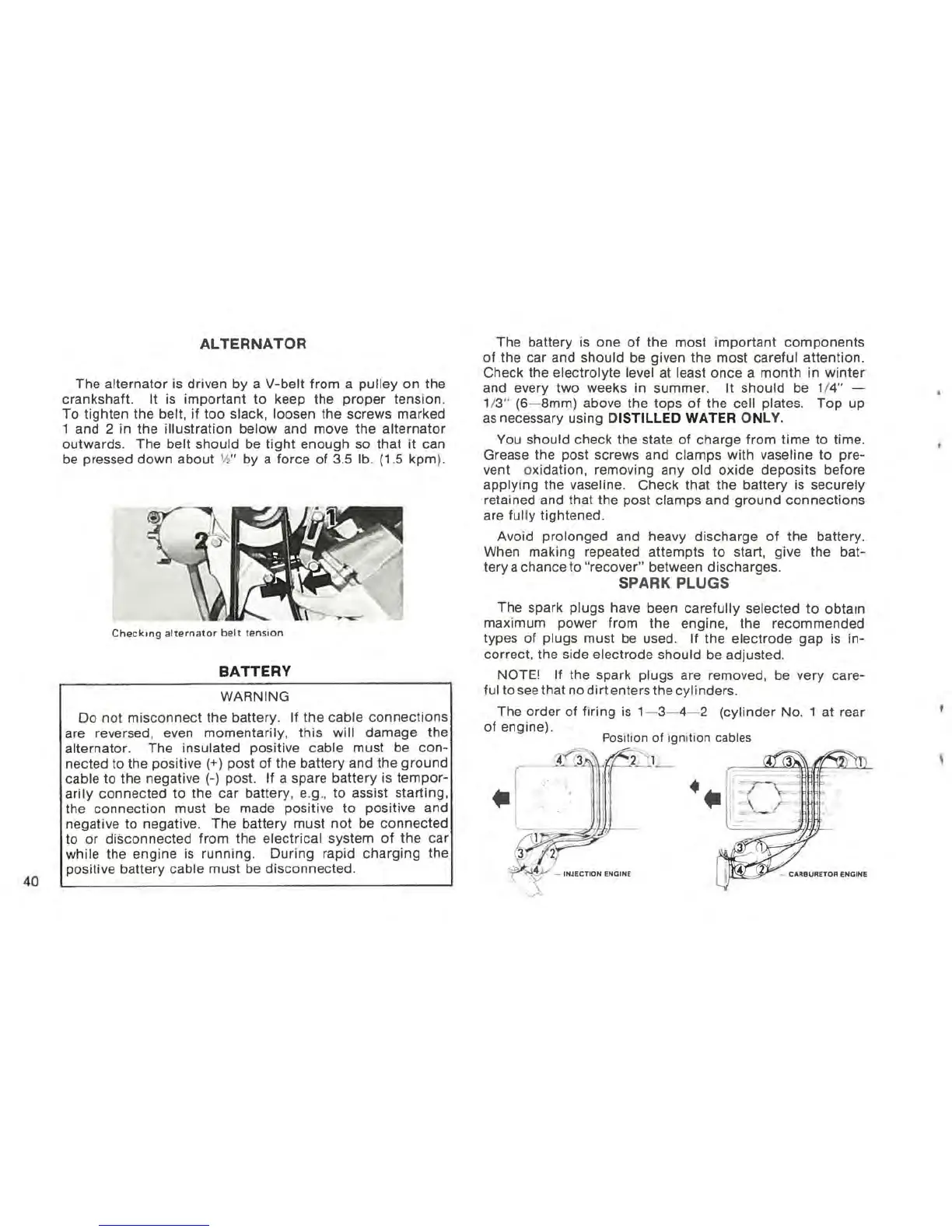
belt, if too slack, loosen the screws marked
1 and 2 in the illustration
below and move the
alternator
outwards. The
belt
should be
tight
enough
so that it can
be
pressed
down
about
V:
" by a force
of
3.5 lb.
(1
.5 kpm).
Checkong
alternator
belt
tension
BATTERY
WARNING
Do
not
misconnect
the battery. If the cable
connections
are reversed, even momentarily,
this
will damage the
alternator. The insulated positive cable must be
con-
nected to the positive (+) post
of
the battery and the
ground
cable to the negative (-) post. If a spare battery is
tempor-
arily connected to the car battery, e.g.,
to
assist starting,
the connection must be made positive to positive and
negative to negative.
The
battery must
not
be connected
to
or
disconnected from the electrical system
of
the
car
while the engine
is
running. During rapid
charging
the
positive battery
cable must be disconnected.
The battery
is
one
of
the most
important
components
of
the car and should be given the most careful attention.
Check the
electrolyte level at least once a
month
in
winter
and every
two
weeks in summer. It should be 1/
4"
-
1/3"
(6
- 8mm) above the
tops
of
the cell plates.
Top
up
as
necessary using DISTILLED WATER ONLY.
You should check the state
of
charge from
time
to time.
Grease the post screws and
clamps with vaseline
to
pre-
vent oxidation, removing any
old oxide deposits before
applying the vaseline. Check that the battery is securely
retained and that the post clamps and
ground
connections
are fully tightened.
Avoid
prolonged and heavy discharge
of
the battery.
When making repeated attempts
to
start, give the bat-
terya
chance to "recover" between discharges.
SPARK PLUGS
The spark plugs have been carefully selected
to
obtain
maximum power from the engine, the recommended
types
of
plugs must
be
used. If the electrode gap is
in-
correct. the side electrode should
be
adjusted.
NOTE! If the spark plugs are removed, be very care-
ful to see that no
dirt
enters the cylinders.
The order
of
firing
is
1- 3- 4- 2 (cylinder
No.1
at rear
of
engine).
-
INJECTION
ENGINE



 To Next Page