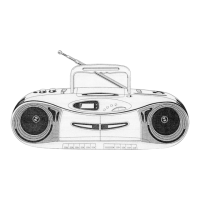
This document is a service manual for the Samsung RCD-2600 DTS Radio Cassette Recorder with Compact Disc Player. It provides comprehensive information for servicing, maintaining, and understanding the device.
Function Description
The Samsung RCD-2600 is a multi-functional audio device that combines a radio tuner, a cassette recorder, and a compact disc player. It is designed for both playback and recording capabilities, offering a versatile audio experience. The device features a graphic equalizer for sound customization, a remote control for convenient operation, and a display for showing various modes and settings.
Important Technical Specifications
General:
- Power consumption: 30W
- Dimensions: 463(W) x 249(H) x 247(D) mm
- Weight: 7.5kg (without batteries)
- Headphone jack: 3.5mm
Radio Section:
- Frequency range:
- FM: 87.5 – 108MHz (87.9 – 107.9)
- AM(MW): 530 – 1720KHz (520 – 1710KHz)
- LW: 146 – 290KHz (150 – 285KHz)
- IF:
- FM: 10.7MHz
- AM(MW)/LW: 455KHz
- Antenna:
- FM: Telescopic rod antenna
- AM(MW)/LW: Ferrite bar antenna
- Frequency response: 20-20000Hz
- Speaker: Woofer: 100mm x 2 (4Ω), SBS: 100mm x 1 (8Ω)
- Max output: 3W/CH
- Power source: AC: See label rating, DC: 9V (D, UM-1, HP2) x 6, DC: 6V (AA x 4) for memory back up.
Tape Section:
- Track system: 4 track 2 channel
- Recording system: AC bias (DECK A)
- Erasing system: Magneto erasing (DECK A)
- Monitor system: Variable monitor
- Frequency response:
- NORMAL: 60 – 8000Hz
- CrO2/METAL (PB): 60-10000Hz
- Tape speed: 4.75cm/sec (Normal speed)
- Wow and flutter: 0.06%
- Tape drive system: Capstan belt driven
- Tape loading system: Front loading
- Motor system: DC synchronous, 2 speed motor (DC 9V)
Compact Disc Player:
- Frequency range: 20-20000Hz
- Signal to noise ratio: 50 dB (1KHz) with filter
- D/A Conversion: 16 bit
Usage Features
The RCD-2600 offers a range of features for user convenience:
- Front Panel Controls: Includes controls for volume, super bass sound, graphic equalizer, CD door open, DTS/CLOCK display, CD/CLOCK operation, tuning, FM mode, program, auto, preset stations, CD operation, function buttons (play, stop/eject, pause, record, timer on, sleep), and a headphone jack.
- Rear Panel Controls: Features MIC MIXING jacks, CD-OUT jacks, battery compartment, voltage selector switch, AC power socket, and battery on/off switch.
- Remote Control: A dedicated remote control unit provides functions such as infrared transmission, power on/off, function buttons, preset buttons, band/sleep buttons, CD control buttons, play/pause, stop, skip, frequency up/down, volume up/down, and a battery compartment.
- Display: The device features an LCD display that shows radio frequency (LW, SW, MW, FM), memory indicators, stereo/auto/mono modes, timer, sleep, and CD multi-function display including intro, shuffle, program, repeat, all, sync, over, track number, time, and synchro recording indicator.
- Recording: Supports recording on cassette tapes with AC bias and magneto erasing.
- Battery Operation: Can be powered by batteries for portable use, with separate batteries for memory backup.
Maintenance Features
The service manual details various maintenance and adjustment procedures to ensure optimal performance of the RCD-2600:
- Servicing Notes: Provides essential safety precautions, including disconnecting power supply, avoiding direct sunshine and heat, using soft cotton swabs for cleaning, checking parts, avoiding strong magnetic forces, disconnecting plugs before servicing, and being careful of electrostatic damage.
- Handling the Optical Pick-up: Specific instructions are provided for handling the optical pick-up unit, emphasizing precautions against electrostatic breakdown and the use of a wrist-strap for grounding.
- Disassembly Instructions: Detailed steps and diagrams are provided for disassembling the device, including removing the back cabinet, front cabinet, CD pack, SBS ass'y, deck main PCB, front PCB, and SBS speaker.
- LCD Display Information: Pin connection and segment chart for both tuner and CD LCD displays are provided for troubleshooting display issues.
- Troubleshooting Charts: Comprehensive flowcharts are included for diagnosing and resolving common issues such as AC power insensibility, battery power insensibility, recording not working, no audio output, compact disc inoperative, tape not working, radio insensibility, and CD troubleshooting (power, lead-in, disc rotation, audio, display).
- Adjustment Procedures: Detailed instructions for various adjustments are provided, including:
- Radio Section: MW/LW adjustment (frequency range, tracking), FM adjustment (no adjustment needed).
- Tape Section: Recording bias adjustment, tape speed adjustment, tape azimuth adjustment.
- CD Adjustment: CLV adjustment, EF balance adjustment, focus bias adjustment, tracking gain adjustment, focus gain adjustment.
- IC and TR Lead Layout: Diagrams and pin descriptions for various integrated circuits (ICs) and transistors (TRs) used in the tuner, pre/rec amp, power amp, remote control, DTS-MICOM, servo signal processor, D/A converter, MICOM, digital processor, RF amp, BTL driver, and OP amp sections.
- Block Diagrams: Illustrative block diagrams for the radio/cassette section and CD section, showing the interconnections of major components.
- Schematic Diagrams: Detailed schematic diagrams for the radio/cassette section (tuner and main) and CD section, providing circuit-level information.
- PCB Pattern & Marking Diagram: Layouts of the printed circuit boards (PCBs) for the radio/cassette section (main and sub) and CD section, indicating component placement and markings.
- Wiring Diagram: Diagrams showing the wiring connections within the radio/cassette section and CD section.
- Exploded Views: Detailed exploded diagrams of the overall device, CD deck, and cassette deck, illustrating the assembly of all components and their part numbers.
- Parts List: Comprehensive lists of parts for the cassette deck, CD deck, and main unit, including symbol number, code number, description, specification, and quantity.
- Abbreviation List: A glossary of abbreviations used throughout the manual.
- Basic Circuit Operation: Descriptions of the operational principles of key circuits, including the amplifier, tone control, deck control, playback equalization, record equalization, tape bias oscillator, power supply, tuner, MICOM, and remote control transmitting/receiving sections.

 Need help?
 General

 To Next Page