Basic t o b eshooti
Learn to solve common problems by setting shooting options.
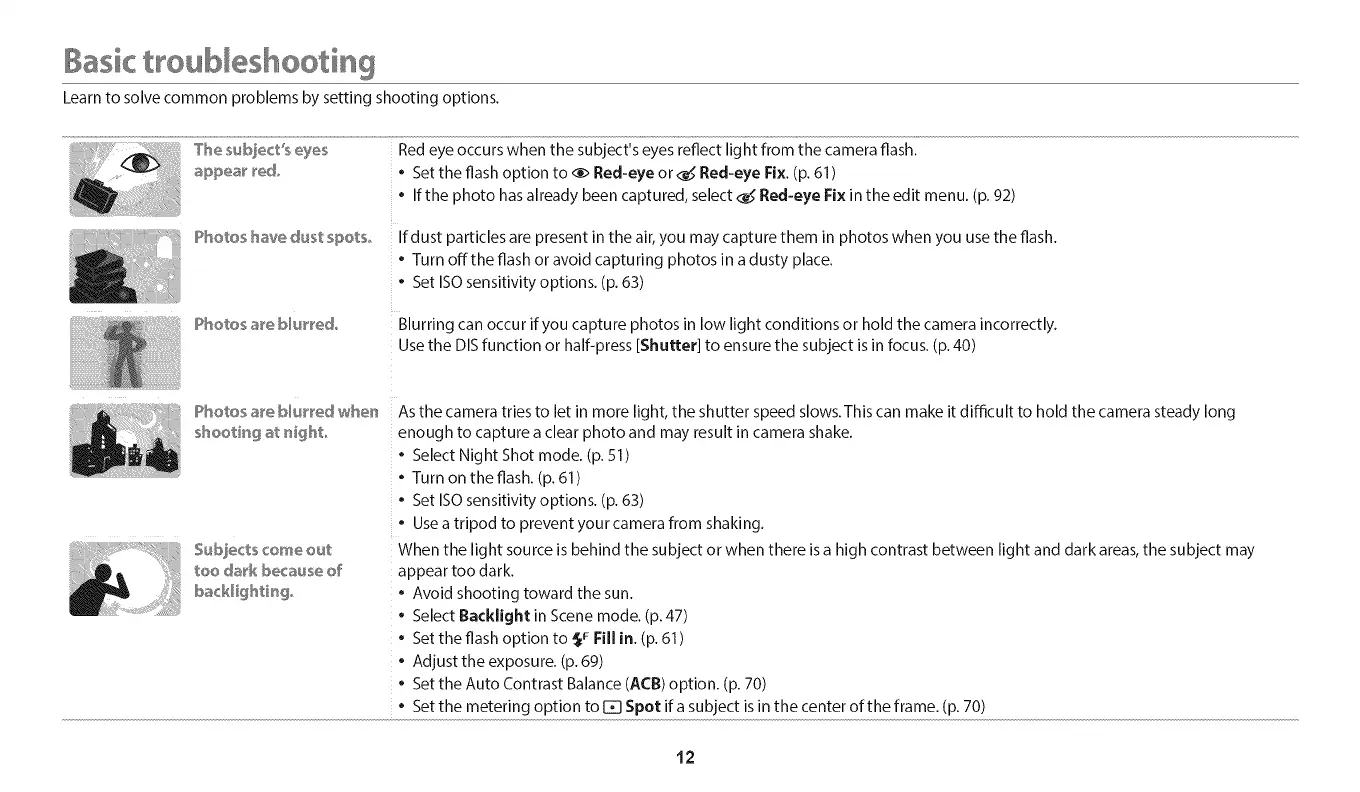
"Fhe _ubject_ eye_
a_Dear red_
IIl:_hete_shave dust sFJets_,
Photos are blurred_,
Red eye occurs when the subject's eyes reflect light from the camera flash.
• Set the flash option to _ Red-eye or c_ Red-eye Fix. (p. 61)
• If the photo has already been captured, select <_ Red-eye Fix in the edit menu. (p. 92)
If dust particles are present in the air, you may capture them in photos when you use the flash.
• Turn off the flash or avoid ca ptu ring photos in a dusty place.
• Set ISO sensitivity options. (p. 63)
Blurring can occur if you capture photos in low light conditions or hold the camera incorrectly.
Use the DISfunction or half-press [Shutter] to ensure the subject is in focus. (p. 40)
IIl:>hoto<gare blurred wheH As the camera tries to let in more light, the sh utter speed slows. This can make it difficult to hold the camera steady long
_hootiHg at Hif_ht,_ enough to capture a clear photo and may result in camera shake.
Select Night Shot mode. (p. 51)
• Turn on the flash. (p. 61)
• Set ISO sensitivity options. (p. 63)
• Use atripod to prevent your camera from shaking.
Subjects come out When the light source is behind the subject or when there is a high contrast between light and dark areas, the subject may
too dark be<ause of appear too dark.
ba_:kHf_hting,_ • Avoid shooting toward the sun.
• Select Backlight in Scene mode. (p. 47)
• Set the flash option to SF Fill in. (p. 61)
. Adjust the exposure. (p. 69)
. Set the Auto Contrast Balance (ACB) option. (p. 70)
Set the metering option to [Z] Spot if a subject isin the center of the frame. (p. 70)
12


 To Next Page