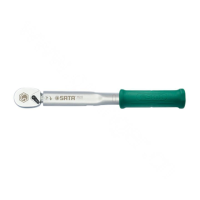
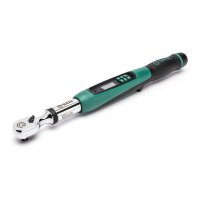
This document provides a comprehensive guide for the SATA Interchangeable Torque Wrench, models 96221, 96222, 96321, 96322, and 96323.
Function Description
The SATA Interchangeable Torque Wrench is a precision measuring tool designed for applying a specific torque to fasteners. It is used to ensure that nuts and bolts are tightened to the correct specification, preventing overtightening that could damage components or undertightening that could lead to loosening. The wrench provides an audible "click" as a reminder when the preset torque value is reached, indicating that the desired torque has been applied. Its pull-down torque lock structure facilitates easy adjustment of the torque value.
Important Technical Specifications
The SATA Interchangeable Torque Wrenches come in various models, each with specific torque ranges, square hole sizes, and overall lengths:
- Model 96221:
- Torque Range: 1-5 N.M
- Square Hole Size: 9x12 MM
- Full Length: 210 MM
- Model 96222:
- Torque Range: 5-25 N.M
- Square Hole Size: 9x12 MM
- Full Length: 250 MM
- Model 96321:
- Torque Range: 20-100 N.M
- Square Hole Size: 9x12 MM
- Full Length: 425 MM
- Model 96322:
- Torque Range: 40-200 N.M
- Square Hole Size: 14x18 MM
- Full Length: 530 MM
- Model 96323:
- Torque Range: 68-340 N.M
- Square Hole Size: 14x18 MM
- Full Length: 591 MM
The wrench guarantees an accuracy of ±3% within its 20%-100% measurement range, conforming to ANSI/ASMEB107.14M and EN ISO 6789:2003 standards. Each wrench is supplied with an ex-factory verification report.
Usage Features
Setting the Torque Value:
- Unlock: Hold the handle with one hand and pull down the lock ring.
- Adjust (Coarse): Turn the handle until the "0" scale on the top of the handle coincides with the center line corresponding to the desired torque value.
- Adjust (Fine): If the required torque value is between the upper and lower limits, continue rotating the handle and hold the pull-down lock ring until the sum of the vertical value and horizontal value equals the required torque value. For example, to set 94 N.m, first pull down the lock ring and turn the handle until the vertical scale reading on the rod shows "90" while the "0" position of the horizontal scale is equal to the centerline of the scale. Then continue to rotate the handle clockwise until the mark "4" coincides with the centerline of scale. The torque value at this time is 90+4=94 N.m.
- Lock: Release the lock ring to complete the setting of the torque value.
Important Precautions During Use:
- Selection: Always select the appropriate torque wrench within the application range. SATA torque wrenches are available in various models and specifications. Note that 1 kg·m (KGM) = 9.8 N·m (NM).
- Range: Do not set the torque beyond the application range of the torque wrench.
- Adjustment: Before adjusting the torque, confirm that the lock ring has been pulled down to make the torque wrench in an adjustable status.
- Locking: When the torque wrench is tightened, do not adjust the torque by turning the handle to avoid damage to internal precision components. Do not turn the handle when the lock ring is locked, as this may damage the adjustment device.
- Application of Force:
- To ensure the accuracy of the torque wrench, make sure the wrench head and fastener are perpendicular when applying force evenly.
- Do not tilt the wrench handle while using it, as tilting can easily result in a deviation of the torque value or even damage to the fastener.
- When tightening the nut, apply force evenly on the torque wrench. As resistance increases, the application rate should slow down accordingly.
- Do not continue applying force after the preset torque is reached and the "click" sound is heard. Continuous application may damage internal parts, nuts, or workpieces due to excessive torque.
- When the wrench is set at a low torque value, the "click" sound will be lighter than at a high torque value. Pay special attention to the "click" sound in this case.
- Do not add a force application tube at the end of the torque wrench to ensure output accuracy.
- Professional Use: This is a high-precision measuring tool. It is recommended that experienced professionals use SATA torque wrenches. Improper use may cause accidental damage to the product itself, the workpieces to be tightened, and your health.
Maintenance Features
- Calibration:
- SATA torque wrenches should be verified after one year of use or after 5000 uses to ensure accuracy.
- All torque wrenches should be periodically verified to ensure accuracy. Wrenches that have been used abnormally (e.g., under overload) should be recalibrated immediately.
- To ensure accuracy, the internal precision parts should be fully lubricated by the lubricant, and the wrench should be operated 5-10 times under high torque (90% of the maximum output torque) for the first use or after long-term storage.
- Storage:
- Torque wrenches should not come into contact with water or dirt.
- Do not place the torque wrench in liquid to avoid damage to internal parts.
- Unless the interval is long, do not set the torque wrench at the lowest torque value after use.
- After each use, the torque wrench should be set to the lowest torque value if the interval is not long.
- The wrench comes in a blow-molded case for convenient storage after use.
- Handle: The aluminum alloy knurled handle is anodized for better durability.
- Warranty:
- For damage due to material or process defects within 90 days from the date of purchase (subject to the invoice date), SATA will provide free repair or replacement parts.
- Free replacement means the product has been used less than 5,000 times and its accuracy is below ±3% according to the test instrument. It may be replaced within 90 days from the date of purchase (based on the invoice date).
- Product damage or accuracy above ±3% caused by misuse, abuse, accident, or failure to follow precautions are not covered by free repair and calibration.
- Products repaired by third parties other than SATA officially authorized service organizations are not covered by free repair and calibration.
The document also includes a reference torque table for various nut and bolt sizes (MM, HEX, INHEX, FM-TX, M-TX) to assist users in selecting the appropriate torque range. It is advised to use the intermediate value and avoid using the maximum torque value frequently to prolong the service life of the tool.

 Need help?
 General

 To Next Page