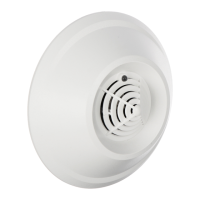
Explanations to Fig. 1:
1 – terminals:
NC – relay (NC)
TMP – tamper contact
COM – common ground
12V – power supply input
2 – LED indicator. Indicates by blinking activation, trouble and alarm of the detector.
Depending on the detector type, the following LED colors are used:
- red – DG-1 CO
- green – DG-1 LPG
- yellow – DG-1 ME
- blue – DG-1 TCM
3 – alarm relay, type NC (normally closed).
4 – buzzer. Indicates acoustically activation, trouble and alarm of the detector.
5 – gas sensor.
6 – tamper contact. Opening of the housing is signaled on TMP terminals.
7 – fixing screw hole.
8 – buzzer ON/OFF pins. Set the jumper to enable the audible signal, remove the
jumper to disable it.
1. Alarm signaling
Depending on the detector type, the conditions of alarm signaling vary. They are
described in Table 1. Additionally, the DG-1 LPG and DG-1 ME detectors feature the
prealarm function.
DG-1 CO DG-1 LPG DG-1 ME DG-1 TCM
Gas concen-
tration to
trigger alarm
50ppm for 75 minutes
100ppm for 25 minutes
300ppm for 1 minute
20% lower explosive
limit
3000ppm CHCl
3
Gas concen-
tration to trig-
ger prealarm
-
10% lower explosive
limit
-
Table 1. Conditions of alarm/prealarm signaling by the detectors.
Gas concentration reaching the dangerous level will trigger the alarm signal (visual
and audible) and open the alarm relay. The alarm is signaled by long sounds and LED
blinking, separated by long intervals (1 second LED blinking / sound, 1 second
interval, etc.). The alarm signaling is on for the whole duration of dangerous gas
concentration. Also the relay will remain open until the gas concentration drops below
the alarm level. The gas sensor reaction to a decrease in the dangerous gas
concentration is delayed, hence the alarm signaling can stop even a few
minutes after the gas concentration has dropped below the alarm level.
The prealarm is signaled by short sounds and LED flashes, separated by long
intervals (0.25 second LED blinking / sound, 1.75 second interval, etc.). The signaling
continues as long as the methane / propane-butane concentration is above the 10%
lower explosive limit, but just below the 20% lower explosive limit. The prealarm has
no effect on the alarm relay status.


 To Next Page
 Loading...