EasyManua.ls Logo

Scale-Tronix 5002 - Technical Description of Scale Components; Readout Electronics Overview; Differential Signal Amplification; Additional Amplification and Signal Filtering

Default Icon
48 pages
Print Icon
To Next Page IconTo Next Page
To Previous Page IconTo Previous Page
Loading...
Readout
electronics
consist
of
the
following:
1.
Differential
signal
amplification.
2.
Additional
amplification
and
signal
filtering.
3.
Analog-to-Digital
(A/D)
converter
and
Clock
circuit.
4.
Battery
and
support
circuitry,
voltage
regulators,
power
supplies,
etc.
5.
Microcomputer
and
support
circuitry.
6.
Display
board.
7.
Printer
assembly.
8.
Printer
interface
board.
9.
Printer
controller
board,
4.21
DIFFERENTIAL
SIGNAL
AMPLIFICATION
The
weight
dependent
output
signal
produced
by
the
load
cell
transducers
in
the
weighing
frame
is
a
“differential
signal",
meaning
it
is
the
voltage
difference
between
the
"+
Signal”
and
"-
Signal"
leads.
Integrated
circuit
U4,
an
instrumentation
amplifier,
is
used
to
interface
to
this
differential
signal
and
amplify
it.
The
output
signal
from
the
load
cells
is
applied
to
the
protection
network
cansisting
of
diodes
CRA4/CRS/CR6/CR7.
These
diodes
prevent
destructive
overvoltages
caused
by
static
discharges
from
damaging
U4,
A
high
frequency
filter,
formed
by
L1/i2/C9/C10
couples
the
weight
signal
to
the
input
of
U4.
In
U4
the
differential
signal
is
amplified
by
a
factor
of
100,
and
converted
to
a
"ground-referenced"
voltage
for
further
processing.
Capacitors
C16/C17/C24
provide
local
bypassing
of
the
power
supplies
used
by
instrumentation
amplifier
U4.
Capacitor
C18
furnishes
compensation
of
U4
by
reducing
amplification
at
higher
frequencies.
4.22
ADDITIONAL
AMPLIFICATION
AND
SIGNAL
FILTERING
Components
for
an
optional
second
gain
stage
may
be
added
on the
printed
circuit
board.
If
included
operational
amplifier
US
is
used
to
provide
additional
gain
and
signal
filtering.
U5,
together
with
capacitors.
C14/C15
and
resistors
R17/R18,
forms
an
active
low-
pass
filter.
This
helps
to
remove
fluctuations
in
the
weight
signal
caused
by
movement
of
the
patient
on
the
scale.
US,
like
U4,
is
“chopper-stabilized"
to
correct
internal
offset
and
drift
errors.
Resistors
R24/R25
(optional)
are
used
to
increase
gain;
resistors
R26/R27
(optional)
are
used
for
gain
reduction.
An
additional
low-pass
filter
stage
is
furnished
by
resistor
R34
and
capacitor C23.
4.23
ANALOG-TO-DIGITAL
(A/D)
CONVERSION
Integrated
circuit
U6
is
the
analog-to-digital
converter.
Included
on
this
integrated
circuit
are
auto-zero
functions,
auto-polarity,
and
the
digital
and
analog
functions
necessary
to
perform
dual
slope
integration
conversion
to
20,000
counts
(4%
digits}.
The
weight
signal
voltage
is
applied
to
the
analog
input
(pin
10)
of
Us.
À
reference
voltage
for
the
conversion
is
applied
to
pin
2
of
U6.
The
reference
voltage,
nominally
1
Volt,
is
derived
from
the
load
cell
transducer
excitation
voltage,
by
the
divider
network
consisting
of
resistors
R29, R30,
and
potentiometer
P1.
Adjusting
P1
sets
the
"span"
or
weight
calibration
of
the
scale.
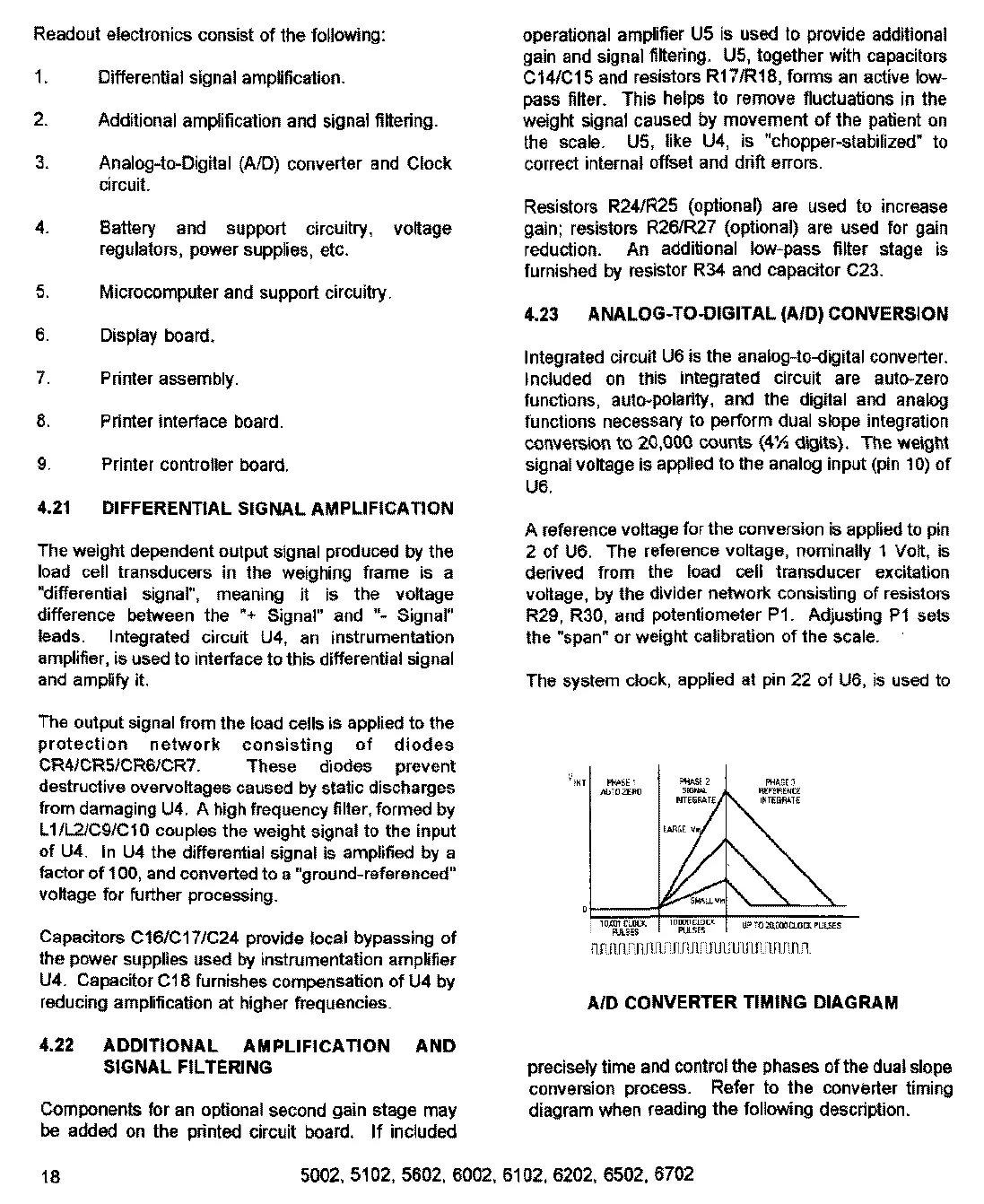
The
system
clock,
applied
at
pin
22
of
U6,
is
used
to
pease:
Past
2
pass
κώνο
|
Son
il
SERA,
INTEGRATE
yanit
v
5
ve
TORRE
|
sao
|
veto
mm
nom
mises
ARARLAR
ARADAN
AID
CONVERTER
TIMING
DIAGRAM
precisely
time
and
control
the
phases
of
the
dual
slope
conversion
process.
Refer
to
the
converter
timing
diagram
when
reading
the
following description.
18
5002,
5102,
5602, 6002,
6102,
6202,
6502,
6702

Related product manuals