ENGLISH 9
|
C- AUTONOMY OF THE E2 SYSTEM
The system’s autonomy depends on the quality and energy of the AA batteries and the frequency
and duration of use in ON or OFF mode. The times listed below assume the use of high-quality alkaline batteries :
• Approx. 2-3 months of autonomy with two new AA alkaline batteries not including recharge of the SuperCapacitors (new batteries
inserted after recharging the SuperCapacitors)
• The system can be used without additional AA batteries. However, we strongly suggest to always use it with the batteries to ensure
extended autonomy.
Note : If the system is charged with the USB-C and used without batteries, it will only have a maximum autonomy of 12 to 24 hours, which is
perfectly normal because the AA batteries ensure the autonomy of the E2.
X ALPRIDE E2 AIRBAG SYSTEM - ACTIVATION/DEACTIVATION
A- ON / OFF AND AUTO-TEST
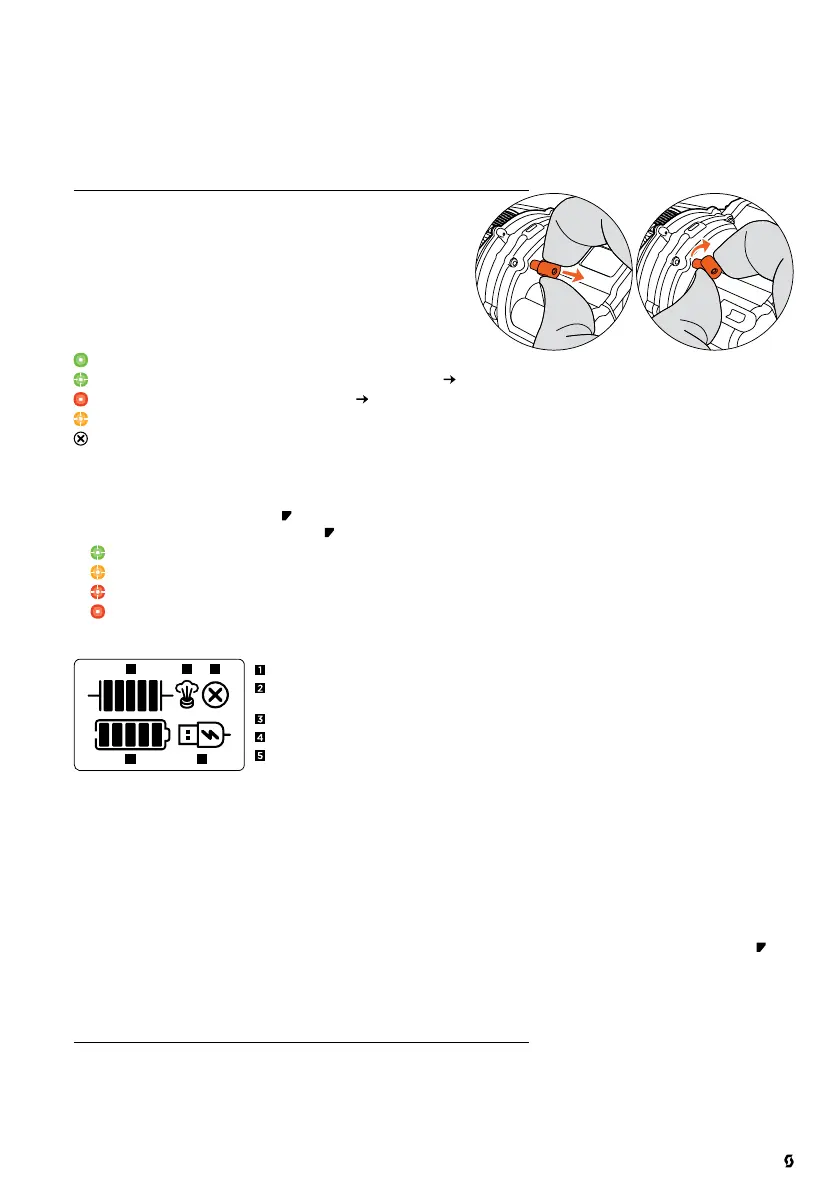
To turn on the E2 System, use the ON /
OFF switch. This safety switch prevents undesired activation inside
the bag. Pull the switch, turn it clockwise and hold for 2 seconds.
Each time it is turned on, the E2 System conducts an auto-test to
verify that the motor, SuperCapacitors and electronics are function
-
ing properly.
During this auto-test, the 3 LEDs light up chronologically to check
that the LEDs are functioning. Simultaneously, the LCD display
blinks to check that the LCD display is working properly and all
icons are visible.
During this auto-test, the motor completes a first rotation at low speed, switching on the green LED.
The motor rotates a second time and the green / orange LED blinks The system is ready for use.
The motor rotates 4x and the red LED remains ON There is a problem in the system and it is not operational.
If the system detects a malfunction and it is charging, the red LED remains ON and the orange LED blinks rapidly.
If there is a failure during the auto-test, this icon will be displayed on the LCD.
To turn the system OFF, pull the switch and turn it clockwise (same procedure as for turning ON). The motor will rotate 1 x and the red LED
will turn on and off again to indicate that the system has shut down.
B- TERRAIN USE AND LED STATUSES
Before every use of the E2 System, you will need to :
1- Turn ON the E2 System (see section
X.A.)
2- Verify that the auto-test is okay (see section
X.A.)
If the green LED blinks, the system is operational with at least six hours of autonomy
If the orange LED blinks, the system is operational with less than six hours of autonomy.
If the red LED blinks, the system cannot guarantee 100% inflation (but it will still attempt to inflate the airbag as much as possible).
If the red LED remains on, the system is defective and should not be used.
Note : The LED blinking speed indicates that the system is either charging (4 x per second) or in standard ON mode (1 x every 10 seconds).
C- LCD DISPLAY
SuperCapacitor charge level
AA battery power level: if the batteries are missing or completely empty, the icon blinks to indicate
that batteries need to be changed or installed.
Displays when the pressure relief valve is activated
Displays if the auto-test is not functioning
Displays when the USB-C cable is connected and powered
D- PRESSURE RELIEF VALVE
The pressure relief valve is an electric valve and is activated 3 minutes after the inflation for a maximum of
10 minutes or less depending on the residual energy in the batteries or SuperCapacitors. It will then close automatically.
The purpose of this valve is to reduce the airbag pressure 3 minutes after inflation. This is to reduce the stress on the seams and fabric of
the airbag, ensuring a longer lifespan inflation after inflation.
The pressure relief valve also allows passive and partial deflation of the airbag by reducing its pressure but does not allow complete defla
-
tion of the airbag. The operation of the pressure relief valve is controlled 3x during each auto-test and can be clearly heard from the char-
acteristic ticking noise.
E- AIRBAG INFLATION
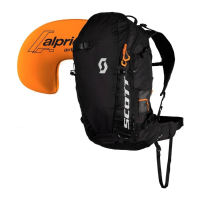
In the event of an avalanche, pull hard (between 5 to 10 kg) on the trigger handle. The airbag will inflate in 3-4 sec-
onds. The compressor will operate for 5 seconds and then stop. The airbag will remain inflated for a minimum of 3 minutes (according to EN
16716) then the pressure relief valve will be activated, and a passive and partial deflation of the airbag will take place.
An avalanche airbag is not a life vest; therefore, it is normal that it does not remain inflated at full pressure for more than three minutes.
Once inflation is complete, the SuperCapacitors will automatically recharge thanks to the two AA batteries if installed (see section
VIII.)
F- DURING AN AVALANCHE INCIDENT
In the event of an avalanche, always try to reach a place of safety or escape from the path of
the snowslip. Try also to remove your skis or snowboard, as these have an anchoring effect in an avalanche. Once the avalanche appears to
be losing momentum, close your mouth and hold your arms in front of your face to create a life-saving air pocket. Once the avalanche has
stopped moving and you can extract yourself, do not remove the airbag to help others.
XI DEFLATING AND FOLDING THE AIRBAG
The airbag should be deflated using the airbag’s deflation knob. Lift the safety cover of the deflation knob and press it to deflate the airbag.
Once the airbag is deflated, let the deflation knob go. The safety cover will close automatically.
1
2
3
5
4


 To Next Page
 Loading...