cer or mechanical transmissions or brushes
are used, which results in a dramatic reduction
in the noise produced by the system.
The electrical board controls the various fun-
ctions of the motor, including those related to
the blind stops (end stops) in its extreme posi-
tions. The amperometric protection device al-
lows it to recognise the natural end stops of the
blind and memorises them, so that the system
will automatically stop in their vicinity (without
reaching the limit positions), increasing the li-
fespan of the blind components; the magnetic
transmission system, on the other hand, fur-
ther reduces the risk of damaging the parts.
The desired end stops of the blind can also be
set manually at any height, via some special
sequences of pulses to be performed from the
external push buttons.
The ScreenLine
®
external motor must be con-
nected to the corresponding 24V dc power
supplier or, using 3.6V dc voltage power, to the
The ScreenLine
®
external motor can be tted
to all double glazing units that make use of the
ScreenLine
®
frontal magnetic transmission sy-
stem and allows their tilt, raising and lowering
movement.
For easy application and removal (if necessa-
ry), the item has been divided into two compo-
nents: a support and a removable body.
The support contains the external connection
contacts and must be applied onto the ma-
gnet of the integral blind.
The removable body incorporates the motor
and the electrical board. An operation LED, an
infra-red receiver and a dip-switch for board
conguration can be accessed from the exter-
nal glass cover.
The motor installed is a rotating-case brushless
motor mounted on bearings, directly coupled
with the external motor magnet, in order to
achieve a direct motion transmission (“Direct
Drive” technology). Therefore, no speed redu-
battery-operated ScreenLine system featuring
an optional self-charging solar panel. In the lat-
ter case, no wiring needs to be done on the
window frame.
The motor and, consequently, the blind, opera-
te by means of the polarity inversion of power
supply, which can be carried out by means of a
couple of push buttons, or via remote control,
or by means of the battery module from the
battery-operated system.
The dedicated software features two operation
speeds so as to optimise and synchronise the
slat tilting function, which is also improved by
the quartz oscillator.
Should centralised control alongside push
button control be requested, it is advisable that
one or several SL1807 or SL1963 (radio) con-
trol units be used in order to rationally manage
several groups of motors.
External motor
SL2190
Technical features
• Supply voltage: 3.6 or 24V dc (+/- 10%)
• Maximum power: 12 W
• Stand-by power: <0.7 W
• Reduction ratio: direct
• Raising speed: about 1.5 m/minute
• Dip-switch for board conguration
• Receiver for infra-red remote control
using 32-kHz frequency
• Quartz oscillator for the ne adjustment
of the motor speed and the raising
movement synchronisation
• Control system: 3-wire input for raising/
lowering
• Operating temperature: 0-70°C
• Storage temperature: -30°C +85°C
• Relative humidity: 30-85%
• Weight: ~ 300 grams
• Dimensions: 136 x 36 x 40 (h) mm
• Protection degree: IP40
Preliminary operations
The external motor must be applied onto the
double glazing unit only after tting the latter
into the window frame. Make sure that there
is sufcient room to accommodate the mo-
tor: the internal spacer bar must be aligned or
protruding inwards with respect to the glazing
bead. Should this not be the case, reduce the
thickness of the double glazing unit support
blocks.
Arrange the supply cables inside the window
frame, close to the position of the magnet of the
integral blind, leaving the upper glazing bead
open.
Make sure also that the glazing bead has a
sealing gasket, in order not to pinch the cables
coming out of the electric motor, which must be
connected to the power supply. When no ga-
sket is available, cut a slot in the glazing bead,
near the area where the cables come out of the
motor. Doing this will prevent the cables from
being sheared or trapped when the glazing
bead is closed.
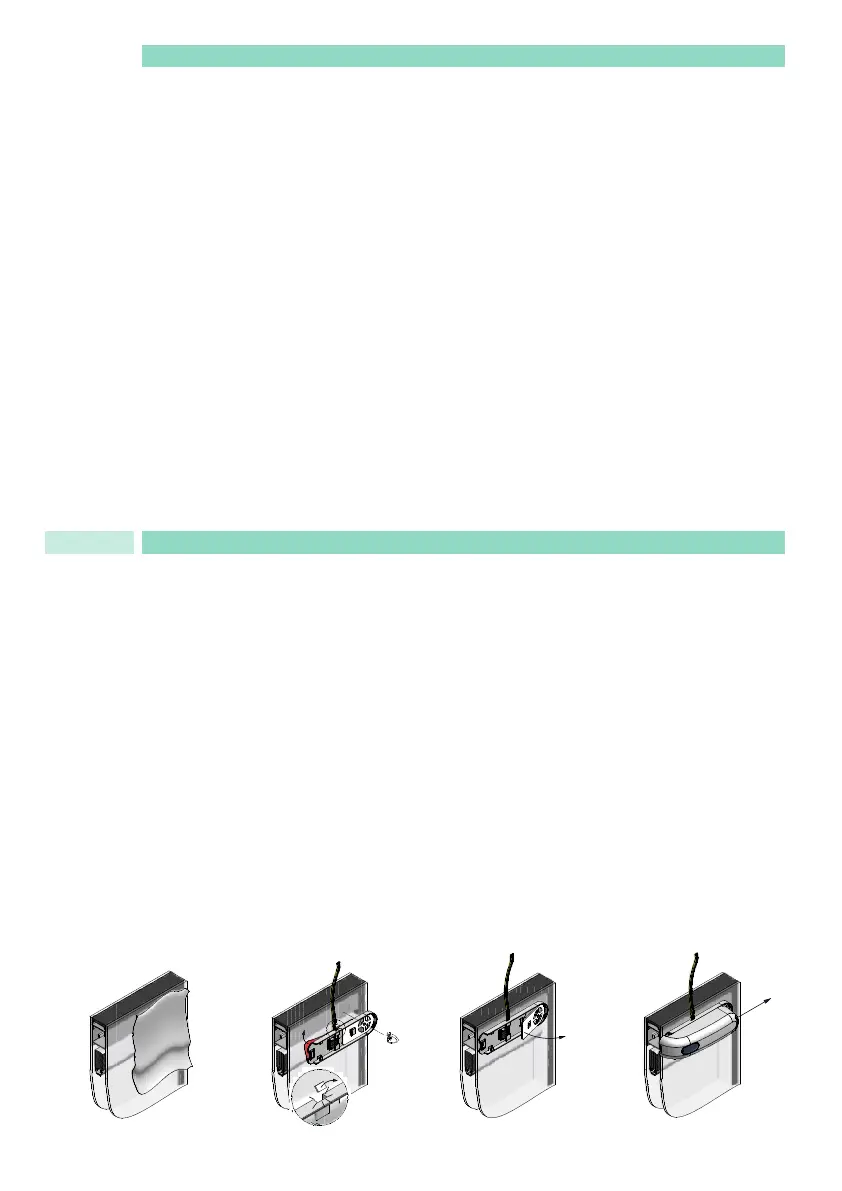
Attaching the support to the glass
The surface of the glass where the external
motor is to be attached must be perfectly clean.
Use isopropyl alcohol if necessary and wait a
few moments for it to dry.
Arrange the cable outlet from the motor support
so that the cables are facing upwards, so that
they can enter the upper glazing bead.
Peel off the three protective lms from the adhe-
sive tape on the motor support.
Draw the support nearer to the glass, centring
it with the internal magnet of the blind. Use the
specially supplied cardboard centring piece to
help with this. This centring piece has a cutout
diameter equal to the external diameter of the
magnet located inside the double glazing unit.
Make sure that the motor support is parallel with
the window frame.
Press the support rmly onto the glass to allow
good adhesion, pressing all over its surface
against the inside as well.
IMPORTANT: please remove the cardboard
centring piece before applying the motor body
(see Fig. 3)
Electrical connections
Three wires (white, black and yellow) come out
of the outer motor support.
Connect the three wires to the cables coming
from the power supply and housed inside the
frame. Follow the electrical diagrams in the
technical catalogue.
Suitably protect the cable joint and hide the
excess cable inside the window frame above
the glazing unit.
Close the upper glazing bead, making sure that
the cables are not squeezed by it.
Fitting the motor
Insert the motor body, sliding it onto the sup-
port until the respective catch at the end of the
support clicks.
When the connections are made, ensure that
the motor works properly, using the push-but-
tons connected thereto.
Installation of the external motor
1. 2. 3. 4.



 To Next Page
 Loading...