EasyManua.ls Logo

Sealey AB900.V2 - User Manual

Sealey AB900.V2
3 pages
Print Icon
To Next Page IconTo Next Page
Loading...
1.2. GENERAL SAFETY INSTRUCTIONS
WARNING! Compressor must only be serviced by an authorised agent.
 Familiarise yourself with the application and limitations of the compressor.
 Ensure the compressor is in good order and condition before use. If in any doubt do not use the unit and contact an electrician/service agent.
 Before moving, or maintaining the compressor ensure it is unplugged from the mains supply and that the air brush is disconnected.
 Do not attach anything other than an air brush to the compressor.
 Ensure the safe working pressure of any air brush used, exceeds the units output pressure.
 Ensure the area selected for spraying is provided with suitable ventilation.
 Ensure the compressor is turned off before disconnecting the air brush.
 To move the compressor use the handle only.
 Use the compressor in a well ventilated area and ensure it is placed on a firm surface.
 Keep tools and other items away from the compressor when it is in use, and keep area clean and clear of unnecessary items.
 Ensure the air brush supply hose is not tangled or twisted, or pinched.
 Keep children and unauthorised persons away from the working area.
 DO NOT disassemble compressor for any reason. The unit must be checked and serviced by an approved service agent.
 DO NOT use the compressor outdoors, or in damp, or wet locations.
 DO NOT operate within the vicinity of flammable liquids, gases or solids.
 DO NOT touch compressor cylinder head as it may be hot and will remain so for some time after shutdown.
 DO NOT attempt to move the compressor by pulling the air brush supply hose. Only move the compressor by its handle.
 DO NOT use this product to perform a task for which it has not been designed.
The use of symbols in this document is to attract your attention to possible danger. The symbols and warnings themselves do not eliminate any danger, nor are they substitutes for correct
accident prevention measures.
Thank you for purchasing a Sealey product. Manufactured to a high standard this product will, if used according to these instructions
and properly maintained, give you years of trouble free performance.
1. SAFETY INSTRUCTIONS
IMPORTANT: PLEASE READ THESE INSTRUCTIONS CAREFULLY. NOTE THE SAFE OPERATIONAL REQUIREMENTS, WARNINGS & CAUTIONS.
USE THE PRODUCT CORRECTLY AND WITH CARE FOR THE PURPOSE FOR WHICH IT IS INTENDED. FAILURE TO DO SO MAY CAUSE DAMAGE
AND/OR PERSONAL INJURY AND WILL INVALIDATE THE WARRANTY. PLEASE KEEP INSTRUCTIONS SAFE FOR FUTURE USE.
1.1. ELECTRICAL SAFETY
WARNING! It is the responsibility of the owner and the operator to read, understand and comply with the following:
You must check all electrical products, before use, to ensure that they are safe. You must inspect power cables, plugs, sockets and any other
connectors for wear or damage. You must ensure that the risk of electric shock is minimised by the installation of appropriate safety devices. A
Residual Current Circuit Breaker (RCCB) should be incorporated in the main distribution board. We also recommend that a Residual Current
Device (RCD) is used. It is particularly important to use an RCD with portable products that are plugged into a supply which is not protected
by an RCCB. If in any doubt consult a qualified electrician. You may obtain a Residual Current Device by contacting your Sealey dealer.
You must also read and understand the following instructions concerning electrical safety.
1.1.1. The Electricity at Work Act 1989 requires all portable electrical appliances, if used on business premises, to be tested by a qualified
electrician, using a Portable Appliance Tester (PAT), at least once a year.
1.1.2. The Health & Safety at Work Act 1974 makes owners of electrical appliances responsible for the safe condition of those appliances
and the safety of the appliance operators. If in any doubt about electrical safety, contact a qualified electrician.
1.1.3. Ensure that the insulation on all cables and on the appliance is safe before connecting it to the power supply. See 1.1.1. and 1.1.2.
and use a Portable Appliance Tester.
1.1.4. Ensure that cables are always protected against short circuit and overload.
1.1.5. Regularly inspect power supply cables and plugs for wear or damage and check all
connections to ensure that none is loose.
1.1.6. Important: Ensure that the voltage marked on the appliance matches the power supply
to be used and that the plug is fitted with the correct fuse - see fuse rating at right.
1.1.7. DO NOT pull or carry the appliance by the power cable.
1.1.8. DO NOT pull the plug from the socket by the cable.
1.1.9. DO NOT use worn or damaged cables, plugs or connectors. Immediately have any faulty
item repaired or replaced by a qualified electrician. When an ASTA/BS approved UK
3 pin plug is damaged, cut the cable just above the plug and dispose of the plug safely.
Fit a new plug according to the following instructions (UK only).
a) Connect the GREEN/YELLOW earth wire to the earth terminal ‘E’.
b) Connect the BROWN live wire to the live terminal ‘L’.
c) Connect the BLUE neutral wire to the neutral terminal ‘N’.
d) After wiring, check that there are no bare wires, that all wires have been correctly
connected, that the cable outer insulation extends beyond the cable restraint and that the restraint is tight.
Double insulated products, which are always marked with this symbol , are fitted with live (brown) and neutral (blue) wires only.
To rewire, connect the wires as indicated above - DO NOT connect either wire to the earth terminal.
1.1.10. Products which require more than 13 amps are supplied without a plug. In this case you must contact a qualified electrician to ensure
that a suitably rated supply is available. We recommend that you discuss the installation of an industrial round pin plug and socket
with your electrician.
1.1.11. If an extension reel is used it should be fully unwound before connection. A reel with an RCD fitted is preferred since any appliance
plugged into it will be protected. The cable core section is important and should be at least 1.5mm², but to be absolutely sure that
the capacity of the reel is suitable for this product and for others which may be used in the other output sockets, we recommend the
use of 2.5mm² section cable. If extension reel is to be used outdoors, ensure it is marked for outdoor use.
FUSE
RATING 3 AMP
Blue
Neutral
Wire
Yellow & Green
Earth Wire
Cable
Restraint
Brown
Live
Wire
INSTRUCTIONS FOR:
MINI AIR BRUSH COMPRESSOR
MODEL No: AB900.V2
Original Language Version
AB900.V2 Issue: 2 - 02/03/10
Question and Answer IconNeed help?

Do you have a question about the Sealey AB900.V2 and is the answer not in the manual?

Overview

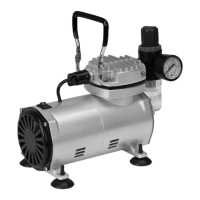
The Sealey AB900.V2 is a mini airbrush compressor, designed for use with most airbrushes. It is a quiet-running piston pump powered by a 110-Watt electric motor, making it suitable for various airbrushing tasks. A key feature of this compressor is that it requires no lubrication, and the air supply from the unit is oil-free, which is crucial for maintaining the purity of the air for delicate airbrush work. The unit comes supplied with an air filter regulator and a pressure gauge, allowing for precise control over the air output.

Technical Specifications:

  • Model No.: AB900.V2
  • Motor Power: 110W
  • Input: 230V - 50Hz - 1A
  • Free Air Delivery: 0.8cfm
  • Air Pressure: 50psi
  • Air Outlet Size: 1/4"BSP
  • Fuse Rating: 3 AMP

Usage Features:

Before operation, users must ensure they have read and understood all safety instructions provided in the manual. The compressor should be removed from its packaging and inspected for any damage. The mains voltage must correspond to the voltage shown on the compressor data plate. For optimal performance and to prevent overheating, the compressor should be operated in a position that allows good air circulation around the unit. It should be placed on a stable and level surface, ensuring the rubber feet are in direct contact with the work surface to minimize vibration. It is crucial not to operate the unit in an enclosed space.

To begin, attach the airbrush hose to the 1/4"BSP air outlet. The mains lead should then be plugged into a convenient socket, but the unit should not be switched on until the medium to be sprayed, the airbrush, and the item/surface to be sprayed are fully prepared. Once switched on, the compressor provides a constant airflow to the airbrush. The compressor motor will automatically cut in and out to maintain the required pressure, as determined by the user's regulator setting. Users should refer to their airbrush manufacturer's instructions for the correct spraying technique.

It is important not to leave the compressor running for extended periods with the airbrush attached but not in use; if there's a pause in work, the compressor should be switched off. If the operating note of the compressor changes, it may indicate a blockage within the airbrush or a pinched air hose. In such cases, the unit should be switched off immediately, and the source of the blockage investigated and eliminated. After the task is complete, the compressor can be used to blow a suitable cleaning solvent through the airbrush. The unit should then be switched off, and the airbrush operated to relieve any pressure left in the hose before disconnecting it from the compressor.

During and immediately after operation, the finned pump head may become hot and should not be touched. If the unit needs to be moved, it should only be lifted by its handle, and allowed to cool before storage. If there is a loss of efficiency when spraying, users should first ensure the airbrush is scrupulously clean and functioning properly. If the airbrush is satisfactory, the troubleshooting guide in the manual should be consulted.

Maintenance Features:

Maintaining the AB900.V2 involves keeping the unit clean at all times. It is essential not to cover any of the ventilation slots or allow extraneous material to enter the unit via these openings. The compressor should be stored in dust-free and dry conditions when not in use.

The manual includes a troubleshooting guide to help identify potential faults that may develop over time. This chart is not intended as a guide for self-repair, but rather to indicate when the unit should be returned to an authorized service agent for rectification. Common faults and their remedies include:

  • Low air flow: This could be due to a damaged air valve plate or air valve, a damaged diaphragm, loose head screws, or an air hose leak. Remedies involve changing the defective parts, tightening screws, or checking/renewing seals.
  • Noisy operation: This might be caused by overly tight head screws or a bearing fault. Solutions include loosening and then equally tightening the screws (without overtightening) or returning the unit to the dealer for bearing checks.
  • Humming noise but does not work: This could indicate overly tight head screws or an armature fault. The remedies are to loosen and equally tighten the screws (without overtightening) or return the unit to the dealer for armature checks.

Parts support is available for this product, and users can obtain a parts listing and/or diagram by logging on to the Sealey website, emailing sales, or calling their support number.

Electrical Safety:

Users are responsible for ensuring all electrical products are safe before use, checking power cables, plugs, sockets, and connectors for wear or damage. The risk of electric shock must be minimized by installing appropriate safety devices, such as a Residual Current Circuit Breaker (RCCB) in the main distribution board, and ideally a Residual Current Device (RCD) for portable products. The Electricity at Work Act 1989 requires portable electrical appliances used in business premises to be tested by a qualified electrician using a Portable Appliance Tester (PAT) at least once a year. The Health & Safety at Work Act 1974 makes owners responsible for the safe condition of appliances and the safety of operators.

Insulation on all cables and the appliance must be safe. Cables must be protected against short circuits and overload. Power supply cables and plugs should be regularly inspected for wear or damage, and connections checked for looseness. The voltage marked on the appliance must match the power supply, and the plug must be fitted with the correct 3 AMP fuse. Users must not pull or carry the appliance by the power cable or pull the plug from the socket by the cable. Worn or damaged cables, plugs, or connectors must be immediately repaired or replaced by a qualified electrician. If a UK 3-pin plug is damaged, the cable should be cut just above the plug, and a new plug fitted according to the instructions: connect the GREEN/YELLOW earth wire to terminal 'E', BROWN live wire to terminal 'L', and BLUE neutral wire to terminal 'N'. After wiring, ensure no bare wires, correct connections, and that the cable outer insulation extends beyond the cable restraint, which must be tight. Double insulated products (marked with ☐) are fitted with live (brown) and neutral (blue) wires only; these should not be connected to the earth terminal.

Products requiring more than 13 amps are supplied without a plug, and a qualified electrician must be contacted to ensure a suitably rated supply is available. If an extension reel is used, it must be fully unwound before connection. An RCD-fitted reel is preferred. The cable core section should be at least 1.5mm², but 2.5mm² section cable is recommended for this product and other output sockets. If used outdoors, the extension reel must be marked for outdoor use.

General Safety Instructions:

The compressor must only be serviced by an authorized agent. Users should familiarize themselves with the application and limitations of the compressor and ensure it is in good order and condition before use. Before moving or maintaining the compressor, ensure it is unplugged from the mains supply and the airbrush is disconnected. Only an airbrush should be attached to the compressor. The safe working pressure of any airbrush used must not exceed the unit's output pressure. The spraying area must be well-ventilated. The compressor should be turned off before disconnecting the airbrush. The compressor should only be moved by its handle. It must be used in a well-ventilated area on a firm surface. Tools and other items should be kept away from the compressor during use, and the area should be clean and clear. The airbrush supply hose must not be tangled, twisted, or pinched. Children and unauthorized persons must be kept away from the working area.

Users must NOT disassemble the compressor for any reason; it must be checked and serviced by an approved service agent. It must NOT be used outdoors or in damp/wet locations. It must NOT be operated within the vicinity of flammable liquids, gases, or solids. The compressor cylinder head must NOT be touched after shutdown as it may be hot. The compressor must NOT be moved by pulling the airbrush supply hose. This product must NOT be used to perform tasks for which it was not designed.

Sealey AB900.V2 Specifications

General IconGeneral
BrandSealey
ModelAB900.V2
CategoryAir Compressor
LanguageEnglish

Related product manuals