5. OPERATION
WARNING! Ensure that you read, understand and apply the safety instructions before use.
5.1. USING THE WRENCH
5.1.1. Useonlyimpactsocketswhicharespecicallydesignedforusewithanimpactwrench.Theuseofnormalchromevanadiumsockets
is dangerous, since these are more brittle and are liable to shatter.
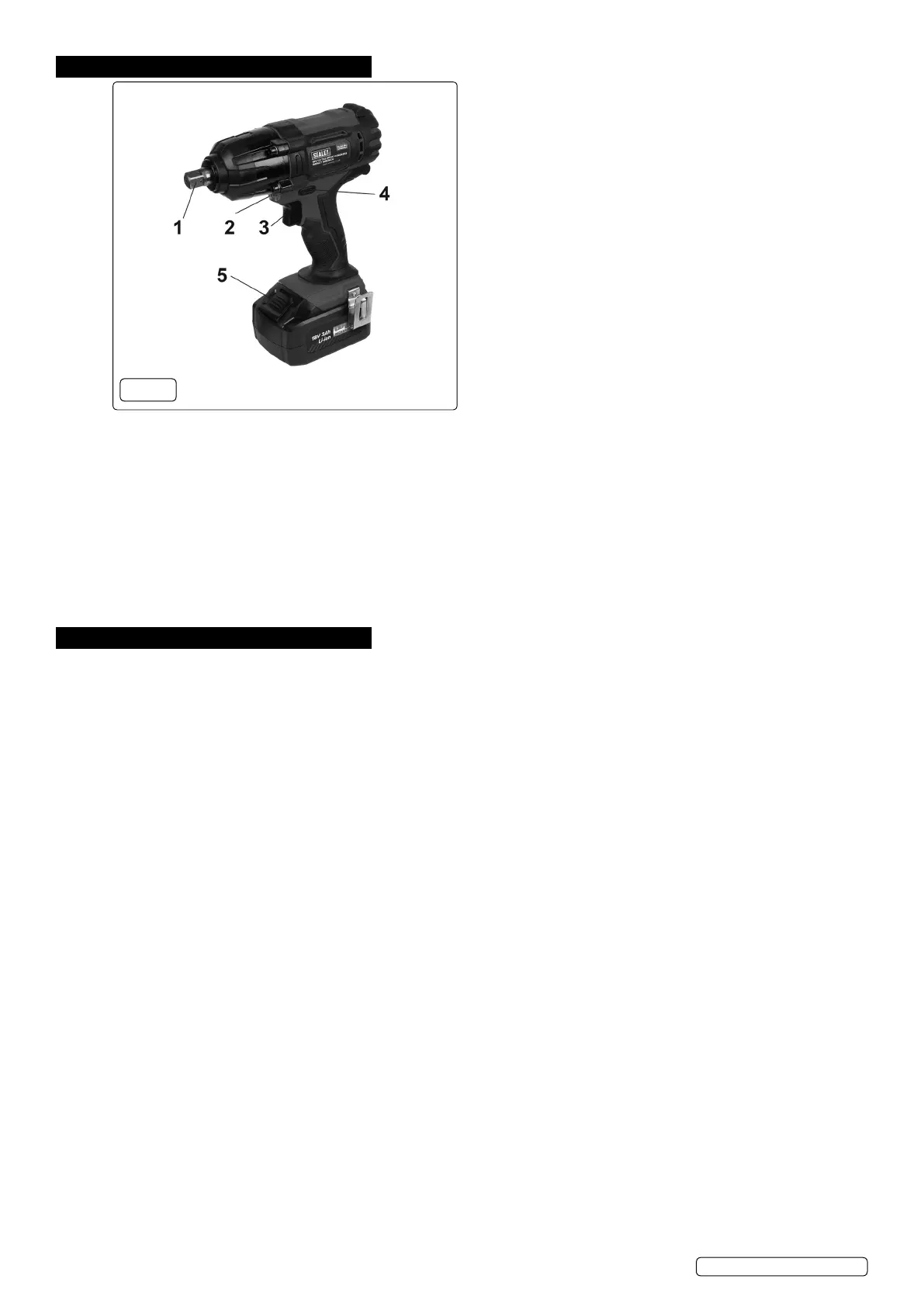
5.1.2. Fitthesockettothewrenchbysnappingitontothesquaredrive(g.1.1).
5.1.3. Fit the battery pack to the wrench by aligning the tongue on the battery with the groove in the housing and slide it into place. Ensure
thatthebatterypackisrmlylocated,youwillhearanaudibleclickwhenithaslockedintoposition.
5.1.4. Selecttherequireddirectionofrotation.Tochangedirection,pushswitch(g.1.4)totheleftorright.Familiariseyourselfwiththis
operation before use. DO NOTattempttochangethedirectionofrotationwhilstthetrigger(g.1.3)isdepressed.
When the wrench is not in use, use the same switch to lock off the trigger by placing the switch in the middle position.
5.1.5. Whentightening,releasethetriggerassoonastheimpactsoundisheard.Takecarenottoover-torquesmallxings.
NOTE: On critical fixings, final tightening should be carried out using a torque wrench, setting it according to the product or the
vehicle manufacturer’s specifications.
6. MAINTENANCE
6.1. CLEANING
Keep the outer case of the wrench clean and free from grease. DO NOT wash with water or use solvents or abrasives, use a damp cloth.
For any other service or maintenance, contact your authorised service agent.
WARNING! - risk of Hand Arm Vibration Injury
This tool may cause Hand Arm Vibration Syndrome if its use is not managed adequately.
ThistoolissubjecttothevibrationtestingsectionoftheMachineryDirective2006/42/EC.
This tool is to be operated in accordance with these instructions.
Measuredvibrationemissionvalue(a): 8.93m/s²
Uncertaintyvalue(k): 1.5m/s²
Please note that the application of the tool to a sole specialist task may produce a different average vibration emission. We recommend that a
specific evaluation of the vibration emission is conducted prior to commencing with a specialist task.
A health and safety assessment by the user (or employer) will need to be carried out to determine the suitable duration of use for each tool.
NB: Stated Vibration Emission values are type-test values and are intended to be typical.
Whilst in use, the actual value will vary considerably from and depend on many factors.
Such factors include; the operator, the task and the inserted tool or consumable.
NB: ensure that the length of leader hoses is sufficient to allow unrestricted use, as this also helps to reduce vibration.
The state of maintenance of the tool itself is also an important factor, a poorly maintained tool will also increase the risk of Hand Arm Vibration
Syndrome.
Health surveillance.
We recommend a programme of health surveillance to detect early symptoms of vibration injury so that management procedures can be modified
accordingly.
Personal protective equipment.
We are not aware of any personal protective equipment (PPE) that provides protection against vibration injury that may result from the
uncontrolled use of this tool. We recommend a sufficient supply of clothing (including gloves) to enable the operator to remain warm and dry and
maintain good blood circulation in fingers etc. Please note that the most effective protection is prevention, please refer to the Correct Use and
Maintenance section in these instructions. Guidance relating to the management of hand arm vibration can be found on the HSE website
www.hse.gov.uk - Hand-Arm Vibration at Work.
Original Language Version
© Jack Sealey Limited
fig.1
KEY:
1.1 1/2” Square Drive
1.2 Work light
1.3 Trigger
1.4 Direction Control
1.5 BatteryReleaseClip
CP400LIHVIssue126/11/19



 To Next Page
 Loading...