2
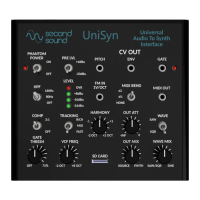
UniSyn Universal Audio to Synth Interface User’s Manual
Congratulaons for purchasing a Second Sound UniSyn Audio to
Synth Interface! Here is a summary of what your UniSyn can do:
• Convert audio from any monophonic source into sine and
low-pass-ltered square or sawtooth waves, oponally pitch-
shied over a ±2 octave range and with semitone resoluon
• Apply envelope modulaon of the built-in Voltage-Controlled
Filter (VCF) with three modulaon depth sengs: no
modulaon, full modulaon, and half depth modulaon
• Convert audio to pitch, envelope, and gate control voltages
(CVs) for controlling analog synths
• Convert audio to MIDI for controlling digital synths
• “Hold” the pitch and envelope of both the internal synth
voices, CV and MIDI using an oponal sustain pedal (not
included)
• Provide a 1v/oct FM CV input for modulang the pitch of the
internal synth voices as well as the CV and MIDI outs
• Provide capability to blend the internal synth mix of sine and
square/sawtooth waves with the dry preamp output
• Provide +24v phantom power according to the IEC 61938
Standard for powering condenser mics
• Provide automac gain control (AGC) over a 50dB range,
yielding opmal preamp gain independent of source signal
level
• Provide an audio preamp output at either +4dBu or -20dBu
• Oponally congure the AGC/preamp as an upward
compressor with 3:1 compression rao and threshold of
-12dBFS, with aack me approaching zero and release me
approaching 2 audio cycles
• Track the fundamental frequency of audio sources as diverse
as voice, guitar, bass guitar, violin, trumpet, saxophone with
minimal conguraon required


 To Next Page
 Loading...