EasyManua.ls Logo

Sharp FDD-412A - Page 9

Sharp FDD-412A
119 pages
Print Icon
To Next Page IconTo Next Page
To Previous Page IconTo Previous Page
Loading...
FDD412A/B
.hese
operations
and
their
control
are
shared
by
the
FDD
and
FDC
(floppy
disk
controller).
Each
of
the
above
steps
is
further
explained
below.
(1)
(2)
(3)
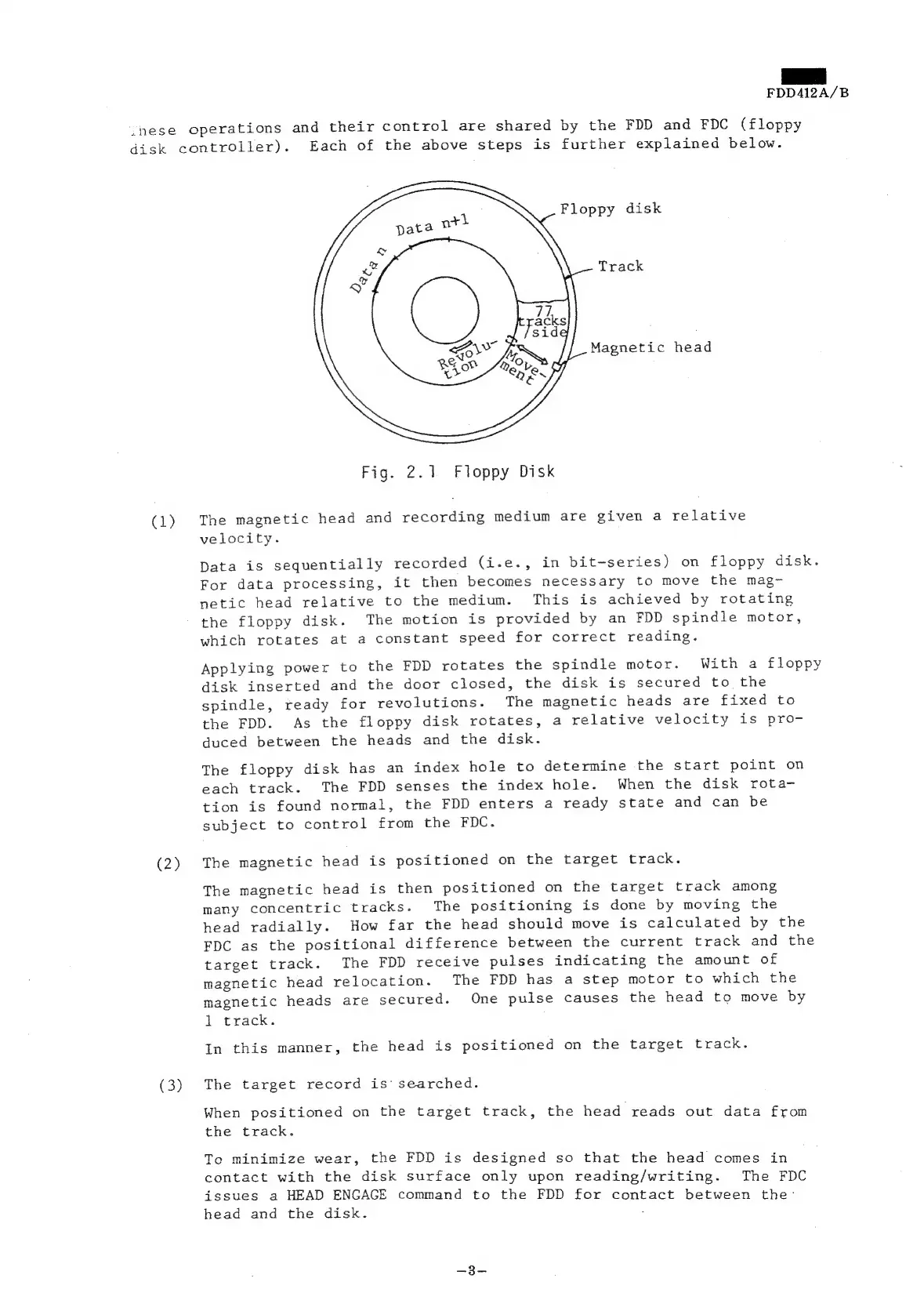
Floppy
disk
Track
Magnetic
head
Fig.
2.1
Floppy
Disk
The
magnetic
head
and
recording
medium
are
given
a
relative
velocity.
Data
is
sequentially
recorded
(i.e.,
in
bit-series)
on
floppy
disk.
For
data
processing,
it
then
becomes
necessary
to
move
the
mag-
netic
head
relative
to
the
medium.
This
is
achieved
by
rotating
the
floppy
disk.
The
motion
is
provided
by
an
FDD
spindle
motor,
which
rotates
at
a
constant
speed
for
correct
reading.
Applying
power
to
the
FDD
rotates
the
spindle
motor.
With
a
floppy
disk
inserted
and
the
door
closed,
the
disk
is
secured
to
the
spindle,
ready
for
revolutions.
The
magnetic
heads
are
fixed
to
the
FDD.
As
the
floppy
disk
rotates,
a
relative
velocity
is
pro-
duced
between
the
heads
and
the
disk.
The
floppy
disk
has
an
index
hole
to
determine
the
start
point
on
each
track.
The
FDD
senses
the
index
hole.
When
the
disk
rota-
tion
is
found
normal,
the
FDD
enters
a
ready
state
and
can
be
subject
to
control
from
the
FDC.
The
magnetic
head
is
positioned
on
the
target
track.
The
magnetic
head
is
then
positioned
on
the
target
track
among
many
concentric
tracks.
The
positioning
is
done
by
moving
the
head
radially.
How
far
the
head
should
move
is
calculated
by
the
FDC
as
the
positional
difference
between
the
current
track
and
the
target
track.
The
FDD
receive
pulses
indicating
the
amount
of
magnetic
head
relocation.
The
FDD
has
a
step
motor
to
which
the
magnetic
heads
are
secured.
One
pulse
causes
the
head
to
move
by
1
track.
In
this
manner,
the
head
is
positioned
on
the
target
track.
The
target
record
is’
searched.
When
positioned
on
the
target
track,
the
head
reads
out
data
from
the
track.
To
minimize
wear,
the
FDD
is
designed
so
that
the
head
comes
in
contact
with
the
disk
surface
only
upon
reading/writing.
The
FDC
issues
a
HEAD
ENGAGE
command
to
the
FDD
for
contact
between
the-
head
and
the
disk.
: