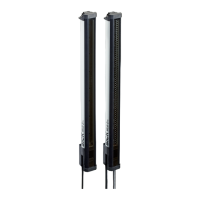
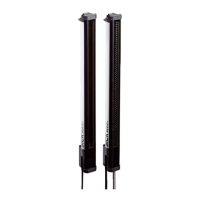
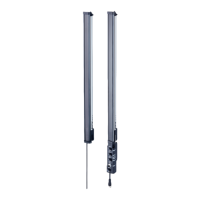
Figure 8: Standard scan method
The scan time increases according to the number of beams of an MLG-2.
Figure 9: Scan time in relation to the number of beams
The scan time is used to determine the response times of the outputs, the minimum
presence time of an object and the repeat accuracy of a measurement result (reprodu‐
cibility).
•
The response time is the time it takes for an output to react following the detec‐
tion of an object/gap. The maximum response time is 3 × the scan time plus the
transmission time to the outputs.
•
The minimum presence time is the time an object or a gap has to be in the
detection area for it to be detected. The minimum presence time is max. 2 × the
scan time.
•
The repeat accuracy of a measurement result (reproducibility) is the amount
of time by which an object detection can differ from a previous or subsequent
detection. The reproducibility time is 1 × the scan time.
3.5.1 Response time, minimum presence time and reproducibility of the MLG-2
On the MLG-2, the response time, minimum presence time, and reproducibility are
displayed via SOPAS ET. Response time and minimum dwell time can be read off in the
diagramsee figure 149, page 160.
3.5.2 Scan time with cross-beam function
When the cross-beam function is enabled, the light beam from a sender LED is received
by three receiver diodes in two scans. This doubles the scan time.
3 PRODUCT DESCRIPTION
18
O P E R A T I N G I N S T R U C T I O N S | MLG-2 ProNet 8018748.1Q3I/2024-12-18 | SICK
Subject to change without notice



 To Next Page
 Loading...