
 Need help?
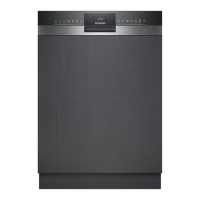
Do you have a question about the Siemens SN536S01KE and is the answer not in the manual?
This document serves as a quick reference guide for a dishwasher, providing essential information on its operation, maintenance, and troubleshooting. It is designed to help users get started quickly and address common issues.
The dishwasher is designed to clean tableware efficiently. It features a water softening system to adapt to different water hardness levels, ensuring optimal cleaning results and preventing limescale buildup. The appliance also has dedicated dispensers for special salt and rinse aid, which are crucial for effective washing and drying. Various washing programs are available, tailored for different types of loads and soil levels, from intensive cleaning for heavily soiled items to quick washes for lightly soiled glassware. The device is equipped with spray arms that distribute water and detergent, and a filter system to capture food remnants, ensuring clean water circulation. A wastewater pump is integrated to drain used water from the appliance.
Initial Setup and Water Hardness: Before first use, users are instructed to read both the operating and installation instructions. A key initial step is setting the water softening system according to the local water hardness. This involves accessing a specific setting menu by pressing and holding program buttons, then adjusting the hardness level (H:xx) using another program button. A table is provided to help users convert mmol/l values to the appropriate setting value (H00-H07).
Adding Special Salt: Special salt is essential for the water softening system. To add salt, the lid of the dispenser needs to be unscrewed and removed. For initial startup, the dispenser should be filled with water before adding salt, which will displace the water. Detergent should never be added to the special salt dispenser. After adding salt, the lid must be replaced and turned to close securely. This process should be performed just before a program starts to prevent damage to the appliance.
Adding Rinse Aid: Rinse aid helps with drying and prevents water spots. To add rinse aid, the catch on the dispenser lid is pressed, and the lid is lifted. Rinse aid should be filled up to the maximum mark. After filling, the lid is closed until it clicks into position.
Adding Detergent: Detergent is added to a dedicated dry detergent dispenser. The dispenser often has markings (e.g., 15 ml, 25 ml, 50 ml) to guide the user on the appropriate amount. After adding detergent, the dispenser lid is closed until it clicks into position.
Operating the Appliance: The general usage sequence involves:
Program Data: The manual includes a table detailing program data, measured according to European standard EN 60436. This data provides estimates for duration, energy consumption, and water usage. It notes that these figures can vary based on additional functions selected and that the runtime may change if the rinse aid system is switched off or if rinse aid needs to be added.
Cleaning Filters: Regular filter cleaning is crucial for optimal performance.
Cleaning Spray Arms: Blocked spray arm nozzles can impair cleaning performance.
Cleaning Wastewater Pump: If the wastewater pump is blocked, it needs to be cleaned.
Troubleshooting: The manual provides a comprehensive troubleshooting guide for common faults:
 General
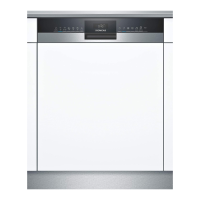
| Type | Built-in |
|---|---|
| Size | Full-size |
| Energy Efficiency Class | A++ |
| Capacity | 13 place settings |
| Noise Level | 44 dB |
| Water Consumption | 9.5 L |
| Dimensions (H x W x D) | 845 x 600 x 600 mm |
| Programs | 6 |
| Annual Energy Consumption | 262 kWh |
| Annual Water Consumption | 2660 L |
| Drying Class | A |
| Delay Start | Yes |
| Child Lock | Yes |
| Water Protection | AquaStop |


 To Next Page