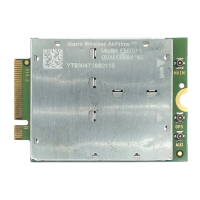
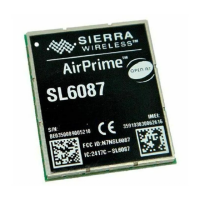
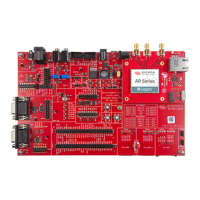
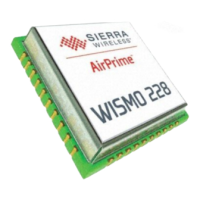
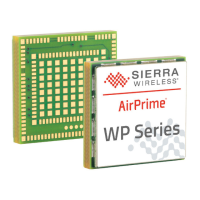
The Sierra Wireless AirPrime EM7690 is a FirstNet-ready (B14 LTE) M.2 embedded module designed to provide 4G LTE Advanced Pro, 3G (HSPA+, UMTS), and GNSS connectivity. It caters to a wide range of devices and applications, including business, personal, portable computing, communication devices, IoT devices, M2M applications, and industrial use cases. The module is available in various region-specific and function-specific SKUs.
Important Technical Specifications:
Power:
The module operates on a VCC (3.3V) power supply, with a voltage range of 3.135V (min) to 4.4V (max) and a typical voltage of 3.3V. The ripple voltage is a maximum of 100 mVpp, and the peak current can reach up to 4000 mA. The continuous current is TBD. The ground (GND) pins are at 0V.
Module Power States:
The EM7690 has five power states:
- Normal (Default State): The module is active and capable of placing/receiving calls or establishing data connections. Current consumption is influenced by radio band, transmit power, receive gain settings, and data rate. This state is entered when VCC is first applied, Full_Card_Power_Off# is deasserted (pulled high), and W_DISABLE# is deasserted.
- Low Power (Airplane Mode): The module is active but with RF activity suspended. It can be entered under host interface control (AT+CFUN=0 or W_DISABLE# assertion after AT!PCOFFEN=0) or automatically when critical temperature or voltage trigger limits are reached.
- Sleep: The normal state between calls or data connections, where the module cycles between wake (polling the network) and sleep at network provider-determined intervals.
- Off: The host keeps the module powered off by asserting Full_Card_Power_Off# (pulled low or left floating). The module draws minimal current.
- Disconnected: The host power source is disconnected, and all voltages are at 0V.
Power State Transitions:
The module monitors supply voltage and operating temperature. Critical thresholds trigger state changes.
- Normal to Low Power: Triggered by VOLT HI CRIT (4.6V), VOLT LO CRIT (2.9V), TEMP LO CRIT (-45°C), or TEMP HI CRIT (118°C). RF activity is suspended.
- Low Power to Normal: Triggered by VOLT HI NORM (4.4V) or TEMP_NORM LO (-30°C). RF activity is resumed.
- Normal (Issue Warning): Triggered by VOLT_LO_WARN (3.135V) or TEMP_HI_WARN (100°C). Performance may be reduced in the TEMP_HI_WARN state.
- Power off/on (Host-initiated): Power off is recommended when supply voltage or operating temperature is critically low or high.
RF Specifications:
The EM7690 features four MHF4 RF connectors for host-supplied antennas:
- Main TX/RX: Primary Tx/PRx path for 3G/4G.
- MIMO1: MIMO1 Rx Path.
- MIMO2/GNSS L5: MIMO2 Rx Path and GNSS L5.
- Aux/GNSS L1: Diversity Rx and GNSS L1.
Antenna Requirements:
- Impedance: Nominal 50Ω with a return loss better than 10 dB across each frequency band.
- Cable Loss: Recommended maximum cable loss for antenna cabling is 0.5 dB.
- Total Radiated Efficiency: > 50% on all bands.
- Radiation Patterns: Nominally Omni-directional in the azimuth plane.
- Envelope Correlation Coefficient: < 0.5 on Rx bands below 960 MHz, < 0.2 on Rx bands above 1.4 GHz.
- Mean Effective Gain (MEG1, MEG2): > -3 dBi.
- Ant1 and Ant2 Mean Effective Gain Imbalance: < 2 dB for MIMO, < 6 dB for diversity.
- Isolation: > 10dB for all antennas at all bands, > 20dB for Ant1 and Ant4 at B41.
- Power Handling: > 1W.
- VSWR: < 2:1 (recommended), < 3:1 (worst case) on all bands including band edges.
GNSS Antenna Requirements:
- Frequency Range: Wide-band GNSS (1559-1606 MHz recommended), Narrow-band GPS (1575.42 MHz ±2 MHz), Galileo (1575.42 MHz ±2 MHz), BeiDou (1561.098 MHz ±2 MHz), GLONASS (1601.72 MHz ±4.2 MHz), QZSS (1575.42 MHz ±2 MHz).
- Field of View (FOV): Omni-directional in azimuth, -45° to +90° in elevation.
- Polarization (Average Gv/Gh): >0 dB (vertical linear polarization is sufficient).
- Free Space Average Gain (Gv+Gh) over FOV: > -6 dBi (preferably > -3 dBi).
- Gain: Maximum gain and uniform coverage in high elevation angle and zenith. Gain in azimuth plane is not desired.
- Average 3D Gain: > -5 dBi.
- Isolation between GNSS and ANTx for WWAN Tx: > 15 dB in all uplink bands and GNSS Rx Bands.
- Typical VSWR: < 2.5:1.
- Polarization: Any other than LHCP (left-hand circular polarized) is acceptable.
- Note: GNSS active antenna is forbidden to use.
Supported Frequencies (LTE/3G):
The module supports a wide range of LTE and 3G bands, including:
- LTE: B1, B2, B3, B4, B5, B7, B8, B12, B13, B14, B17, B18, B19, B20, B25, B26, B28, B29, B30, B32, B34, B38, B39, B40, B41, B42, B46, B48, B66, B71. B30 can operate as Tx/Rx or Rx only. B42/B48 are disabled as of publication date, support pending regulatory approval.
- 3G (HSPA+/WCDMA): Bands 1, 2, 3, 4, 5, 6, 8, 9, 19.
- GNSS: GPS/QZSS L1, GLONASS G1, Galileo E1, BeiDou Bli, GPS L5, GAL E5a, QZSS L5, BDS B2a.
Usage Features:
- Connectivity: Provides robust 4G LTE Advanced Pro, 3G, and GNSS capabilities.
- Integration: Designed for easy integration into host devices using M.2-spec connectors and industry-standard SIM connectors.
- Antenna Flexibility: Supports external multi-band 4x4 MIMO antenna systems for LTE and multi-band antenna systems with diversity for 3G.
- RF Performance Optimization: Guidelines for antenna selection, cabling, and placement to ensure optimal RF performance and minimize interference.
- Diversity Antenna Control: Receive diversity can be enabled/disabled using AT commands (!RXDEN, !LTERXCONTROL) for testing purposes, though commercial deployment with diversity disabled is not recommended.
- Regulatory Compliance: Designed to meet FCC, IC, CE, RoHS, and other regional regulatory requirements. Modular approval simplifies certification for end products.
Maintenance Features:
- Shielding: The module is fully shielded to protect against EMI, and this shielding should not be removed.
- Thermal Management: System design should provide sufficient cooling for the module to prevent performance degradation due to high temperatures.
- Interference Mitigation: Recommendations for host device design to mitigate RF interference, including antenna placement, host device shielding, filtering, and cable routing.
- Troubleshooting: The module is designed to withstand antenna connection short circuits or open circuits without permanent damage.
- Documentation and Support: A hardware development kit is available for evaluation and development. Sierra Wireless offers engineering services for modem OTA sensitivity testing and desensitization investigation. Contact information for sales, technical support, and corporate information is provided.
- Regulatory Information: Clear guidelines for labeling and user manual content to ensure compliance with FCC/IC RF exposure requirements, especially regarding separation distances and antenna gain limits for standalone and collocated transmitters. Specific EIRP limits for Band 30 are highlighted due to its sensitive nature.

 Need help?
 General

 To Next Page