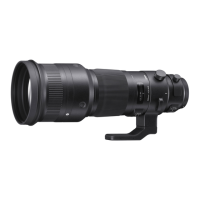
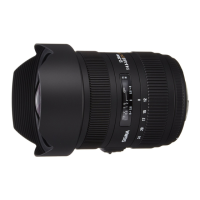
ANGLE OF VIEW AND FOCAL LENGTH
84.1° 24mm
18.2° 135mm
75.4° 28mm
12.3° 200mm
46.8° 50mm
8.2° 300mm
122° 12mm
34.3° 70mm
5° 500mm
103.7° 17mm
23.3° 105mm
3.1° 800mm
94.5° 20mm
FISHEYE 180° 15mmFISHEYE 180° 8mm
TELE CONVERTER
angle relative to the diagonal line of 36 mm x 24 mm
and 20.7 mm x 13.8 mm frames. As the focal length
becomes larger, the field angle becomes smaller and
the image larger.
• f Value (f-Number; f-Stop)
The aperture settings of a lens are called f-numbers
or f-stops. An f-number represents a ratio between
lens focal length and the effective diameter of
a given aperture. The f-number equals the focal
length of the lens divided by the entrance pupil of
the aperture. Aperture settings are marked so that
each position changes the amount of light passing
through the lens by a factor of 2: the light is either
doubled, or reduced by one-half. That is, a high
number represents a smaller aperture, one that
stops twice as much light as the previous aperture.
Conversely, a lower number represents a larger
aperture, one that increases light twice as much
as the pervious number. The speed of a lens is the
f-number of its maximum effective diameter — i.e.,
when the aperture is wide open.
These APO Tele Converters are compatible with
digital cameras, and when mounted between the
lens and the camera body, they can increase the focal
length of the lens by the power of 1.4 or 2. They are
also compatible with the AF function, depending on
the open-aperture F value of the lens being used,
and they work with the AE (Automatic Exposure)
function, dispensing with complicated exposure
calculations. They increase maximum photography
magnification by 1.4X or 2X, without any variation in
the minimum focusing distance.
• Perspective
Depending on the focal length of the lens, the
background appears close to or further away from
the object. This visual effect is called perspective.
With a wide-angle lens the background will appear
remote, and the distance from the subject to the
background will be emphasized; when the focal
length of a telephoto lens is large, the background
will appear to be closer to the object. To take
advantage of this effect, use a wide-angle lens to
capture both the background and the object, and a
telephoto lens to emphasize only the object.
APO 300mm F2.8 EX DG / HSM
APO 500mm F4.5 EX DG / HSM
APO 800mm F5.6 EX DG / HSM
AF MF
AF
AF
MF MF
MF
MF
MF
—
MF
MF
AF
MF
—
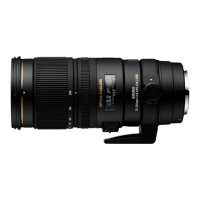
APO 70-200mm F2.8 II EX DG MACRO HSM
Dedicated Lenses
for SIGMA
824402
for SONY
for NIKON
824556
for CANON
824273
for PENTAX
824266
APO 50-500mm F4.5-6.3 DG OS HSM MF MF
MF
MF
—
AF AF
AF
AF
—
APO 120-300mm F2.8 EX DG HSM
APO 120-400mm F4.5-5.6 DG OS HSM
APO 150-500mm F5-6.3 DG OS HSM
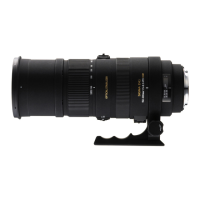
APO 300-800mm F5.6 EX DG HSM
APO MACRO 150mm F2.8 EX DG HSM
AF
—
AF
AF
—
MF MF
MF
MF
—
MF MF
MF
MF
—
MF
—
MF
MF
—
AF
*
1
—
AF
*
1
AF
*
1
—
APO TELE CONVERTER 1.4x EX DG
*Four Thirds mount is not available.
*1 : It is capable of AF from 0.52m (20.5 in) to infinity.
824624
APO 70-200mm F2.8 EX DG OS HSM AF AF
AF
AF
—
APO 120-300mm F2.8 EX DG HSM
APO 120-400mm F4.5-5.6 DG OS HSM
APO 150-500mm F5-6.3 DG OS HSM
APO 300-800mm F5.6 EX DG HSM
APO MACRO 150mm F2.8 EX DG HSM
AF
—
AF
AF
—
MF MF
MF
MF
—
MF MF
MF
MF
—
MF
—
MF
MF
—
MF
—
MF
MF
—
APO 70-200mm F2.8 II EX DG MACRO HSM
Dedicated Lenses
for SIGMA
876401
for SONY
for NIKON
876555
for CANON
876272
for PENTAX
876265
APO 50-500mm F4.5-6.3 DG OS HSM MF MF MF MF
—
AF AF
AF
AF
—
APO 300mm F2.8 EX DG / HSM
APO 500mm F4.5 EX DG / HSM
APO 800mm F5.6 EX DG / HSM
AF MF
AF
AF AF
MF MF
MF
MF MF
MF
—
MF
MF
—
APO TELE CONVERTER 2x EX DG
*Four Thirds mount is not available.
876623
APO 70-200mm F2.8 EX DG OS HSM AF AF AF AF
—
23


 To Next Page
 Loading...