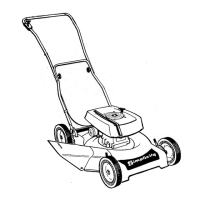
The Simplicity Model 1121 is a 21-inch push mower designed for lawn maintenance. This operator's manual provides essential information for safe and effective operation, maintenance, and parts replacement.
Function Description:
The Simplicity Model 1121 is a rotary push mower primarily used for cutting grass in residential lawns. It features a gasoline-powered engine that drives a rotating blade to cut grass. The mower is designed for manual pushing, meaning it does not have a self-propelled mechanism. Key safety features are integrated to protect the user and bystanders, including a chute extension, a trailing plate, and a starting footpad. The mower can be used with or without an optional grass catcher to collect clippings.
Important Technical Specifications:
- Model Number: 1121
- Manufacturing Number: 1690362
- Cutting Width: 21 inches
- Recommended Oil: SAE 30 (above 40°F / Summer) or SAE 5W-20 (below 40°F / Winter)
- Blade Bolt Torque: 35 ft.-lbs.
- Cutting Height Adjustments: Approximately 1-1/8", 1-5/8", 2-1/8", 2-5/8", 3-1/4", 3-5/8"
- Optional Accessory: Grass Catcher (Part Number 1690363) and Replacement Bag (Part Number 1664166)
Usage Features:
- Safety First: The manual emphasizes reading all safety rules thoroughly before operation. It highlights the importance of keeping the area clear of people and pets, wearing substantial footwear, and never operating the mower barefoot or in open sandals.
- Starting Procedure: To start the engine, the throttle control lever should be moved to the "Start" position (the engine is equipped with an automatic choke). The user must place one foot on the starting footpad (located on the top left side of the mower housing) to prevent movement while pulling the starter cord sharply. Once the engine starts, the throttle control lever should be moved to the desired speed.
- Stopping Procedure: To stop the engine, the throttle control lever should be moved to the "Stop" position.
- Cutting Height Adjustment: The mower features individual cutting height adjusters for each wheel. To adjust, users place fingers on the outside of the wheel and thumb on the spring operating lever. Squeeze the lever until the tab clears the hole, then rotate the lever to the desired direction and allow the tab to enter the locking hole in the plate. It's crucial to ensure all adjusters are set to the same height.
- Mowing Conditions: It is recommended to mow only in daylight or good artificial light and never in wet grass. Users should always be sure of their footing and walk, never run.
- Slope Operation: Mow across the face of slopes, never up and down. Extreme caution is advised when changing direction on slopes, and excessively steep slopes should be avoided.
- Chute Extension: The chute extension (Item 17) must always be in place, whether using a grass catcher or not, to keep thrown objects near the ground and minimize damage.
- Trailing Plate: The trailing plate (Item 16) helps prevent accidental blade contact from the rear and reduces the danger of thrown objects.
- Folding Handles: The handles can be folded for storage or transport by loosening two wing nuts (Item 8) from the bolts (Item 6) holding the handle to the yoke (Item 9). The yoke can then be squeezed inwardly to release it from the notches in the brackets, pulled over the engine, and the handle pushed down so the throttle control is toward the rear of the mower. Caution is advised to avoid kinking the cable during this process.
- Grass Catcher: An optional grass catcher (Part Number 1690363) is available for collecting clippings. It is installed using two carriage bolts on top of the chute, and the chute extension must remain in place when the catcher is used.
Maintenance Features:
- General Maintenance: All bolts should be kept tight and inspected frequently. A drop or two of oil should be applied to wheel bearings occasionally.
- Engine Maintenance: Refer to the separate Engine Instruction Manual for complete instructions on engine lubrication, operation, and care.
- Spark Plug Check: If the engine fails to start, disconnect the spark plug wire and place it 1/16" from the end of the plug. A sharp pull of the starter cord should produce a visible spark. If no spark occurs, the magneto system may be faulty, requiring service at a service station. This check should be performed in the shade as spark may not be visible in bright sun.
- Blade Sharpening and Replacement: Always disconnect the spark plug wire before working on the blade. The blade can be sharpened with a file or grinding wheel, ensuring it is balanced before use. An unbalanced or bent blade will cause vibration and damage not covered by warranty. A long 9/16" offset box end wrench is recommended for removing the blade bolt (41). When replacing the blade, inspect the blade adapter (37) for cracks, ensure the woodruff key (36) is in the engine slot, and reassemble with the rectangular washer (39) and lock washer (40), tightening the engine bolt (41) securely to 35 ft.-lbs.
- Cleaning: Stop the engine and wait for the blade to come to a complete stop before cleaning the mower housing or unclogging the chute. Disconnect the spark plug wire and keep it away from the plug to prevent accidental starting.
- Storage: Never store the equipment with gasoline in the tank inside a building where fumes could reach an open flame or spark. Allow the engine to cool before storing. Keep the engine free of grass, leaves, or excessive grease to reduce fire hazards.
- Grass Catcher Bag: Check grass catcher bags frequently for wear or deterioration and replace them with new bags for safety protection. The replacement bag must meet manufacturer's specifications.

 Need help?
 General

 To Next Page