8.2 Parking
8.2.1 General
Parking the airplane in the open air should be considered as a emergency measure in view of the dangerous effects of the
strong wind and slackening of the skin due to rain or excessive humidity.
It is recommended to turn up the stabilizers to the fin for parking and to connect the rear cable hinges together in the
same way as for hangaring.
Ground equipment: - pressure sensor plug of the airspeed indicator
- securing cable for joining the turned up stabilizers
8.2.2 Pressure sensor plug of the airspeed indicator
Airspeed indicator is protected against blowing through by means of a rubber plug put on the input pipe of the total
pressure sensor located in front of the laminate cockpit cover in the input hub of the cabin ventilation.
The plug is provided with a red flag.
8.3 Mooring
The airplane should be moored if parked
outside the hangar to protect it against possible
damage in case of increased wind intensity.
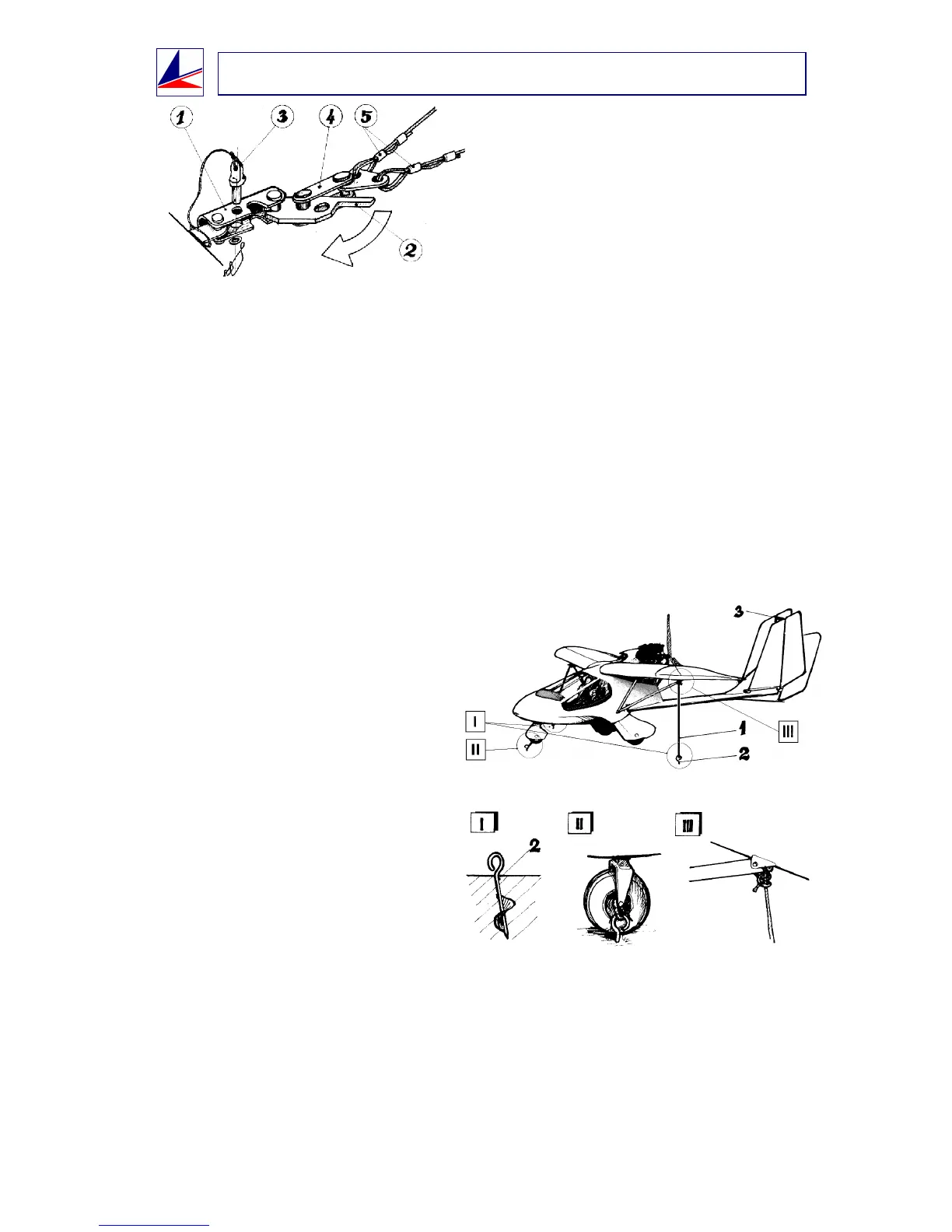
The airplane mooring equipment consists of the
following:
- 3 mooring bolts
- 2 long and 1 short mooring cables
Mooring bolts should be screwed in the ground
and the airplane should be moored by means of
cables as shown in Fig. 3.
Fig.3: Airplane mooring
1 - Mooring cable
2 - Mooring bolt
3 - Cable to join stabilizers
I - Mooring ring(bolt) detail
II - Cable fixing to the landing gear hinge
III - Cable fixing to the wing hinge
8.4 Hangaring
Moving the airplane during hangaring, parking, etc. is recommended by pushing the empty airplane. Grip the backbone
fin tube of the airplane close to the fin and push it slightly down to pick up the nose landing gear.
The airplane can be then controlled simple by side movements. If the assistance of further persons is needed, the wing
struts near their hinges on the wing are the recommended positions for pushing the airplane.
Pushing or leaning on the control surface skin is forbidden.
8.5 Towing
Towing the airplane with a car is not allowed.


 To Next Page
 Loading...