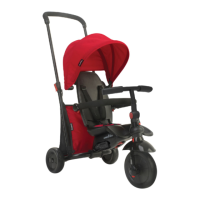
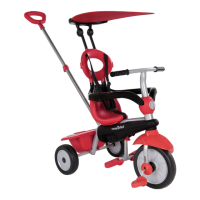
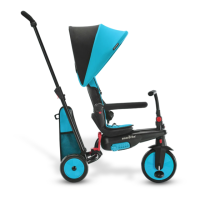
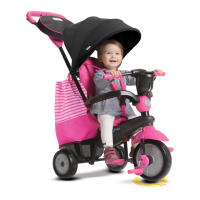
The smarTrike Breeze™ 605 is a multi-stage tricycle designed to grow with a child, offering various modes of use from 15 months up to 24 months and beyond. It functions as a parent-controlled push trike initially, transitioning to a child-controlled tricycle as the child develops.
Function Description:
The smarTrike Breeze™ 605 serves as a versatile outdoor mobility device for young children. Its primary function is to provide a safe and enjoyable riding experience, adaptable to different developmental stages. In its early stages (15 months+), it operates as a parent-steered push trike, where the parent has full control over steering and propulsion using a long handle. The child can rest their feet on footrests, which are adjustable for different age groups (15m+ and 24m+). As the child grows and gains more motor skills, the trike can be converted into a child-controlled mode. This involves disengaging the parent control, allowing the child to steer and pedal independently. The pedals can be engaged or disengaged from the wheel, meaning they can rotate freely without affecting the trike's movement in parent mode, or be locked to drive the wheel in child mode. The trike features a safety bar and a seat with a safety belt to ensure the child's security, especially in the earlier stages. A basket is included for storage, and a canopy (not explicitly shown in all assembly steps but implied by the overall design of smarTrikes) would typically provide sun protection.
Important Technical Specifications:
While specific technical specifications like weight capacity or material composition are not detailed in the provided pages, the manual illustrates several key components:
- Wheels: The trike features three wheels, with the front wheel being larger and designed for steering and propulsion. The rear wheels provide stability. The manual shows a front wheel with a "Front" label, indicating directional assembly.
- Axles: A main wheel axle is used for the front wheel assembly, secured with bolts and nuts.
- Handlebar: A child-sized handlebar is present, with a mechanism to lock or unlock its steering function, allowing for parent or child control. The handlebar stem connects to the trike's body.
- Parent Handle: A long, adjustable parent handle is provided for pushing and steering the trike in parent-controlled modes. This handle can be removed for child-controlled use.
- Seat: The seat is designed to be adjustable, with multiple screw holes indicated for different positions to accommodate the child's growth (15m+ and 24m+). It includes a safety belt for secure seating.
- Footrests: Two sets of footrests are shown: one for younger children (15m+) that can be folded up, and another for older children (24m+) that are integrated into the pedal mechanism.
- Pedals: The pedals are designed to be engaged or disengaged, allowing them to function as footrests or as a means of propulsion. They can be twisted and pressed inward to fit into a depression in the fork, indicating a mechanism for switching between modes.
- Storage Basket: A small basket is included, typically mounted at the rear of the trike, for carrying small items.
- Tools: The manual includes illustrations of an Allen key (P) and a screwdriver (V) as necessary tools for assembly and adjustments.
Usage Features:
- Multi-Stage Design: The core feature is its adaptability across different age groups (15 months+ to 24 months+), allowing it to evolve from a parent-push trike to an independent tricycle.
- Parent Control Mode (15 Months+): In this mode, the parent steers and pushes the trike using the parent handle. The child's feet can rest on the footrests, and the pedals can be disengaged so they don't interfere with the child's feet. The manual shows a "red parent control button" and a 180-degree turn of the front wheel to activate this mode.
- Child Control Mode (24 Months+): As the child grows, the trike can be switched to child control. This involves engaging the pedals to drive the front wheel and allowing the child to steer the handlebar. The parent handle can be removed. The footrests can be folded up for this stage.
- Safety Bar: A safety bar (K) is provided, which can be released by pressing circles on the back of the seat and pulled away from the handlebar stem, likely for easier child access or removal in later stages.
- Adjustable Seat: The seat (J) can be adjusted to different positions by screwing it into different holes, accommodating the child's leg length as they grow.
- Foldable Footrests: The footrests can be folded up, particularly for the 24 Months+ stage when the child is expected to use the pedals.
- Live Assembly Guide: A QR code is provided to access a "live assembly" video, offering step-by-step visual instructions for easy product assembly. This is a significant user-friendly feature.
- Contact Support: Email and phone support (USA: 1-855-SMTRIKE) are available for assembly questions, enhancing user experience.
Maintenance Features:
- Screw-Based Assembly/Disassembly: Most components are attached using screws and bolts, requiring an Allen key (P) and a screwdriver (V) for assembly, adjustments, and disassembly. This allows for relatively straightforward part replacement or tightening.
- Clear Assembly Steps: The manual provides detailed, illustrated step-by-step instructions for assembly, including parts needed for each section, ensuring users can follow along easily.
- Warning for Nut/Screw Security: The manual includes warnings to ensure nuts are inserted correctly and secured, and to make sure not to lose screws during disassembly, highlighting important maintenance considerations for safety and functionality.
- Order of Screw Tightening: For the handlebar assembly (Step 6b), a specific order (a, b, c, d) for screwing in the four screws is indicated, suggesting a best practice for secure and proper installation.
- Regular Checks: While not explicitly stated as "maintenance," the warnings about ensuring safety pins are inserted correctly and secured imply a need for regular checks by the user to maintain the trike's safety and integrity.
- Cleaning: Although not detailed, the materials (likely plastic and metal) suggest standard cleaning with a damp cloth would be appropriate for general upkeep.

 Need help?

 To Next Page
 General