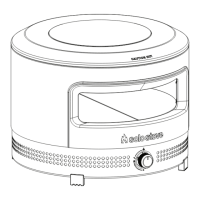
The Solo Stove Pi is a versatile outdoor pizza oven designed for both wood-firing and gas-firing, allowing users to create authentic Neapolitan or New York-style pizzas in their backyard. Its design emphasizes ease of use, efficient heating, and consistent results, catering to both seasoned artisans and casual pizza enthusiasts.
Function Description:
The Solo Stove Pi functions as a dual-fuel pizza oven, capable of operating with kiln-dried hardwoods for a traditional wood-fired experience or with a gas burner for a clean, controlled flame. The oven is designed to reach high temperatures quickly, typically between 650°F and 800°F, to cook pizzas in approximately two minutes. Its primary function is to provide a portable and efficient way to bake stone-baked pizzas with a crispy crust and perfectly cooked toppings. The oven's Demi-Dome construction and ceramic fiber insulation are engineered to distribute heat evenly and minimize heat loss, replicating the three-fold heating approach of traditional brick ovens.
Important Technical Specifications:
- Fuel Type: Dual fuel (wood-firing with kiln-dried hardwoods, gas-firing with an optional gas burner).
- Pizza Stone: Two durable, reversible cordierite stone halves, providing wall-to-wall coverage and uniform heat transfer.
- Heating Elements: Ceramic fiber insulation and Demi-Dome construction for efficient heat retention and distribution.
- Temperature Range: Aiming for 650°F to 800°F for the pizza stone, with ambient temperatures reaching around 900°F.
- Preheat Time: As little as 15 minutes after the first extended preheating session (30 minutes for the first burn).
- Bake Time: Approximately 2 minutes per pizza.
- Fuel Grate: Stainless steel, designed for small cuts of kiln-dried firewood, with wide-set grids for increased oxygen flow.
- Ash Pan: Collects spent ashes, capable of holding ashes for up to 3 hours of baking.
- Rear Door: Lightweight and removable stainless steel, designed to work with the Demi-Dome for continuous heat flow.
- Gas Burner (if applicable): Converts the oven to gas-firing, providing a clean and controlled flame.
- Match Holder (if applicable): Extendable tool for manually lighting the gas burner.
- Fuel Stoker: For safely poking and stoking embers when refueling.
Usage Features:
- Dual Fuel Versatility: Users can choose between the authentic wood-fired flavor and the convenience of gas-firing. The wood-firing option involves loading kiln-dried firewood into the fuel grate, while the gas-firing option requires installing a gas burner and connecting it to an LP tank.
- Easy Assembly: The oven comes with few loose parts and minimal assembly required, making it ready to use quickly after unboxing.
- Optimal Placement: It is recommended to place the Pi on a sturdy, heat-resistant surface, about waist-high, and orient it for complete access to the rear door for refueling and pizza turning.
- Preheating: An initial extended preheating session of at least 30 minutes is recommended for the first burn. Subsequent preheating can be as short as 15 minutes, aiming for a pizza stone temperature of 650°F to 800°F. An Infrared Thermometer is suggested for accurate temperature measurement.
- Fueling (Wood-firing): Kiln-dried hardwoods (4-5 inches long, 1-1.5 inches diameter) are recommended for a clean, efficient fire. Firestarters and tinder should be food-safe. Fuel should be added in small pieces every 5 minutes to maintain consistent temperature.
- Launching Pizzas: Pizza peels should be dusted with flour or cornmeal to prevent sticking. Pizzas are launched into the oven, aiming for the center, with the back bumper shielding from direct flame contact.
- Turning Pizzas: After an initial setting period of 15-20 seconds, pizzas should be turned frequently using a turning peel to ensure an even bake. A 180° rotation is suggested for even cooking.
- Gas-Firing Operation: To switch to gas, the wood-burning assembly (rear door, fuel grate, ash pan) must be removed when cool, and the gas burner installed. The gas burner valve and LP tank valve should be in the 'Off' position before attaching the regulator hose. The gas burner is turned counter-clockwise to ignite and set to 100% power for preheating.
- Safety Features: Includes warnings about hot surfaces, the need for heat-resistant gloves, keeping children and pets away, and proper ash disposal. It also emphasizes outdoor-only use to prevent carbon monoxide poisoning and warns against using chemicals or accelerants to light the fire.
Maintenance Features:
- Cooling: Always allow the oven to cool gradually and completely before disassembling or performing any maintenance.
- Exterior Cleaning: The exterior can be cleaned with warm soapy water and a lint-free towel. Abrasive cleaning products are not recommended.
- Interior Cleaning: The interior can be self-cleaned by firing the oven on high heat to burn off crumbs or residue. Once cooled, debris can be brushed away, and soot wiped down with a lightly dampened cloth.
- Pizza Stone Care: The cordierite pizza stone can be brushed clean and left inside during self-cleaning sessions. A wire or grill brush and putty knife can be used to loosen and scrape away baked-on crumbs. The pizza stone should not be washed or submerged in water; if it gets wet, it must be allowed to dry completely before use. Discoloration and charring of the porous stone are normal and can impart unique flavors.
- Ash Pan Emptying: The ash pan should be emptied before or after each use, but only after the ashes have cooled completely, as embers can retain heat for hours. Ashes must be disposed of responsibly in a metal container to prevent fires.
- Wind Considerations: The oven performs best in low-wind conditions. When breezy, it's recommended to set up on the leeward side of a house and orient the oven so the front opening is downwind, with the rear door or gas burner blocking wind.

 Need help?
 General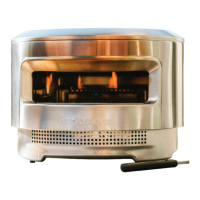

 To Next Page