The SRG-8600DX is an all-mode scanning receiver designed for continuous coverage from 60 to 905 MHz, with 100 keypad-programmable memory channels.
Function Description:
The SRG-8600DX offers a comprehensive range of reception modes including FM wide (for FM and TV broadcasts), FM narrow (for two-way police, military, business, and amateur communications), AM wide and narrow (for aeronautical and amateur communications), and SSB (single sideband) reception up to 460 MHz. The SSB mode is particularly useful for amateur and military SSB, as well as the new ACSB mode, and facilitates reception of CW (radiotelegraph). A front panel tuning knob simplifies tuning in SSB, CW, and narrowband AM modes. The receiver features seven tuning/scanning rates, ranging from 100 Hz to 100 kHz, for efficient operation.
The scanning system supports both full and limited (keypad-programmed) band scanning, as well as memory channel scanning with auto-resume. Scan stop conditions are selectable, allowing the scanner to stop on carrier-only signals or only on signals with audio modulation. Tuning steps are selectable, with the chosen step size indicated on the front panel display. Signal strength is visually represented by a two-color graphic S-meter. A 24-hour clock/timer is included for automatic power on/off switching and recording. Additional jacks provide CPU band selection outputs, multiplexed (FM wide) output, AF and RF mute, and other control signals for future expansion. A mobile mounting bracket is supplied for automotive use.
The Yaesu CAT System allows direct control of the receiver's CPU via personal computers, enabling customized control functions such as organized memory banks, automatic tuning, and specialized scanning systems. This requires a Yaesu FIF CAT Interface Unit.
Important Technical Specifications:
- Frequency Range: 60-905 MHz (up to 460 MHz for SSB).
- Modes, 3dB Bandwidth:
- FM Narrow: 15 kHz BW
- FM Wide: 180 kHz BW
- AM Narrow: 2.4 kHz BW
- AM Wide: 6 kHz BW
- SSB: 2.4 kHz BW
- Conversion Schemes:
- Triple (FM-N, AM, SSB)
- Double (FM-W)
- Single (Optional TV Video Unit)
- Intermediate Frequencies: 47.754 MHz, 10.7 MHz, and 455 kHz.
- Image Rejection: -50dB typical (60-460 MHz), -40dB typical (460-905 MHz).
- Typical Sensitivity:
- FM-N: 0.5uV (for 12dB SINAD)
- FM-W: 1.0uV (for 12dB SINAD)
- AM-N: 1.0uV (for 10dB S+N/N)
- AM-W: 1.5uV (for 10dB S+N/N)
- SSB: 1.0uV (for 15dB S+N/N)
- Tuning Steps:
- FM-N: 5/10/12.5/25 kHz
- FM-W: 100 kHz
- AM-N: 100 Hz/1 kHz
- AM-W: 5/10/12.5/25 kHz
- SSB: 100 Hz/1 kHz
- Memory Channels: 100.
- Audio Output: 1W (into 8 ohms, with less than 10% THD).
- Power Supply Voltage: DC 12-15V.
- Power Supply Current:
- Operating: 550 mA (maximum)
- Power switch off: 100 mA
- DC supply off: 3 uA max. (backup)
- Case Size (WHD): 180 x 80 x 220 (mm).
- Weight: 2.2 kg (4.9 lb) without options.
- Supplied Accessories: Whip Antenna (0.6m), DC Power Cord (1.8m), MMB-28 Mobile Mounting Bracket, Wire Stand.
- Options: AC-DC Wall Adapter (PA-4B for 110-120V, or PA-4C for 220-240V), Video Unit (NTSC), SP-55 External Speaker.
Usage Features:
- Front Panel Controls:
- SQL (Squelch): Adjusts squelch sensitivity for all modes, muting receiver audio until a signal stronger than the threshold is received. Disabled in FM-W mode.
- TONE: Adjusts treble and bass response for comfortable listening.
- VOL (and OFF): Main ON/OFF switch and volume control.
- AF SCAN: Selects scan-stop condition; stops on any signal (undepressed) or only on signals with audio modulation (depressed).
- PHONES: Standard monaural or stereo headphone jack (32 ohms recommended). Disables internal/external speaker when in use.
- ATT (ATTenuator): Decreases signal level from the antenna to prevent overloading by strong signals.
- M CLEAR (Memory Clear): Clears data from a memory channel and transfers frequency/mode to Dial state. Disabled in Dial state.
- Tuning Knob: Step-tunes across the band in Dial state or through memories.
- DOWN/UP Keys: Momentarily move frequency by one tuning step (Dial state) or to next memory channel (Memory state). Holding activates scanner.
- Small Metallic Function Keys:
- STEP: Selects frequency steps for tuning and scanning (Dial state only).
- MODE: Selects receiver detector type and IF bandwidth (Dial state only). Cycles through LSB, USB, AM-N, AM-W, FM-N, FM-W.
- PRI (Priority): Toggles automatic priority channel checking, testing a preselected memory for activity every three seconds.
- D-M (Dial-to-Memory): Transfers frequency and mode data from Dial to a memory channel.
- DIAL: Selects Dial state, recalling last used frequency/mode.
- MR (Memory Recall): Selects Memory state, recalling a memory channel.
- CLOCK: Displays clock/timer status, allows setting time, Timer On, Timer Off, and Timer Off/On select modes.
- CE [ON] (Clear Entry & Timer On): Cancels numerical keypad entries. Toggles auto-ON timer in timer ON/OFF select mode.
- White Keypad Keys (1-9, 0/OFF): Numeric entry for frequency, memory channel, or clock/timer settings. "0" key toggles auto-OFF timer.
- TIMER SET: Sets clock and On/Off times in clock/timer modes.
- Display: Shows signal strength (bar-graph), frequency, reception mode, memory channel number, and timer status.
- FM Broadcast Reception (FM-W): Simplest mode for broadcast reception (88-108 MHz, TV audio). Tuning steps are always 100 kHz. AF MUTE control on rear panel is used to silence noise.
- Memory Storage, Recall, and Scanning: 100 memory channels (00-99). Storing involves tuning in Dial state, entering two-digit channel number, then D-M. Recalling involves MR key or entering channel number then MR. Memory scanning is in blocks of ten channels.
- Two-Way Communications Monitoring (FM-N): Used for police, military, business, amateur communications. Channel spacing varies (5, 10, 12.5, 25 kHz). SQL control silences noise when no signal is present.
- Airband Communications Monitoring (AM-W/AM-N): Primarily for aeronautical mobile band (118-136 MHz), using 100 kHz channel spacing (50 kHz in North America). AM-W is best for general monitoring. SQL reduces noise volume. AM-N may improve reception of weak stations.
- Single-Sideband (SSB) Communications (LSB/USB): Used for amateur and military communications (144-145 MHz, 430-440 MHz). Requires fine tuning with the knob. USB is typically used. SQL can be set as for FM-N, but keeping it open is recommended for weak SSB signals due to lack of carrier.
- Limited Band Operation: Sets scanning and tuning limits between two adjacent memory channels. Useful for monitoring specific frequency bands.
- Priority Channel Monitoring: Periodically checks a preselected priority frequency for activity while listening to other stations. Automatically shifts to the priority channel if a signal is detected.
- Clock/Timer Operation: 24-hour clock. Automatic power ON/OFF timer requires the receiver's power switch to be ON. OFF timer must be set before ON timer can function.
Maintenance Features:
- Power Connections: Operates from 12-15V DC. Requires optional AC-DC adapter for AC mains. Center pin of 13.8V DC power jack must be positive. Incorrect polarity will damage the receiver.
- Antenna Installation: Designed for 50-ohm coaxial cable. Supplied whip antenna is for casual listening; an outdoor antenna is recommended for optimum performance.
- MUTE Jack: Allows silencing the receiver during transmission when used with a transmitter.
- REC Jack: Provides constant level audio output (70mV @50 kilohms) for tape recording or data decoding. Unaffected by VOL and TONE controls.
- EXT SPKR Jack: For external loudspeaker (4-16 ohms). Disables internal speaker when in use.
- AF MUTE Potentiometer: Sets squelch threshold for FM-W mode.
- MPX Jack: Provides output from FM-W detector for external stereo demultiplexer.
- VIDEO Jack: Provides baseband video output (1Vp-p) when optional Video Unit is installed.
- TV AGC Potentiometer: Adjusts video Automatic Gain Control when optional Video Unit is installed.
- CAT System: 6-pin DIN jack for microcomputer interface unit (e.g., Yaesu FIF-series). Allows external control and feedback of signal level and scan stop status.
- Memory Backup: Mode and frequency data is retained by a lithium backup battery with an estimated lifetime of at least 5 years.
- Clearing Stored Data: To clear all stored data, remove power, open the top cover, locate the miniature backup on/off slide switch, set it to the right for 30 seconds, then return it to the left.
- Battery Replacement: If memory backup fails, consult a dealer for replacement of the backup battery.
- Computer Interference Mitigation: Recommendations include locating antenna far from receiver/computer, proper chassis grounding, and using shielded cables for external connections.

 Need help?
 General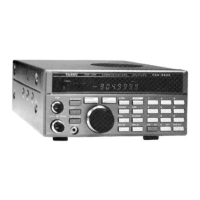

 To Next Page