Need help?
Do you have a question about the Sony HT-SD40 and is the answer not in the manual?
Instructions for placing the soundbar and subwoofer on a surface for setup.
Guide for securing the soundbar and subwoofer to a wall.
Connects the system via HDMI cable, utilizing the ARC feature for audio transmission.
Connects the system via an optical digital cable when ARC is not supported.
Details on connecting the AC power cords for the TV and speaker system.
Guide on powering on, selecting input, and adjusting volume and bass levels.
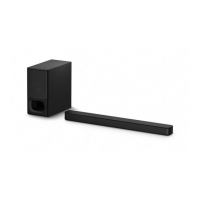
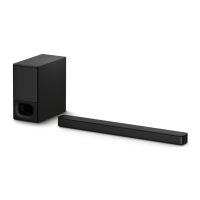
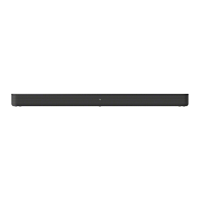
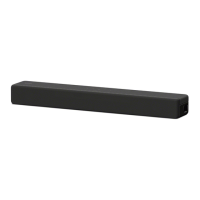
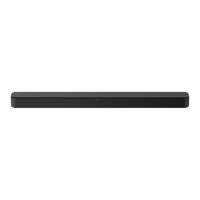
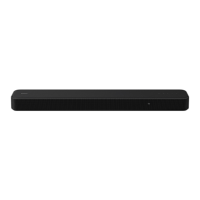
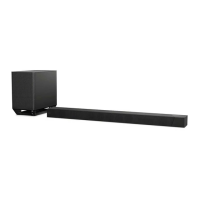
This document describes the Sony Sound Bar, a speaker system designed to enhance TV audio. It functions as an external audio output for televisions, offering improved sound quality for various media content. The system typically includes a bar speaker and a subwoofer, which work together to deliver a more immersive audio experience.
The Sony Sound Bar primarily serves as an audio enhancement system for televisions. It connects to a TV to output audio, providing clearer dialogue, richer bass, and a more dynamic soundstage compared to a TV's built-in speakers. The system supports various audio inputs, allowing it to be connected to different devices such as Blu-ray Disc players, set-top boxes, and gaming consoles.
The bar speaker houses multiple drivers to produce mid-range and high-frequency sounds, often designed to be placed directly in front of or below the TV. The subwoofer is dedicated to reproducing low-frequency sounds (bass), adding depth and impact to movies, music, and games. The wireless connection between the bar speaker and the subwoofer simplifies setup and allows for flexible placement of the subwoofer within the room.
The sound bar system can be controlled using a dedicated remote control, which allows users to power the system on/off, select input sources, adjust volume levels for both the main system and the subwoofer, and potentially apply various sound modes or effects. The system's front panel display provides visual feedback on the current status, such as the selected input or volume level.
A key feature is its compatibility with HDMI ARC (Audio Return Channel), which allows audio to be sent from the TV to the sound bar through a single HDMI cable, simplifying connectivity and enabling control of basic sound bar functions (like power and volume) using the TV's remote. For TVs without ARC, an optical digital cable can be used to transmit audio.
The sound bar is designed for both shelf/stand placement and wall mounting, offering flexibility to integrate into different home entertainment setups.
Installation Flexibility: The sound bar can be installed in two primary ways:
Connection to TV:
Power Connection: After connecting the audio cables, the AC power cords (mains leads) for both the bar speaker and the subwoofer are connected to AC outlets. It's important to connect the TV's power cord and turn on the TV first. The sound bar system will display "HELLO" on its front panel during startup, and the remote control will not function until this message disappears.
Basic Operation:
Troubleshooting Muting: If the system enters muting mode, especially if the TV and sound bar are turned on in a specific order, it is recommended to turn on the TV first, then the sound bar.
The document does not explicitly detail specific maintenance features, but general best practices for electronic devices apply:
The remote control design and button layout may vary slightly depending on the specific model, but the core functions remain consistent across the Sony Sound Bar range. The images provided in the manual are for illustrative purposes and may differ slightly from the actual product.
 General
| Wall mounting kit | No |
|---|---|
| HDMI in | 0 |
| Line-in | - |
| Bluetooth version | 5.0 |
| Number of HDMI outputs | 1 |
| Connectivity technology | Wired & Wireless |
| Power source | AC |
| Power consumption (typical) | 0.5 W |
| Subwoofer connectivity | Wireless |
| Woofer diameter (subwoofer) | 7.5 \ |
| Soundbar speaker RMS power | 330 W |
| Audio output channels | 2.1 channels |
| Product color | Black |
| Volume control | Buttons |
| Country of origin | Malaysia |
| Audio formats supported | DTS, LPCM, SBC |
| Package depth | 968 mm |
| Package width | 248 mm |
| Package height | 53 mm |
| Package weight | 13000 g |
 Weight and Dimensions
| Depth | 64 mm |
|---|---|
| Width | 900 mm |
| Height | 88 mm |
| Weight | 2400 g |
| Cord length | - m |
| Subwoofer depth | 387 mm |
| Subwoofer width | 192 mm |
| Subwoofer height | 400 mm |
| Subwoofer weight | 7300 g |

 To Next Page