6
Gotcha Distanz-
Rettungsvorrichtung
Die Idee des GOTCHA™ ist eine Rettungsvorrichtung, die
dem Retter ermöglicht:
- Einen Verunglückten zu sichern, der an einer
Fallsicherungsleine hängt.
- Den Verunglückten zu heben und ihn vom ursprünglichen
Gurt zu befreien.
- Einen Verunglückten an einer höher oder tiefer gelegenen
Stelle in Sicherheit zu bringen.
Die oben genannten Möglichkeiten sind alle nutzbar, ohne
dass der Retter in der Lage sein müsste, zum Verunglückten
zu gelangen. Der Retter muss nur imstande sein, den Punkt
zu erreichen, an dem der Verunglückte seine Leine verankert
hat. Das Sperrelement der Rettungsvorrichtung verriegelt
sich beim versehentlichen Auslösen automatisch.
Der GOTCHA™ kann zweifach eingesetzt werden: je
nachdem, ob der Ankerpunkt sich auf Bodenhöhe des Retters
befindet oder über ihm(idealerweise 1,5 m über ihm, um die
Wirkung voll zu entfalten). Es gibt hier wichtige Unterschiede.
Bei einem Anker auf Bodenhöhe des Retters kann die
Vorrichtung den Verunglückten nicht hoch genug anheben,
um ihn zumAusgangspunkt zurückzubringen. Der Verunglückte
muss erst angehoben werden, um seine Leine zu lösen und
dann zu einer sicherenStelle abgeseilt werden. Der nötige
Krafteinsatz des Retters beim Anheben des Verunglückten
ergibt eine mechanische Kraftverstärkungvon 4:1.
Bei einem Anker 1,5 m über dem Boden – vorzugsweise
auf Kopfhöhe –ist es möglich, den Verunglückten zu
seinem Ausgangspunkt zurückzubringen. Der Retter kann
den Vorgang mit seinem Gewicht unterstützen, sodass die
mechanische Kraftverstärkung geringer ist(3:1).
The idea of the GOTCHA™ is to provide a rescue kit that will enable a rescuer to:
• Attach a casualty who is suspended by a fall arrest lanyard.
• Raise the casualty in order to release their current attachment.
• Raise or lower the casualty to a point of safety.
The above capabilities are all achievable without the need for the rescuer to access the casualty. In order to carry out this the
rescuer must be able to access the point at which the casualty anchored their lanyard. The control feature of the rescue kit
locks automatically if released.
The GOTCHA™ will be used in two different modes depending upon whether the anchor point is at the rescuers foot level o
above (ideally 1.5m above to have any material effect), as this has important effects.
If the anchor is at foot level then the system will not be able to raise the casualty sufficiently to bring them back to their start
point. The casualty must be raised in order to release their lanyard then lowered to safety. Also the rescuer is required to use
their strength when raising the casualty, so the mechanical advantage is greater (4:1).
If the anchor is 1.5m above foot level, preferably at head height it will be possible to raise the casualty to their start point. Fo
this the rescuer is able to use their weight to assist in the operation and therefore the mechanical advantage is lower (3:1).
GOTCHA™ REMOTE RESCUE KIT
PATENT PENDING - PUBLICATION No. 2376009
SPANSET UK Limited
Telford Way, Middlewich, Cheshire, CW10 0HX, UK.
Phone: 44 (0)1606 73 7494 Fax: 44 (0)1606 737264
The idea of the GOTCHA™ is to provide a rescue kit that will enable a rescuer to:
• Attach a casualty who is suspended by a fall arrest lanyard.
• Raise the casualty in order to release their current attachment.
• Raise or lower the casualty to a point of safety.
The above capabilities are all achievable without the need for the rescuer to access the casualty. In order to carry out this the
rescuer must be able to access the point at which the casualty anchored their lanyard. The control feature of the rescue kit
locks automatically if released.
The GOTCHA™ will be used in two different modes depending upon whether the anchor point is at the rescuers foot level o
above (ideally 1.5m above to have any material effect), as this has important effects.
If the anchor is at foot level then the system will not be able to raise the casualty sufficiently to bring them back to their start
point. The casualty must be raised in order to release their lanyard then lowered to safety. Also the rescuer is required to use
their strength when raising the casualty, so the mechanical advantage is greater (4:1).
If the anchor is 1.5m above foot level, preferably at head height it will be possible to raise the casualty to their start point. Fo
this the rescuer is able to use their weight to assist in the operation and therefore the mechanical advantage is lower (3:1).
GOTCHA™ REMOTE RESCUE KIT
PATENT PENDING - PUBLICATION No. 2376009
SPANSET UK Limited
Telford Way, Middlewich, Cheshire, CW10 0HX, UK.
Phone: 44 (0)1606 73 7494 Fax: 44 (0)1606 737264
The idea of the GOTCHA™ is to provide a rescue kit that will enable a rescuer to:
• Attach a casualty who is suspended by a fall arrest lanyard.
• Raise the casualty in order to release their current attachment.
• Raise or lower the casualty to a point of safety.
The above capabilities are all achievable without the need for the rescuer to access the casualty. In order to carry out this the
rescuer must be able to access the point at which the casualty anchored their lanyard. The control feature of the rescue kit
locks automatically if released.
The GOTCHA™ will be used in two different modes depending upon whether the anchor point is at the rescuers foot level o
above (ideally 1.5m above to have any material effect), as this has important effects.
If the anchor is at foot level then the system will not be able to raise the casualty sufficiently to bring them back to their start
point. The casualty must be raised in order to release their lanyard then lowered to safety. Also the rescuer is required to use
their strength when raising the casualty, so the mechanical advantage is greater (4:1).
If the anchor is 1.5m above foot level, preferably at head height it will be possible to raise the casualty to their start point. Fo
this the rescuer is able to use their weight to assist in the operation and therefore the mechanical advantage is lower (3:1).
GOTCHA™ REMOTE RESCUE KIT
PATENT PENDING - PUBLICATION No. 2376009
SPANSET UK Limited
Telford Way, Middlewich, Cheshire, CW10 0HX, UK.
Phone: 44 (0)1606 73 7494 Fax: 44 (0)1606 737264
The idea of the GOTCHA™ is to provide a rescue kit that will enable a rescuer to:
• Attach a casualty who is suspended by a fall arrest lanyard.
• Raise the casualty in order to release their current attachment.
• Raise or lower the casualty to a point of safety.
The above capabilities are all achievable without the need for the rescuer to access the casualty. In order to carry out this the
rescuer must be able to access the point at which the casualty anchored their lanyard. The control feature of the rescue kit
locks automatically if released.
The GOTCHA™ will be used in two different modes depending upon whether the anchor point is at the rescuers foot level o
above (ideally 1.5m above to have any material effect), as this has important effects.
If the anchor is at foot level then the system will not be able to raise the casualty sufficiently to bring them back to their start
point. The casualty must be raised in order to release their lanyard then lowered to safety. Also the rescuer is required to use
their strength when raising the casualty, so the mechanical advantage is greater (4:1).
If the anchor is 1.5m above foot level, preferably at head height it will be possible to raise the casualty to their start point. Fo
this the rescuer is able to use their weight to assist in the operation and therefore the mechanical advantage is lower (3:1).
GOTCHA™ REMOTE RESCUE KIT
PATENT PENDING - PUBLICATION No. 2376009
SPANSET UK Limited
Telford Way, Middlewich, Cheshire, CW10 0HX, UK.
Phone: 44 (0)1606 73 7494 Fax: 44 (0)1606 737264
The idea of the GOTCHA™ is to provide a rescue kit that will enable a rescuer to:
• Attach a casualty who is suspended by a fall arrest lanyard.
• Raise the casualty in order to release their current attachment.
• Raise or lower the casualty to a point of safety.
The above capabilities are all achievable without the need for the rescuer to access the casualty. In order to carry out this the
rescuer must be able to access the point at which the casualty anchored their lanyard. The control feature of the rescue kit
locks automatically if released.
The GOTCHA™ will be used in two different modes depending upon whether the anchor point is at the rescuers foot level o
above (ideally 1.5m above to have any material effect), as this has important effects.
If the anchor is at foot level then the system will not be able to raise the casualty sufficiently to bring them back to their start
point. The casualty must be raised in order to release their lanyard then lowered to safety. Also the rescuer is required to use
their strength when raising the casualty, so the mechanical advantage is greater (4:1).
If the anchor is 1.5m above foot level, preferably at head height it will be possible to raise the casualty to their start point. Fo
this the rescuer is able to use their weight to assist in the operation and therefore the mechanical advantage is lower (3:1).
GOTCHA™ REMOTE RESCUE KIT
PATENT PENDING - PUBLICATION No. 2376009
SPANSET UK Limited
Telford Way, Middlewich, Cheshire, CW10 0HX, UK.
Phone: 44 (0)1606 73 7494 Fax: 44 (0)1606 737264
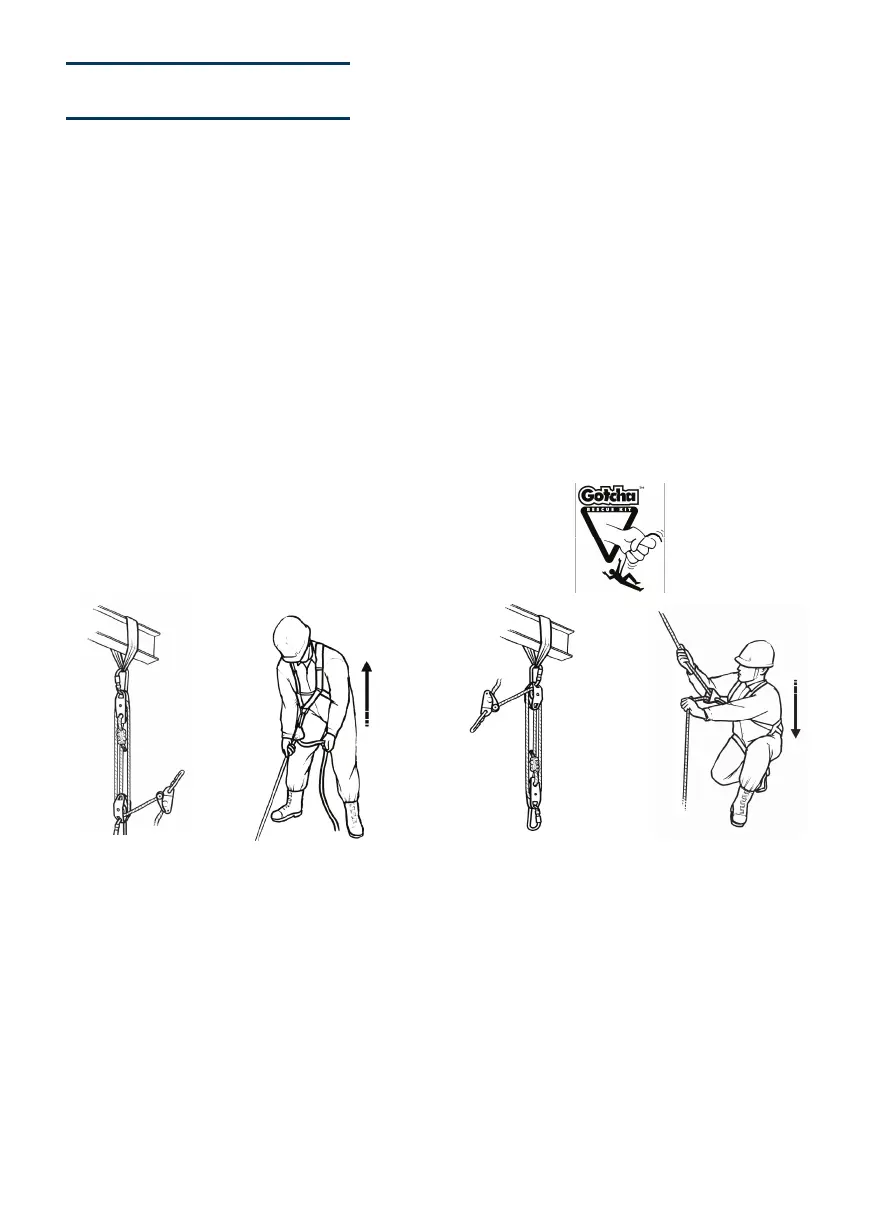
Ankerschlaufe 1,5 m über der Bodenhöhe desRetters.
1. Den Verankerungspunkt des Verunglückten suchen.
2. Die Ankerschlaufe an einem geeigneten Ankerpunkt
überdem Verunglückten befestigen.
3. Der Retter unterstützt diese Operation mit
seinemKörpergewicht. Die Doppelrolle wird in die
Ankerschlaufeeingehängt.
4. Das Gestänge auf die erforderliche Länge einstellen.
5. Den roten Karabinerclip mit dem Ende des
Gestängesverbinden und die Rolle in den Gurt einhängen.
6. Die Seile zwischen den Rollen auf die gleiche Länge wie
dasGestänge justieren.
7. Den roten Karabinerclip öffnen.
8. Mit dem Gestänge den roten Karabinerclip im Gurt
desVerunglückten einhängen.
9. Das Gestänge vom roten Karabinerclip lösen.
10. Den GRIGRI am Gurt des Retters befestigen.
11. Das entspannte Seil durch den GRIGRI ziehen und
dieVorrichtung spannen.
12. Der Retter setzt sich und hebt den Verunglückten
dadurchan.
13. Mit einer Hand hält der Retter das Seil nah an
DE


 To Next Page
 Loading...